

BDQ Implementer's Guide
Title
BDQ Implementer's Guide
Date version issued
2026-06-03
Date created
2025-05-10
Part of TDWG Standard
http://example.org/to_be_determined
This version
https://rs.tdwg.org/bdq/doc/implementers2026-06-03
Latest version
https://rs.tdwg.org/bdq/doc/implementers
Previous version
Abstract
This document is a users guide for the BDQ standard, providing guidance for those wishing to create software implementations (bdqffdq:Mechanism) of BDQ Tests.
Authors
Lee Belbin (Blatant Fabrications), Arthur D. Chapman (Australian Biodiversity Information Services), Paul J. Morris (Museum of Comparative Zoology, Harvard University), John Wieczorek (Rauthiflor LLC)
Creator
TDWG Biodiversity Data Quality Interest Group Task Group 2: Data Quality Tests and Assertions
Bibliographic citation
TDWG Biodiversity Data Quality Interest Group Task Group 2: Data Quality Tests and Assertions. 2026. BDQ Implementer's Guide. Biodiversity Information Standards (TDWG). https://rs.tdwg.org/bdq/doc/implementers2026-06-03
Status
Draft Standard for Review
Table of Contents
-
2 About the Tests and their Implementation (normative)
- 2.1 Independence (normative)
- 2.2 The Concept of "Empty" in the BDQ Standard (normative)
- 2.3 Reading Test Descriptors (non-normative)
- 2.3.1 Key Parts of a Test Descriptor (non-normative)
- 2.3.2 Reading a Specification (non-normative)
- 2.3.2.1 Response as Shorthand for a Set of bdqffdq: Concepts (non-normative)
- 2.3.2.2 Guidance for Reading a Specification (normative)
- 2.3.2.3 Further Guidance for Reading a Specification (non-normative)
- 2.3.2.4 Default Value Strings in Parameters (normative)
- 2.3.2.5 Example Interpretation of a Parameter String Default Value (non-normative)
- 2.3.3 The Concept of "interpreted as" (normative)
- 2.3.4 Handling Leading and Trailing Whitespace (normative)
- 2.4 Matching to controlled vocabularies (normative)
-
3 Compliant Implementation (normative)
- 3.1 Compliance depends on Use Case (normative)
- 3.2 Minimum Test Suite composition (normative)
- 3.3 Rationale and expectations for suite design (non-normative)
- 3.4 Required outputs for every Test execution (normative)
- 3.5 Describing additional Tests (normative)
- 3.6 Parameterized Tests: default behavior and unsupported values (normative)
- 3.7 Bulk / non-Framework execution (normative)
-
6 Guidelines for Implementers (normative)
- 6.1 Parameters and Changing the Behavior of a Test (normative)
- 6.1.1 Identifying non-default Parameter values in reports (normative)
- 6.1.2 Identifying non-default Parameter values in Response.comment (normative)
- 6.1.3 Expectations for Tests with Parameters (normative)
- 6.1.4 Test departures from specifications (normative)
- 6.1.5 Further guidance on Parameters and Arguments (non-normative)
- 6.2 Execution Process Agnostic (non-normative)
- 6.3 Considerations for Test Execution (normative)
- 6.4 Order of Test Execution (normative)
- 6.4.1 Phases: Pre-Amendment, Amendment, Post-Amendment (normative)
- 6.4.2 Test Dependencies (normative)
- 6.4.3 Implementing a complete Test (normative)
- 6.4.4 Presenting Darwin Core Data to a Method that Implements a Test (non-normative)
- 6.4.5 Example Test Implementations (non-normative)
- 6.4.6 Implementing an Abstract Test (normative)
- 6.4.7 Implementing a Test in a Specific Environment (non-normative)
- 6.5 Common Pattern for Implementing a Test (non-normative)
- 6.6 Responsibilities of a Test Execution Framework (non-normative)
- 6.1 Parameters and Changing the Behavior of a Test (normative)
-
8 Conformance Testing Implementations (normative)
- 8.1 Introduction to Test Conformance Testing (non-normative)
- 8.2 Structure of the Test Conformance Testing Data (non-normative)
- 8.3 Examples of the Data for Conformance Testing (non-normative)
- 8.4 Where to Get the Test Conformance Testing Data (non-normative)
- 8.5 Implementation and the Conformance Testing Data (normative)
- 8.6 Existing Software tools (non-normative)
1 Introduction (non-normative)
1.1 Purpose (non-normative)
The purpose of this document is to provide implementation guidance for software developers and systems architects building tools or workflows that conform to the BDQ standard. It explains how to interpret and operationalize the BDQ Test specifications, including the semantics of inputs and outputs, expected behaviors, parameter handling, dependency resolution, and result reporting.
This guide supports consistent, standards-compliant implementations across various environments by clarifying technical aspects of the Tests, detailing extension points, and describing conformance testing procedures using shared datasets. It includes both normative content necessary for implementation conformance and non-normative advice for implementers seeking efficiency, clarity, and compatibility.
1.2 Audience (non-normative)
This document is intended for technical audiences responsible for implementing BDQ Tests in software applications or data processing pipelines. It will be particularly useful to:
- Software developers integrating the BDQ standard into biodiversity data infrastructures
- Tool builders seeking to support data validation or annotation workflows
- Technical architects and standards implementers creating reusable data quality services
- Power users customizing or extending BDQ Test suites.
Readers should be familiar with basic software development concepts and, ideally, have experience working with data structures and RDF vocabularies. This guide assumes a need for detailed implementation-level knowledge, but provides both high-level explanations and concrete examples (e.g., in pseudocode and Java).
1.3 Associated Documents (non-normative)
For the list and links to all associated documents see The Biodiversity Data Quality (BDQ) Standard.
The set of information most relevant to implementers of Biodiversity Data Quality (BDQ) Tests can be found in the following subset of resources:
- BDQ Implementer's Guide - For anyone interested in the technical implementation of the BDQ Tests (this document).
- BDQ Tests: Concepts and Use - Defines how each Test is modelled using standard vocabulary terms and how it should behave under various conditions.
- BDQ Tests Quick Reference Guide - Provides a concise, easy-to-read reference about the BDQ Tests.
- BDQ User's Guide - For anyone interested in how to use the BDQ Tests in practice.
- BDQ Supplemental Information - Background and developmental notes for practitioners who evaluate and improve the quality of biodiversity data. Includes material not covered elsewhere in the BDQ standard.
- Current Single Record Tests as csv - Convenient list of BDQ
Single RecordTests in a csv file. - Current Multi Record Tests as csv - Convenient list of BDQ
Multi RecordTests in a csv file. - Tutorial: From Use Case to Test - Worked out examples of defining new
Use Casesand new Tests.
1.4 Status of the Content of this Document (normative)
Sections may be either normative (defines what is required to comply with the standard) or non-normative (supports understanding but is not binding) and are marked as such.
Any sentence or phrase beginning with "For example" or "e.g.", whether in a normative section or a non-normative section, is non-normative.
1.5 RFC 2119 key words (normative)
The key words "MUST", "MUST NOT", "REQUIRED", "SHALL", "SHALL NOT", "SHOULD", "SHOULD NOT", "RECOMMENDED", "MAY", and "OPTIONAL" in this document are to be interpreted as described in RFC 2119.
1.6 Namespace abbreviations (non-normative)
The following namespace abbreviations are used in this document:
| Abbreviation | Namespace |
|---|---|
| bdqdim: | https://rs.tdwg.org/bdqdim/terms/ |
| bdqffdq: | https://rs.tdwg.org/bdqffdq/terms/ |
| bdqtest: | https://rs.tdwg.org/bdqtest/terms/ |
| bdqval: | https://rs.tdwg.org/bdqval/terms/ |
| dc: | https://purl.org/dc/elements/1.1/ |
| dcterms: | http://purl.org/dc/terms/ |
| dqv: | http://www.w3.org/ns/dqv# |
| dwc: | http://rs.tdwg.org/dwc/terms/ |
| oa: | http://www.w3.org/ns/oa# |
| owl: | http://www.w3.org/2002/07/owl# |
| prov: | http://www.w3.org/ns/prov# |
| rdf: | http://www.w3.org/1999/02/22-rdf-syntax-ns# |
| rdfs: | http://www.w3.org/2000/01/rdf-schema# |
| skos: | http://www.w3.org/2004/02/skos/core# |
| xsd: | http://www.w3.org/2001/XMLSchema# |
1.7 Referring to Terms (normative)
In any technical treatment of the BDQ standard, a precise reference to a class or property term SHOULD be made using its qualified name (the namespace prefix followed by the term local name; e.g., bdqffdq:InformationElement) and the namespace IRI corresponding to the namespace prefix (e.g., https://rs.tdwg.org/bdqffdq/terms/ for bdqffdq:) MUST be provided. In less formal descriptions where the technical precision is not needed, the preferred label (skos:prefLabel, e.g., Information Element) or the term local name (e.g., InformationElement) MAY be used. The BDQ documents use all these methods.
2 About the Tests and their Implementation (normative)
2.1 Independence (normative)
Test implementations SHOULD be independent of how data are stored and transported, data serializations, and the framework or environment in which the Tests are being executed.
2.2 The Concept of "Empty" in the BDQ Standard (normative)
Empty and Not Empty in the context of the BDQ standard are defined as follows:
| term | definition |
|---|---|
| bdqval:Empty | An evaluation of a value, which in the context of the evaluation, returns true if the value does not contain any characters or values other than those in the range U+0000 to U+0020, otherwise returns false. |
| bdqval:NotEmpty | An evaluation of a value, which in the context of the evaluation, returns false if the value contains any characters or values other than those in the range U+0000 to U+0020, otherwise returns true. |
See the formal definitions and usage comments of bdqval:Empty and bdqval:NotEmpty terms in the BDQ Controlled Vocabulary List of Terms
Data that have passed through arbitrary serializations and transformations can contain anomalies. bdqval:Empty is defined to allow Tests to clearly separate concerns. A bdqffdq:InformationElement containing invalid characters, (e.g., letters in an Information Element that would be expected to contain integers) or values (including string serializations of the NULL value) are bdqval:NotEmpty and are the concern of Tests that evaluate bdqdim:Conformance. Presence or absence of data is a concern for Tests evaluating bdqdim:Completeness.
2.2.1 The Concept of Empty (normative)
(1) Spaces, tabs, and other non-printing characters are bdqval:Empty.
Unicode characters in the range U+0000 to U+0020, equivalent to ASCII characters 0-32, MUST be treated as bdqval:Empty.
(2) Actual NULLs are bdqval:Empty.
Objects that are null (or are null values in a relational database) at the point of Test execution MUST be treated as bdqval:Empty.
(3) Serializations of NULL are bdqval:NotEmpty.
Data serialized from relational database systems may contain string representations of NULL. We considered, and explicitly rejected, treating common string serializations of null such as "\N" and "NULL" as empty values.
String serializations of NULL outside of a database, present at the point of evaluation of a Test, MUST be treated as bdqval:NotEmpty.
A Test execution environment MAY deserialize these string serializations of NULL as null objects (see 5), and present them to a Test as NULL objects, where they would evaluate as bdqval:notEmpty (see 2).
(4) Data values indicating an unknown are treated as bdqval:NotEmpty.
The definition of bdqval:Empty is not applicable to a discussion of what value to include in a controlled vocabulary to indicate that no meaningful value is present, so no suggestion is made that "EMPTY" should be used as a data value to represent some form of "null", "unknown", "not recorded", etc. Choices there would fall into the semantics for some set of controlled vocabularies. The relevance to such a discussion is that this definition would treat an empty string as an empty value, with no semantics attached as to why the value is empty.
(5) Independence of Tests from the execution framework.
The evaluation of bdqval:Empty MUST be at the point of evaluation of the Test. This allows the Tests to be independent of data serializations for transport and the representation of data in Test execution environments.
In the BDQ standard, bdqval:Empty is used to evaluate bdqffdq:InformationElements within a Test specification, it therefore means empty if the dataset being evaluated does not contain the term matching the Information Element, or if the dataset contains that term but the value for that term is empty. This is to allow the application programming interface expressed by the Test bdqffdq:DataQualityNeed to be agnostic about the structure presented to a framework for executing the Tests.
For CSV data, a column is either there or not in a dataset, but in an RDF representation, some data objects could have relevant properties and others not - and the Tests are independent of that.
2.2.2 Example Implementation of a Function to Assess Empty (non-normative)
Here is a Java function to evaluate Empty, using trim() to exclude U+0020 (space), U+000A (LF), U+000D (CR) and the other non-printing characters in the unicode range U+0000 to U+0020, and also evaluating null as Empty. Test implementations can reuse a function like this for any Test that evaluates bdqval:Empty in its specification (hasExpectedResponse).
    public boolean isEmpty(String aString)  {
        boolean result = true;
        if (aString != null && aString.trim().length()>0) {
            result = false;
        }
        return result;
    }
Here is a MariaDB implementation of a lightweight version of VALIDATION_KINGDOM_NOTEMPTY, which provides a list of NOT_COMPLIANT records for some flat taxonomy table in a database, again handing off the responsibility for evaluation of non-printing characters to the trim function available in the language.
    SELECT taxonomy_id, kingdom,
         'VALIDATION_KINGDOM_NOTEMPTY' as test, 'NOT_COMPLIANT' as response_result, 'RUN_HAS_RESULT' as response_status,
         'The value of kingdom is Empty.' as response_comment
    FROM taxonomy
    WHERE
         kingdom is null
         OR
         length(trim(kingdom)) = 0
    ;
2.3 Reading Test Descriptors (non-normative)
The Tests defined in BDQ are described in the BDQ Tests Quick Reference Guide, with more detail in the BDQ Tests List of Terms. A CSV file of just the Single Record Tests is available for the convenience of implementers. Viewing the data in this file in a spreadsheet program can be an effective way to examine and compare the descriptions of the Tests.
2.3.1 Key Parts of a Test Descriptor (non-normative)
The descriptions of the Tests are complex. The following (abstracted from the Key to bdqtest: vocabulary terms and the bdqffdq: ontology) are the most important terms to understand for implementation:
- Term Name (
rdf:value) - a UUID that identifies the Test (e.g., 3c2590c7-af8a-4eb4-af57-5f73ba9d1f8e). - Term IRI (
dcterms:isVersionOf) - the machine readable identifier for the Test, in the form of an IRI terminating in the Term Name UUID (https://rs.tdwg.org/bdqtest/terms/3c2590c7-af8a-4eb4-af57-5f73ba9d1f8e). - Versioned IRI - the machine readable identifier for a specific version of the Test, in the form of an IRI terminating in the Term Name UUID and a date (https://rs.tdwg.org/bdqtest/terms/3c2590c7-af8a-4eb4-af57-5f73ba9d1f8e-2025-03-07) Term IRI and Versioned IRI follow the guidance of the TDWG Metadata Standards document for IRIs for Terms.
- Label (
rdfs:label) - a human readable identifier for the Test (e.g., VALIDATION_COUNTRYCODE_STANDARD). - ExpectedResponse (bdqffdq:hasExpectedResponse) - the description of the expected behavior of a Test implementation.
- SourceAuthorities/Defaults (bdqffdq:hasAuthoritiesDefaults) - information about source authorities and parameters listed in the expected response, including default values for parameters.
- Information Elements Acted Upon (bdqffdq:composedOf; bdqffdq:ActedUpon) - the inputs to the Test that the Test affects.
- Information Elements Consulted (bdqffdq:composedOf; bdqffdq:Consulted) - the inputs to the Test that the Test uses.
- Parameters (bdqffdq:hasParameter; bdqffdq:Parameter) - optional inputs to a Test that can change the behavior of the Test by changing the range or scope of values or the authority to use.
- Examples (
skos:example) - examples of expected inputs and outputs from a Test implementation. - Notes (
skos:note) - additional notes about the Test, including clarification and guidance for implementation.
2.3.2 Reading a Specification (non-normative)
Consider these properties of an example Specification (for the Validation VALIDATION_PHYLUM_FOUND):
hasExpectedResponse:
EXTERNAL_PREREQUISITES_NOT_MET if the bdqval:sourceAuthority is not available; INTERNAL_PREREQUISITES_NOT_MET if dwc:phylum is bdqval:Empty; COMPLIANT if the value of dwc:phylum is found as a value at the rank of Phylum in the bdqval:sourceAuthority; otherwise NOT_COMPLIANT
hasAuthoritiesDefaults:
bdqval:sourceAuthority default = "GBIF Backbone Taxonomy" {[https://doi.org/10.15468/39omei]} {API endpoint [https://api.gbif.org/v1/species?datasetKey=d7dddbf4-2cf0-4f39-9b2a-bb099caae36c&name=]}
example:
dwc:phylum="Tracheophyta": Response.status=RUN_HAS_RESULT, Response.result=COMPLIANT, Response.comment="dwc:phylum has an equivalent at the rank of Phylum in the bdqval:sourceAuthority. GBIF.org uses Trachyophyta for the Phylum including ferns"
These properties describe the expected behavior of an Implementation of this Test. This section gives further guidance on how to interpret these properties in order to produce an implementation that follows this specification.
2.3.2.1 Response as Shorthand for a Set of bdqffdq: Concepts (non-normative)
We regularly (particularly in examples) use Response, Response.status, Response.result, and Response.comment as shorthand for a more complicated set of bdqffdq: classes, object properties and datatype properties. The table below describes how these concepts are related.
| Shorthand Concept | bdqffdq Term(s) | Description |
|---|---|---|
| Response | bdqffdq:Response | The report from a single execution of a single Test, consisting of a Response.status, a Response.result, a Response.comment, and optionally, a Response.qualifier. |
| Response.status | bdqffdq:ResponseStatus, bdqffdq:hasResponseStatus | A metadata element in a Response indicating whether a Test was able to be performed or not. |
| Response.result | bdqffdq:ResponseResult, bdqffdq:hasResponseResult, bdqffdq:hasResponseResultValue | The element in a Response containing the value returned by a Test. |
| Response.comment | bdqffdq:hasResponseComment | A human readable interpretation of the results of the Test. |
| Response.qualifier | bdqffdq:ResponseQualifier, bdqffdq:hasResponseQualifier | Additional structured information that qualifies the Response, intended as an extension point for uncertainty. |
2.3.2.2 Guidance for Reading a Specification (normative)
A bdqffdq:hasExpectedResponse property of a bdqffdq:Specification provides expectations for the behavior of an implementation of a Test. A bdqffdq:hasExpectedResponse consists of a sequence of blocks of "RESPONSE, criteria;". The "criteria" are a sequence of options for that "RESPONSE". When reading a specification (hasExpectedResponse), implementers SHOULD read each block in sequence, evaluating each of the "criteria" in sequence, and return the first response for which the specified "criteria" are met. An exception to this is the placement of EXTERNAL_PREREQUISITES_NOT_MET as the first "RESPONSE" in the specification. This does not imply that the responsiveness of an external resource should be assessed first. Implementers MAY handle failure of an external resource in any appropriate manner, for example, with exception handling.
Some Amendment Tests can propose values for a single Darwin Core Term (Darwin Core Maintenance Group 2021). A few Amendment Tests can propose values for multiple Darwin Core Terms.
2.3.2.3 Further Guidance for Reading a Specification (non-normative)
Responses in a hasExpectedResponse property of a Specification are expressed in a concise and abbreviated form for readability by implementers, expanding these to string properties on a Response object gives:
EXTERNAL_PREREQUISITES_NOT_MET means
Response.status=EXTERNAL_PREREQUISITES_NOT_MET, Response.result=null, Response.comment={some bdqval:NotEmpty description of the failure condition}
INTERNAL_PREREQUISITES_NOT_MET means
Response.status=INTERNAL_PREREQUISITES_NOT_MET, Response.result=null, Response.comment={some bdqval:NotEmpty description of the failure condition}.
COMPLIANT means
Response.status=RUN_HAS_RESULT, Response.result=COMPLIANT, Response.comment={some bdqval:NotEmpty description of the success condition}.
Expressed with bdqffdq: terms, as would be if Responses are expressed in RDF, the first example above these would be:
EXTERNAL_PREREQUISITES_NOT_MET means
@prefix bdqffdq: <https://rs.tdwg.org/bdqffdq/terms/> .
@prefix xsd:    <http://www.w3.org/2001/XMLSchema#> .

# Example: a Response with Response.status = EXTERNAL_PREREQUISITES_NOT_MET
# In this case, Response.result is omitted (i.e., there is no hasResponseResult triple),
# which matches the BDQ guidance that the result MUST be empty/null for this status.

[] a bdqffdq:Response ;
   bdqffdq:hasResponseStatus bdqffdq:EXTERNAL_PREREQUISITES_NOT_MET ;
   bdqffdq:hasResponseComment "Source authority service was not available at time of evaluation."^^xsd:string .
Note that in RDF representations, the Response is an instance of bdqffdq:Response, and the Response.status is a value of bdqffdq:hasResponseStatus, while the Response.result may be either a literal using bdqffdq:hasResponseResultValue or a Named Individual using bdqffdq:hasResponseResult, or, as a best practice with RDF, when null, is ommitted, and the Response.comment is a value of bdqffdq:hasResponseComment.
For example, the bdqffdq:hasExpectedResponse for the Specification for VALIDATION_COUNTRYCODE_STANDARD states:
EXTERNAL_PREREQUISITES_NOT_MET if the bdqval:sourceAuthority is not available; INTERNAL_PREREQUISITES_NOT_MET if the dwc:countryCode is bdqval:Empty; COMPLIANT if dwc:countryCode can be unambiguously interpreted as a valid ISO 3166-1-alpha-2 country code in the bdqval:sourceAuthority; otherwise NOT_COMPLIANT
To understand the meaning of bdqval:sourceAuthority in the expected response, see the bdqffdq:hasAuthoritiesDefaults for the Specification:
bdqval:sourceAuthority default = "ISO 3166 Country Codes" {[https://www.iso.org/iso-3166-country-codes.html]} {ISO 3166-1-alpha-2 Country Code search [https://www.iso.org/obp/ui/#search]}
The Specification is thus intended to be read as:
- Return EXTERNAL_PREREQUISITES_NOT_MET if the ISO Country codes list (https://www.iso.org/iso-3166-country-codes.html, searchable at https://www.iso.org/obp/ui/#search) is not available;
- else Return INTERNAL_PREREQUISITES_NOT_MET if the
dwc:countryCodeisbdqval:Empty; - else Return COMPLIANT if
dwc:countryCodecan be unambiguously interpreted as a valid ISO 3166-1-alpha-2 country code in the ISO Country Codes list; - otherwise NOT_COMPLIANT
This could be implemented with a local copy of the ISO 3166 Country Codes (likely the better choice for this small, stable list), or with a web service call.
Any EXTERNAL_PREREQUISITES_NOT_MET can also be read as exception handling, thus:
- Return INTERNAL_PREREQUISITES_NOT_MET if the
dwc:countryCodeisbdqval:Empty; - else
- try :
- Return COMPLIANT if
dwc:countryCodecan be unambiguously interpreted as a valid ISO 3166-1-alpha-2 country code in the ISO Country Codes list (https://www.iso.org/iso-3166-country-codes.html, searchable at https://www.iso.org/obp/ui/#search);
- Return COMPLIANT if
- catch :
- Return EXTERNAL_PREREQUISITES_NOT_MET (as the the ISO Country codes list is not available);
- try :
- otherwise NOT_COMPLIANT
Where a Test is parameterized or when a bdqval:sourceAuthority is specified in the text of the expected response the Specification should include a bdqffdq:hasAuthoritiesDefaults data type property containing the parameters, default values, and references to resources, including API endpoints that would provide access to values in the authority.
Values of bdqffdq:hasAuthoritiesDefaults are text strings listing parameters in the form of a semicolon-delimited list of one or more of the following:
- parameter default = "default value"
- parameter default = "default value" {[resource]}
- parameter default = "default value" {[resource]} {API endpoint [resource]}
The bdqffdq:hasAuthoritiesDefaults property may be present in isolation (to make the expected response easier to read) as in the Test VALIDATION_COUNTRYCODE_STANDARD example above when a Test is not parameterized, or when a Test is parameterized, with corresponding bdqffdq:Arguments and bdqffdq:Parameters.
See section Parameterizing the Tests (normative) of the BDQ Tests: Concepts and Use document for further guidance on bdqval:sourceAuthority values, Parameters, and Arguments.
2.3.2.4 Default Value Strings in Parameters (normative)
When a Test is defined as parameterized, implementations SHOULD support the parameter in addition to the Information Elements.
When a Test is defined as parameterized:
- Implementations MUST support the default value.
- Implementations MAY choose to support only the default value.
- Implementations MAY choose to not include the
Parametersin the Test API, that is, only support the default value internally to the Test.- Note that some Test Conformance Testing Data provide non-default
Parametervalues, and implementations that only support the default value will be unable to validate against all of the Test Conformance Testing Data (see 8 Conformance Testing Implementations)).
- Note that some Test Conformance Testing Data provide non-default
When the parameter has a default value and a resource, and an implementation includes the parameter in its API, that implementation MUST support the string literal given as the default value, and internally choose the resource "{[resource]}" or "{API endpoint [resource]}" based on that string literal "default value". Implementations MAY also accept other values including the "{[resource]}" or "{API endpoint [resource]}" as the value for the parameter in the API for the Test implementation.
2.3.2.5 Example Interpretation of a Parameter String Default Value (non-normative)
The following code snippet in Java from the FilteredPush rec_occur_qc library (Morris 2025) illustrates interpretation of the default value "Creative Commons" when provided as a parameter to an implementation of AMENDMENT_LICENSE_STANDARDIZED. The literal "Creative Commons" is accepted as a parameter value.
    @Amendment(label="AMENDMENT_LICENSE_STANDARDIZED", description="Propose amendment to the value of dwc:license using bdqval:sourceAuthority.")
    @Provides("dcbe5bd2-42a0-4aab-bb4d-8f148c6490f8")
    @ProvidesVersion("https://rs.tdwg.org/bdqtest/terms/dcbe5bd2-42a0-4aab-bb4d-8f148c6490f8-2023-09-18")
    @Specification("EXTERNAL_PREREQUISITES_NOT_MET if the bdqval:sourceAuthority is not available; AMENDED value of dcterms:license if it could be unambiguously interpreted as a value in bdqval:sourceAuthority; otherwise NOT_AMENDED. bdqval:sourceAuthority default = 'Creative Commons' {[https://creativecommons.org/]} {Creative Commons licenses [https://creativecommons.org/about/cclicenses/]}")
    public static DQResponse<AmendmentValue> amendmentLicenseStandardized(
        @ActedUpon("dcterms:license") String license,
        @Parameter(name="bdqval:sourceAuthority") String sourceAuthority
    ) {
        DQResponse<AmendmentValue> result = new DQResponse<AmendmentValue>();

        if (MetadataUtils.isEmpty(license)) {
            result.addComment("No Value provided for dcterms:license");
            result.setResultState(ResultState.NOT_AMENDED);
        } else {
            if (MetadataUtils.isEmpty(sourceAuthority)) {
                sourceAuthority = "Creative Commons";
            }
            try {
                MetadataSourceAuthority sourceAuthorityObject = new MetadataSourceAuthority(sourceAuthority);
                if (sourceAuthorityObject.getAuthority().equals(EnumMetadataSourceAuthority.INVALID)) {
                    result.setResultState(ResultState.EXTERNAL_PREREQUISITES_NOT_MET);
                }
                String pattern = "";
                if (sourceAuthorityObject.getAuthority().equals(EnumMetadataSourceAuthority.CREATIVE_COMMONS)) {
                   ....

This library also includes a method whose signature does not include the parameter, but which runs the implementation of [AMENDMENT_LICENSE_STANDARDIZED](../../terms/bdqtest/index.html#AMENDMENT_LICENSE_STANDARDIZED) with the default parameter.

    @Amendment(label="AMENDMENT_LICENSE_STANDARDIZED", description="Propose amendment to the value of dwc:license using bdqval:sourceAuthority.")
    @Provides("dcbe5bd2-42a0-4aab-bb4d-8f148c6490f8")
    @ProvidesVersion("https://rs.tdwg.org/bdqtest/terms/dcbe5bd2-42a0-4aab-bb4d-8f148c6490f8-2023-09-18")
    @Specification("EXTERNAL_PREREQUISITES_NOT_MET if the bdqval:sourceAuthority is not available; AMENDED value of dcterms:license if it could be unambiguously interpreted as a value in bdqval:sourceAuthority; otherwise NOT_AMENDED. bdqval:sourceAuthority default = 'Creative Commons' {[https://creativecommons.org/]} {Creative Commons licenses [https://creativecommons.org/about/cclicenses/]}")
    public static DQResponse<AmendmentValue> amendmentLicenseStandardized(
        @ActedUpon("dcterms:license") String license
    ) {
        return amendmentLicenseStandardized(license, null);
    }
2.3.3 The Concept of "interpreted as" (normative)
In the hasExpectedResponse of a Specification the phrase "interpreted as" SHOULD BE interpreted by Implementers to mean:
- where Darwin Core (Wieczorek et al. 2012) data are serialized as strings, but the Test refers to data as numeric or other non-string data type, can the string value be cast into the target data type in the language of implementation (e.g., "1" as the integer 1), or
- matching a representation of a value unambiguously onto a controlled vocabulary (e.g., ‘WGS84’ to ’EPSG:4326’), or
- interpreting the representation of a numeric value (e.g., a Roman numeral) as a number (e.g., an integer).
When interpretations of strings containing Roman numerals as numbers is intended, guidance associated with the text, usually in the skos:note for the Test, MUST be explicit about this meaning. For example, the skos:note for the Test AMENDMENT_MONTH_STANDARDIZED states: "Implementations should translate interpretable Roman numerals in the range I-XII in dwc:month as integer month values 1-12, as some natural science domains use Roman numeral months to avoid language and day/month vs month/day order." This is explicit guidance for the meaning of "interpreted as" in the specification for this Test: "AMENDED the value of dwc:month if it can be unambiguously interpreted as an integer between 1 and 12 inclusive".
2.3.4 Handling Leading and Trailing Whitespace (normative)
Whitespace refers to characters such as spaces and tabs that affect rendering of printed or displayed output, but which themselves are not printed (see the Glossary).
A field that only includes whitespace MUST be treated as bdqval:Empty.
In bdqffdq:Validation Tests that require the lookup of a bdqval:sourceAuthority, leading and/or trailing whitespace may cause the Test to return a NOT_COMPLIANT result as no preprocessing is performed on the data, and the literal value, with leading or trailing whitespace is not exactly matched in the sourceAuthority. This behavior MAY be subject to the internals and behavior of external source authorities, and may not be under the control of Test implementers. Leading and trailing whitespaces SHOULD be stripped out in a subsequent bdqffdq:Amendment Tests. When the same bdqffdq:Validation Test is re-run in a post-amendment phase with the proposed changes applied to its inputs, COMPLIANT results would be expected (if the value matches a value in the sourceAuthority).
Validations that match input values against a sourceAuthority SHOULD perform an exact match against that sourceAuthority (unless the Test specifies otherwise).
Amendments SHOULD propose changes with leading or trailing whitespace removed unless the Test specifies otherwise.
2.4 Matching to controlled vocabularies (normative)
When a Test specification requires matching to a controlled vocabulary, the expectation is that the implementation will perform an exact match against the controlled vocabulary (unless the Test specifies otherwise). This means that the value being evaluated must match exactly a value in the controlled vocabulary, including any leading or trailing whitespace, and any differences in case (e.g., "WGS84" would match neither "wgs84" nor " WGS84" (with a leading space)). This is denoted in the skos:note for VALIDATION_...STANDARD Tests with the phrase "This Test must return NOT_COMPLIANT if there is leading or trailing whitespace or there are leading or trailing non-printing characters."
Implementations MUST respect the behavior specified in this note, for the data as it is presented to the Test API for a Test implementation.
2.4.1 Matching to controlled vocabularies rationale (non-normative)
It is possible that implementations and transport frameworks may, outside of Tests, and outside of the control of Test implementations, remove leading and trailing whitespace from data elements. Because such behavior is outside of the control of the Test implementation, this exact matching behavior including whitespace is only included in the notes and not as part of the hasExpectedResponse for the Tests.
3 Compliant Implementation (normative)
The BDQ Tests are part of a coherent framework for describing and reporting on data quality, and the Tests are intended to be implemented as suites of Tests that fit particular Use Cases (see BDQ Fitness For Use Framework). The following sections provide normative guidance on what is required for an implementation of a Test Suite to be compliant with the BDQ standard, and non-normative guidance on the rationale for these requirements and expectations for how implementers will design their Test Suites.
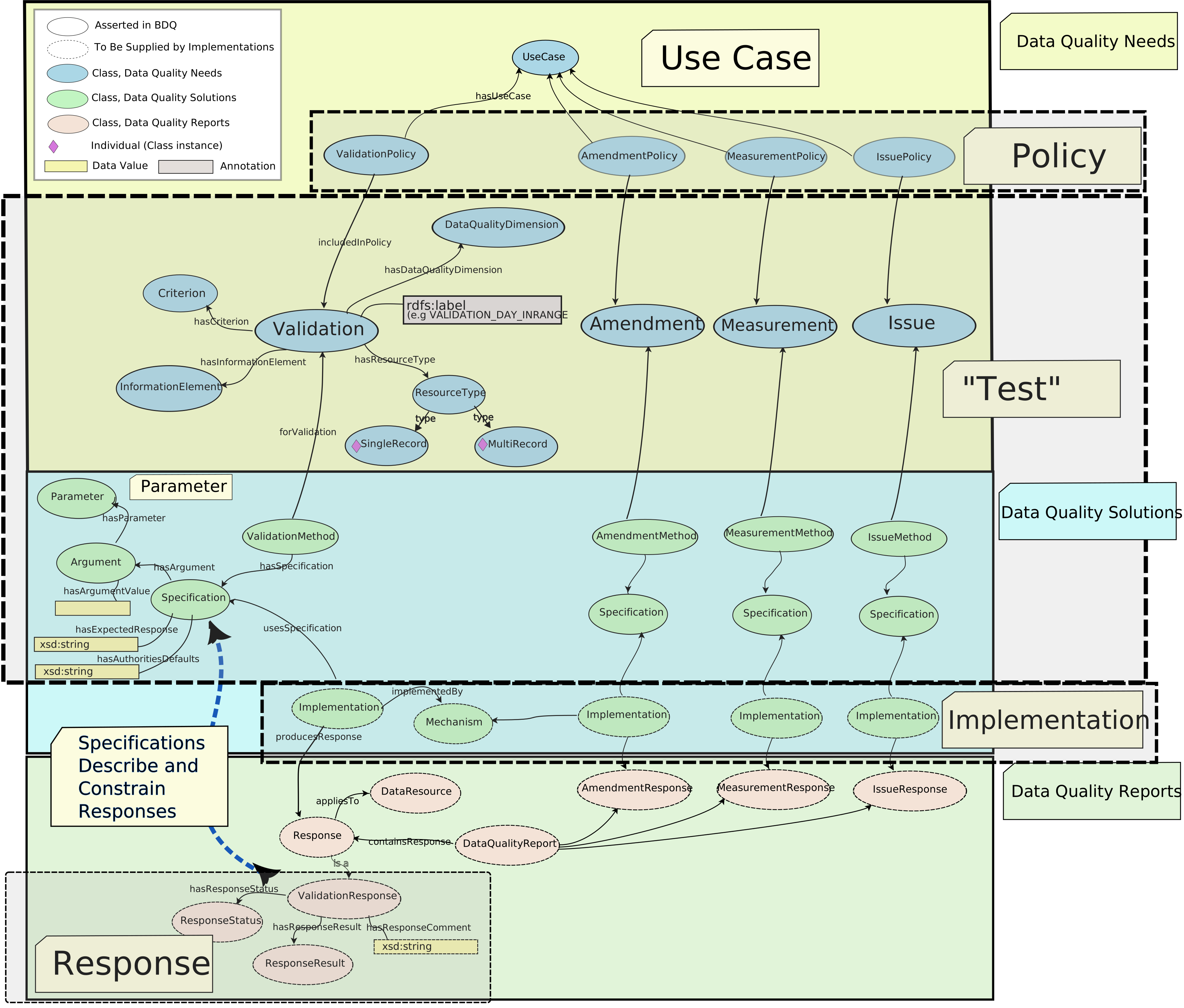 Non-normative diagram illustrating the relationships among Use Cases, Policies, Tests, Parameters, Implementations and Reports in bdqffdq:
3.1 Compliance depends on Use Case (normative)
The BDQ standard defines a library of Tests that can produce Data Quality Reports and can be used in Quality Control and Quality Assurance. See the discussion of Quality Control and Quality Assurance in the Users Guide. Compliance of Test implementations with the BDQ standard depend upon several conditions:
- Tests can not assert or assure quality independently of a
Use Case. - A
Use Case(through a set ofPolicies) defining a suite of Tests needed to assert or filter for quality is required. Without it, an implementation of a set of Tests in aMechanismIS NOT compliant with the BDQ standard. - All of the Tests required by the
Policiesof aUse CaseMUST be implemented and individually compliant with BDQ Test specifications in order for theUse CaseTest suite to be compliant with the BDQ standard.
Note that BDQ Compliance of a Test Suite implementation does not mean that the Use Case that defines the Test Suite is valid or useful, rather, it simply means that every Test in the Use Case is (1) in the implementation and (2) each Test implementation is independently compliant with the Test's BDQ specification.
3.2 Minimum Test Suite composition (normative)
An implementation of a Test Suite MUST include all bdqtest:SingleRecord Validation, Measure, and Amendment Tests for each Use Case it implements. An implementation MUST provide complete coverage for at least one bdqffdq:UseCase. Implementations MAY include additional Tests and additional Use Cases. Implementations SHOULD be explicit about the composition of implemented Tests into Policies and Use Cases.
3.3 Rationale and expectations for suite design (non-normative)
The most important elements of the BDQ standard are the structure that holds explicit descriptions of what a data quality Test is intended to do, and the consistent structure for reporting the results from the execution of a Test upon data. We expect that implementers will implement suites of these Tests that fit their Data Quality Needs (their Use Case), including Tests that are specifically suited for their domain. The BDQ standard provides a coherent library of Tests that can be applied to the set of defined bdqffdq:UseCases in BDQ, and considerable thought has gone into describing Tests that isolate particular data quality issues and work together as a coherent suite.
3.4 Required outputs for every Test execution (normative)
Results from each Test MUST be produced in the form Response.status, Response.result, and Response.comment, with one Test producing one Response. Results MAY include Response.qualifier (see section 4 Extension Points). The values of Response.status and Response.result MUST be those specified. This standard is agnostic concerning data structures and serializations of a Response. The standard is agnostic concerning internationalization and languages of labels applied to human readable presentations of values within a Response. See 4.1 Structure of Response (normative) in BDQ Tests: Concepts and Use for further normative guidance on Responses as RDF or as data structures. See section 5.1 The Response Object for further normative guidance on Responses.
3.4.1 Amendment Response.result ordering (normative)
Within the Response.result for an Amendment Test, the order of key-value pairs is not specified and MAY vary.
3.5 Describing additional Tests (normative)
Additional Tests that conform to the BDQ standard MUST describe those Tests using the BDQ Fitness For Use Framework Ontology, those Tests MUST use the same Response structures, and those Tests MUST be related to bdqffdq:UseCases, either those defined in the standard or additional Use Cases.
3.6 Parameterized Tests: default behavior and unsupported values (normative)
Implementations MUST provide Parameterized Tests that support the default Parameter values. Implementations SHOULD provide for Parameterized Tests to take parameters, but MAY produce an implementation of a Parameterized Test that takes no parameters but only uses a default parameter value applicable within their domain.
BDQ does not specify how a Test implementation is to respond when given a Parameter value that is not supported by the implementation. Implementers SHOULD handle this in a manner appropriate for their implementation framework. Unless otherwise noted in properties of the Specification, implementations MUST NOT use Response.status="EXTERNAL_PREREQUISITES_NOT_MET" to indicate a non-supported parameter value.
3.7 Bulk / non-Framework execution (normative)
Implementers are encouraged to produce the means to test data quality in bulk in settings such as SQL queries on relational data stores where construction of Response objects is not feasible, but the logic of a specification (hasExpectedResponse) can be framed as a question on a data store. Such non-Framework implementations MUST NOT assert compliance with the BDQ standard.
4 Extension Points (normative)
A response MAY include a Response.qualifier (in RDF, a bdqffdq:hasResponseQualifier object property on an instance of a bdqffdq:Response). This is intended as a place to include structured Responses concerning uncertainty in a response. This is also intended as a place to include structured Responses about the details of Amendment Tests (e.g., TRANSPOSED MAY be attached to a Response.qualifier for some Amendment Tests).
Multi Record (bdqffdq:MultiRecord) Measures that count results from Single Record Tests (that is, that return counts where the input Information Element consists of Response values from Tests on Single Records (bdqffdq:SingleRecord)) MUST report only a single count as the Response.result. Such Multi Record Measures MAY provide a Response.qualifier containing structured data describing additional information such as the total number of Single Records evaluated (to calculate percentages), the number of each value of Response.status encountered, and the number of each Response.result encountered. Measures under the Framework are only allowed to return "COMPLETE", "NOT_COMPLETE", or a single number. If it is desirable for any Measure to return more than a single number, Response.qualifier is the extension point to use.
5 Responses from Tests (normative)
5.1 The Response Object (normative)
The four Test Types (Validation, Issue, Amendment, and Measure) all provide a Response from the execution of the Test. The Response from a Test is an assertion which MAY form part of a Data Quality Report or MAY be wrapped in an oa:Annotation.
Responses from each of the Tests MUST consist of structured data, and MUST NOT be simple pass fail flags.
The Response MUST include the following three components:
-
Response.resultis a result returned for a Test - a controlled vocabulary consisting of "COMPLIANT" or "NOT_COMPLIANT" forValidationTests, "NOT_ISSUE" or "POTENTIAL_ISSUE" forIssueTests, either a numeric value or a controlled vocabulary consisting of "COMPLETE" or "NOT_COMPLETE" forMeasureTests, and a data structure (e.g., a list of key value pairs) for proposed changes forAmendmentTests. -
Response.statusprovides a controlled vocabulary, metadata concerning the success, failure, or problems with the Test. TheResponse.statusalso serves as a link to information about warning type values and, in the future, probabilistic assertions about the likeliness of the value could be made. -
The
Response.commentsupplies human-readable text describing reasons for the Test result.
5.1.1 Amendment Test Responses (normative)
An Amendment Test may propose a change to a value found in an existing Darwin Core (Wieczorek et al. 2012), or a set of Darwin Core Terms (Darwin Core Maintenance Group 2021), including potentially filling in a missing value. Amendment Tests are intended to improve one or more components of the quality of the record. The Response.result from an Amendment Test MUST always be treated as a proposal for a change, and MUST NOT be blindly applied to a database of record when a Data Quality Report is used for Quality Control of an existing record. Consumers of Data Quality Reports under Quality Assurance uses MAY choose to accept all proposed Amendments as part of a pipeline in preparing data for an analysis. The Framework also supports changes to procedures but we have not framed any such Tests in this form.
An Amendment Test Response.result SHOULD consist of a set of key:value pairs, where each key is an Information Element to be modified, and each value is a proposed new value for that Information Element. The Response.result key:value pairs SHOULD be a JSON serialization of the proposed changes.
Under the Fitness For Use Framework, Amendment Tests may propose changes to processes as well as data. BDQ prescribes no structure for the Response.result of an Amendment Test that proposes changes to processes. Implementers MAY develop their own structures and serializations for the Response.result of Amendment Tests that propose changes to processes.
5.1.2 Response Serialization and Presentation (normative)
Nothing in this section should be taken as a requirement for a particular format or serialization of bdqffdq:Responses. Implementations MAY serialize Responses in any appropriate form for their needs.
Nothing in this document should be taken as a requirement for how bdqffdq:Responses are to be presented to consumers of Data Quality Reports. Implementations MAY present the results of Tests in any form appropriate for their consumers.
5.1.3 Further Guidance on Responses (non-normative)
See 4.1 Structure of a Response (normative) in BDQ Tests: Concepts and Use for further normative guidance on representing Responses as RDF or in data structures.
See Definitions for Named Individuals in the bdqffdq: ontology for formal definitions of the named individuals that are used as values (e.g. COMPLIANT, NOT_COMPLIANT, RUN_HAS_RESULT) for Response.status and Response.result in the expected responses of Test specifications.
5.1.4 Results from Measures (normative)
Measure Tests that return numeric values MUST return a single numeric value in Response.result. The value MAY be zero, a positive or negative integer, or a real number. Implementers SHOULD be mindful of interoperability issues when numbers are serialized or exchanged across programming languages, runtimes, or storage systems (for example, loss of integer precision, floating-point rounding differences, and handling of non-finite values such as NaN or ±Infinity).
Measure Tests that return "COMPLETE" or "NOT_COMPLETE" MUST return one of those two values as the Response.result.
A single Measure Test MUST NOT return a list of numbers. A single Measure Test MUST NOT return a list of "COMPLETE"/"NOT_COMPLETE" values.
5.2 Framework Elements Not Included in BDQ Test Descriptions (normative)
Implementers SHOULD create an instance of bdqffdq:Mechanism to uniquely identify their suite of Test implementations.
Implementations producing Data Quality Reports SHOULD create instances of bdqffdq:Responses grouped in bdqffdq:DataQualityReports that also specify the bdqffdq:DataResource that the bdqffdq:DataQualityReport concerns.
Implementers MUST provide Response data in Data Quality Reports consisting of Response.status, Response.result, and Response.comment.
Implementations MAY perform data Quality Control, data Quality Assurance, or both.
6 Guidelines for Implementers (normative)
6.1 Parameters and Changing the Behavior of a Test (normative)
Many Tests specify bdqffdq:Parameters that are intended to change the behavior of a Test to fit local Data Quality Needs without changing the Specification of the Test.
A Parameterized Test will behave differently on the same data when using different Parameter values.
Implementers SHOULD only present non-default Parameter values to a Test implementation if needed for local Data Quality Needs.
6.1.1 Identifying non-default Parameter values in reports (normative)
When a Test is executed with non-default Arguments specified for Parameters, consumers of Responses and Data Quality Reports resulting from such MUST be able to tell that non-default Arguments were used, and what the non-default values were.
When a Test is Parameterized, and a value other than the default value is used for some Parameter, reports: SHOULD identify the Tests using at least:
- the
Label(rdfs:label) for the Test class, - in combination with the
Parameter, - and the value of the argument that replaced the
Parameterin this specific case.
For example: "VALIDATION_MINDEPTH_INRANGE with bdqval:maximumValidDepthInMeters=1642" (Label with Parameter=non-default value).
When a non-default Argument is used, a new instance of an Implementation linked to a new instance of a Specification linked to an instance of an Argument asserting the non-default value SHOULD be used.
When Responses are represented in RDF a Response produced by a Test run with a non-default Argument value
- MUST NOT be linked to the instance of the
Specificationwith theArgumentwith the default value, - MUST be linked to novel instances of
Implementation,Specification, andArgument, such that a query on theResponsecan identify whatArgumentvalue was used for theParameterto produce theResponse. It is the novel instances of these classes that provides the non-default value for software consumers.
6.1.2 Identifying non-default Parameter values in Response.comment (normative)
When a non-default Argument is used, a Response.comment SHOULD include the Parameter and the non-default value. This provides the non-default value for human consumers.
6.1.3 Expectations for Tests with Parameters (normative)
An implementation of a Test:
- MUST support the Test execution with the default
Parametervalues. - MAY optionally support other
Parametervalues. - Provided
ParametersMUST NOT change the behavior of the Test to depart from theSpecificationhasExpectedResponse. ParametersMUST only change the behavior of the Test as specified in theSpecificationhasExpectedResponse.
6.1.4 Test departures from specifications (normative)
An implementation of a Test that, by design, has a behavior that departs from the Specification hasExpectedResponse MUST be identified by different identifiers than the BDQ Test from which it departs.
An implementation of a parameterized Test that only supports non-default Parameter values MUST be identified by different identifiers than the BDQ Test that supports the default Parameter values. For example, an implementation of VALIDATION_LICENSE_STANDARD that does not support the default bdqval:sourceAuthority "Creative Commons 4.0 Licenses or CC0", but only supports a different source authority is not the same Test as VALIDATION_LICENSE_STANDARD, and must be identified by a different identifier.
6.1.5 Further guidance on Parameters and Arguments (non-normative)
See also the Test Parameters section in the User's Guide for further guidance on Parameters and Arguments.
6.2 Execution Process Agnostic (non-normative)
The Test descriptions in the BDQ standard are designed to be able to be used anywhere in the life cycle of biodiversity data, and are designed to be independent of the environment in which the Tests are run. Test implementations may be run within a framework that evaluates entire records one at a time, behind user interface elements that evaluate single Information Elements one at a time, on streams of data within workflows, on distinct values aggregated within streams of data within workflows, and more.
Tests may be run
- at the point of initial collection or observation of organisms,
- to support data transcription,
- in loading data into databases of record from field or transcription sources,
- in preparing data from databases of record for aggregation,
- during data aggregation,
- individually on single Darwin Core records,
- on fragments of Darwin Core (Wieczorek et al. 2012) records within a data capture interface,
- in sequence in a processing pipeline of Darwin Core records, or
- in parallel in a processing pipeline of Darwin Core records, or
- in a workflow environment that produces lists of unique values of
Information Elementsfor each Test, executes the Test on the unique values, and then maps the results back out into rows in the dataset.
Data may be presented to an execution framework as Simple Darwin Core, or as Structured Darwin Core, or in another structure that can be mapped to the Information Elements of relevant Tests. The commonalities the Tests support are clearly defined specific Tests, which produce standard outputs from input Information Elements onto which domain specific terms (i.e., Darwin Core) are mapped.
Multiple sequential and parallel workflows that process streams of data are possible. One possible workflow for Test execution is to group the unique values of applicable Information Elements within a bdqffdq:MultiRecord from each Validation or Measure Test, and then execute the Validation or Measure Tests on the unique values, and then disaggregate the results back to each bdqffdq:SingleRecord. This is analogous to performing Tests as SQL queries. Another possible workflow is to present each data record sequentially to all of the Validation and Measure Tests. Yet another is to split the data into streams by Information Element, and then, in parallel, present data in each streams to relevant Tests.
6.3 Considerations for Test Execution (normative)
Many Tests invoke external bdqval:sourceAuthorities. Some of these bdqval:sourceAuthorities are downloadable vocabulary files, others are web services with changing data.
Implementations of Tests SHOULD locally cache the results of calls to remote web services, particularly if they operate on a sequence of bdqffdq:SingleRecords instead of operating on distinct values of bdqffdq:InformationElements. Data sets typically contain many repeated values, and remote web services SHOULD NOT be subject to repeated requests using the same question.
Some source authorities are highly stable small vocabularies. Implementers MAY choose to query a local copy of such a vocabulary, even if a remote service is specified in a bdqval:sourceAuthority for a Test. Implementers SHOULD monitor for changes to that vocabulary in the authoritative source and update local data when changes occur.
6.4 Order of Test Execution (normative)
6.4.1 Phases: Pre-Amendment, Amendment, Post-Amendment (normative)
Tests MAY be run in Pre-Amendment, Amendment, and Post-Amendment phases.
6.4.1.1 Explanation of Phases (non-normative)
A good practice for executing the BDQ Tests is to follow a sequence that begins by executing all bdqffdq:SingleRecord Validation and Measure Tests in a pre-amendment phase. Then, to execute all Amendment Tests in an amendment phase. Finally, re-run all Validation and Measure Tests on the data with the proposed changes asserted by the Amendments applied to the data in a post-amendment phase. Such a sequence of phases allows Responses to be made first about the quality of the data as they were initially presented, and then about how much the quality of the data would be improved if all proposed changes from the Amendments were accepted. The order and method of running Validation and Measure Tests within the pre-amendment and post-amendment phases is not specified by the BDQ standard. Within pre-amendment and post-amendment phases, the Validation and Measure Tests are agnostic about the order in which they are run, the extent to which they are run in parallel, or the extent to which they are run on single records or on unique values within a dataset.
6.4.1.2 Phases and Quality Assurance (normative)
It is RECOMMENDED, for Quality Assurance (bdqffdq:QualityAssurance) with the current suite of BDQ Tests, to run all pertinent (to a Use Case) bdqffdq:SingleRecord Validation and Measure Tests, then run all pertinent Multi Record Measures that return "COMPLETE" or "NOT_COMPLETE"". These Measures MAY be used as filters. Exclude records from the dataset until all Multi Record Measure Tests return "COMPLETE". This, under the mathematical formulation of the Framework, is the assertion that the data are fit for the purpose of the selected Use Case. This process MAY be performed in a single Validation and Measure phase without Amendments. This process MAY be performed on a post-amendment phase with all or selected proposed changes from Amendments accepted into the data stream. Acceptance of proposals for changes to the data in a processing stream SHOULD NOT be done blindly, and SHOULD involve thoughtful consideration of the proposed changes.
6.4.1.3 Phases and Quality Control (normative)
Under Quality Control (bdqffdq:QualityControl), bdqffdq:MultiRecord Measure Tests that return numeric values MAY be used to assess the prevalence of quality issues in the data with respect to the selected bdqffdq:UseCase. This MAY be done in a pre-amendment phase and again in a post-amendment phase with all proposed changes applied to the data stream to evaluate how much accepting proposed Amendments would improve the data. Acceptance of proposals for changes to the data in a processing stream SHOULD NOT be done blindly, and SHOULD involve thoughtful consideration of the proposed changes. See: 5.1.1 Amendment Test Responses (normative) for further normative guidance on the use of Amendment Test Responses.
Numeric values from Multi Record Measure Tests under Quality Control MAY be used to identify areas to target effort to improve data quality in a database of record for one or more Use Cases.
6.4.2 Test Dependencies (normative)
While BDQ Tests are designed to be independent and agnostic to sequence of Test execution, some Amendment Tests have potential interactions given the by-design redundancies in Darwin Core (Wieczorek et al. 2012). In consequence the order of execution of some Amendment Tests can affect results. This is a particular concern when developing workflows with parallel data streams. When Amendment Tests are executed in a workflow where downstream Amendments operate on data with the changes proposed by upstream Amendments applied, the following sequences SHOULD be followed.
Given that Amendment Tests propose a value to a primary term (e.g., dwc:eventDate, dwc:taxonID) from secondary terms (e.g., dwc:day, dwc:year, dwc:scientificName), primary-from-secondary SHOULD be applied before secondary-from-primary. Where multiple Amendments on secondary terms could propose conflicting changes to a primary term, the sequence of Amendment Tests SHOULD be ordered.
For dwc:eventDate:
See Diagram of the TIME-oriented Tests and Information Elements Acted Upon (non-normative) in BDQ Supplemental Information for the relationships between the Tests and associated Information Elements Acted Upon that operate on aspects of date and time (Darwin Core class dwc:Event).
Similarly, for dwc:taxonID:
| Order | Test |
|---|---|
| 1 | AMENDMENT_SCIENTIFICNAMEID_FROM_TAXON |
| 2 | AMENDMENT_SCIENTIFICNAME_FROM_SCIENTIFICNAMEID |
The corresponding NAME Tests diagram displays the Tests and associated Information Elements Acted Upon that operate on aspects of taxonomic name (Darwin Core class dwc:Taxon).
See also the SPACE Tests diagram and the OTHER Tests diagram.
The BDQ standard does not specify how the ordering of these Tests should be accomplished. Ordering of Tests COULD be done by describing an Amendment Test with an expected response that specifies the execution of each Test in order. Such a composition of Amendment Tests would be the preferred method of sequencing under the Framework, but to keep Tests as independent a possible, and to allow the maximum flexibility for the composition of Tests in Profiles to support bdqffdq:UseCases, the BDQ standard does not provide such a Test specification. Ordering of Tests could be done by providing a configuration file for a Test execution framework specifying Test dependencies. Ordering could be supported in a workflow environment by composing a workflow to execute these Tests in sequence. The order specified above SHOULD be followed.
6.4.2.1 Terms for describing Test Dependencies (non-normative)
The Fitness For Use Framework Ontology does not include a property to describe sequence inter-dependencies among Amendments. The Ontology does provide the terms bdqffdq:targetedMeasure, bdqffdq:targetedValidation, and bdqffdq:TargetedIssue, which could be used, together with bdqffdq:improvedBy to relate Amendment Tests to Validation, Measure, and Issue Tests. The BDQ standard does not use these terms to describe Test interrelationships, though they could be used for this purpose.
6.4.3 Implementing a complete Test (normative)
An implementation of a Test MAY be complete as described with bdqffdq: terms in BDQ Tests List of Terms. A complete Test implementation MUST encompass the elements of the Test defined in an instance of bdqffdq:DataQualityNeed, plus its associated bdqffdq:InformationElements, instance of a subclass of bdqffdq:Method, instance of bdqffdq:Specification, any related Arguments and Parameters, and MUST be able to produce instances of bdqffdq:Response (carrying Response.status, Response.result, Response.comment). In contrast, see Section 6.4.6 Implementing an Abstract Test (normative) for settings where implementations may abstractly consider only the instance of bdqffdq:DataQualityNeed with its associated bdqffdq:InformationElements.
6.4.4 Presenting Darwin Core Data to a Method that Implements a Test (non-normative)
One complexity introduced by the abstraction of Tests into APIs that take Darwin Core Terms (Darwin Core Maintenance Group 2021) as input and output is to make sure that Response objects are correctly mapping Darwin Core terms loaded in an execution framework onto the parameters of an implementation method. Consider an implementation of the Test VALIDATION_ENDDAYOFYEAR_INRANGE that has the following method signature:
public Response validationEnddayofyearInrange(String startDayOfYear, String eventDate)
If an implementation framework calls this method, reversing the binding of dwc:startDayOfYear and dwc:eventDate, for example:
Response endDayTestResponse = validationEnddayofyearInrange(eventDate, startDayOfYear);
the Test will not return the desired result, even if the implementation is correct. Thus correct matching of input terms to the implementation of each Test is critical.
Multiple approaches are possible to correctly match input Darwin Core terms onto method signatures for methods that implement Tests.
6.4.4.1 Binding Darwin Core Data (normative)
The BDQ standard is entirely agnostic as to how the binding between domain terms (i.e., input Darwin Core terms) and Information Elements considered inside Test implementations is done. Implementers MAY freely implement in any appropriate way for their environment. However, Test Implementations MUST provide structured Responses containing Response.status, Response.result, and Response.comment.
Implementations MAY define objects corresponding to the set of Information Elements for each Test, and may pass the object to the Test implementation (pushing the problem of binding input values to the correct properties of these objects upstream). Implementations MAY operate on domain objects (e.g., Darwin Core objects), with a Test implementation taking a domain object as input and extracting the Information Element Acted Upon and the Information Element Consulted from that object internally. Implementations MAY be methods on domain objects (e.g., Darwin Core objects) and assert the results as properties of the domain object.
Implementers MAY use any approach appropriate for their language(s) and environment to pass data into Test implementations.
6.4.4.2 Examples of matching input Darwin Core to Method parameters (non-normative)
If a Test implementation is a function that takes Darwin Core terms as input parameters, the function (or method) call becomes the point of concern for correctly matching input Darwin Core terms to the Parameters of the Test (function or method).
In Java, annotating method parameters and using reflection to bind between the execution framework and Test implementations works well. Following is a simplified code snippet from the FilteredPush event_date_qc library (Morris & Lowery 2025) that uses Java annotations, (e.g., @ActedUpon(value="dwc:endDayOfYear") to provide metadata about which parameter goes with which Information Element.
    public Response validationEnddayofyearInrange(
            @ActedUpon(value="dwc:endDayOfYear") String endDay,
            @Consulted(value="dwc:eventDate") String eventDate) {
An execution framework can use reflection to determine, from the annotations on the parameter, which Darwin Core term to bind to which parameter.
Additional metadata can be added in Java annotations. In the following, again from the FilteredPush event_date_qc (Morris & Lowery 2025) library, annotations enable an implementation framework to look up a Test implementation by the Test GUID, and can provide metadata about the Test to users. For maintenance, annotations can be used to determine if an implementation is up to date with the latest version of a Test specification.
    @Validation(label="_ENDDAYOFYEAR_INRANGE", description="Is the value of dwc:endDayOfYear an integer between 1 and 365 inclusive, or 366 if a leap year?")
    @Provides("9a39d88c-7eee-46df-b32a-c109f9f81fb8")
    @ProvidesVersion("https://rs.tdwg.org/bdqtest/terms/9a39d88c-7eee-46df-b32a-c109f9f81fb8-2023-09-18")
    @Specification("INTERNAL_PREREQUISITES_NOT_MET if dwc:endDayOfYear is bdqval:Empty or if the value of dwc:endDayOfYear is equal to 366 and (dwc:eventDate is bdqval:Empty or the value of dwc:eventDate cannot be interpreted to find a single year or an end year in a range); COMPLIANT if the value of dwc:endDayOfYear is an integer between 1 and 365 inclusive, or if the value of dwc:endDayOfYear is 366 and the end year interpreted from dwc:eventDate is a leap year; otherwise NOT_COMPLIANT")
    public static DQResponse<ComplianceValue> validationEnddayofyearInrange(
            @ActedUpon(value="dwc:endDayOfYear") String endDay,
            @Consulted(value="dwc:eventDate") String eventDate) {
        ....
    }
This approach will only work with a subset of programming languages.
In many languages, a domain object can be passed as a method parameter.
    public Response validationEnddayofyearInrange(Event event) {

    }
Here, both the execution framework and the internals of the validationEnddayofyearInrange method must be able to work with the Event (object or structure) and work with its Event.enddayofyear and Event.eventdate properties.
It is also possible to implement this in an object-oriented manner as methods on a class:
    public class Event() {

        private eventDate;
        private enddayofyear;

        public Response validationEnddayofyearInRange()...

    }
Other approaches are also possible.
6.4.5 Example Test Implementations (non-normative)
6.4.5.1 Example in Pseudocode (non-normative)
A specification (the content of a hasExpectedResponse property of a Specification) is a sequence of statements in the form of a string representing the Response followed by the Criteria that would result in that Response. Thus, given the following specification:
EXTERNAL_PREREQUISITES_NOT_MET if the bdqval:SourceAuthority is not available; INTERNAL_PREREQUISITES_NOT_MET if the dwc:countryCode was EMPTY; COMPLIANT if the value of dwc:countryCode is found in bdqval:sourceAuthority; otherwise NOT_COMPLIANT
'EXTERNAL_PREREQUISITES_NOT_MET' is a Response and 'if the bdqval:SourceAuthority is not available' is the Criterion.
The expected response provides a sequence of Criteria to evaluate. This should be done in the order specified in the expected response, except for EXTERNAL_PREREQUISITES_NOT_MET, which can be handled as an exception raised from an invocation of an external resource.
Following is pseudocode that follows the same order of evaluation of the Criteria, returning a result for the first matched Criterion, or EXTERNAL_PREREQUISITES_NOT_MET for the first failure to invoke the external resource.
    Function validationCountrycodeStandard(countryCode) returns Result {
      String sourceAuthority = "ISO 3166-1-alpha-2"
      Result result = new Result()
      try {
          if (isEmpty(countryCode) {
              result.setStatus(INTERNAL_PREREQUISITES_NOT_MET)
              result.setComment("provided countryCode is empty."
          } else {
              result.setStatus(RUN_HAS_RESULT)
              if (isFoundCountryCode(countryCode,sourceAuthority)) {
                 result.setValue(COMPLIANT)
                 result.setComment("provided countryCode ["+countryCode+"] is a known "+sourceAuthority+" countryCode ")
              } else {
                 result.setValue(NOT_COMPLIANT)
                 result.setComment("provided countryCode ["+countryCode+"] is not a known "+sourceAuthority+" countryCode ")
              }
          }
      } catch NetworkException {
          result.setStatus(EXTERNAL_PREREQUISITES_NOT_MET)
          result.setComment("Temporary failure looking up countryCode, try later")
      }
      return result
    }

    Function isfoundCountryCode(countryCode,sourceAuthority) returns boolean throws NetworkException {...}
The Criteria for EXTERNAL_PREREQUISITES_NOT_MET do not have to be evaluated first, but would be expected to be raised from wherever in the sequence the external resource first fails to be invoked, and is handled within the construct that builds a Result object.
Note that this implementation will reach the block that can return EXTERNAL_PREREQUISITES_NOT_MET only if the input dwc:countryCode contains a value. This deviation from the logical sequence implied by the specification (EXTERNAL_PREREQUISITES_NOT_MET if the bdqval:SourceAuthority is not available; INTERNAL_PREREQUISITES_NOT_MET if the dwc:countryCode was EMPTY;) is perfectly acceptable, for the case of network resources being evaluated later in the implementation than other conditions.
Below is pseudocode for a similar implementation as a method on a Darwin Core domain object, less general, and more tightly bound to the domain concept, but making the concern of correctly binding input data to domain concepts not a concern of the Test.
    class flatDarwinCore {
       property countryCode

       method setCountryCode(countryCode) {
          this.countryCode = countryCode
       }

        method validationCountrycodeStandard() returns Result {
          String sourceAuthority = "ISO 3166-1-alpha-2"
          Result result = new Result()
          try {
              if (isEmpty(this.countryCode) {
                  result.setStatus(INTERNAL_PREREQUISITES_NOT_MET)
                  result.setComment("provided countryCode is empty."
              } else {
                  result.setStatus(RUN_HAS_RESULT)
                  if (AuthorityUtility.isFoundCountryCode(this.countryCode,sourceAuthority)) {
                     result.setValue(COMPLIANT)
                     result.setComment("provided countryCode ["+this.countryCode+"] is a known "+sourceAuthority+" countryCode ")
                  } else {
                     result.setValue(NOT_COMPLIANT)
                     result.setComment("provided countryCode ["+this.countryCode+"] is not a known "+sourceAuthority+" countryCode ")
                  }
              }
          } catch NetworkException {
              result.setStatus(EXTERNAL_PREREQUISITES_NOT_MET)
              result.setComment("Temporary failure looking up countryCode, try later")
          }
          return result
       }
    }
6.4.5.2 Example in Java (non-normative)
Consider the following Test Specification for VALIDATION_DAY_STANDARD from BDQ:
Specification:
hasExpectedResponse: INTERNAL_PREREQUISITES_NOT_MET if dwc:day is bdqval:Empty; COMPLIANT if the value of the field dwc:day is an integer between 1 and 31 inclusive; otherwise NOT_COMPLIANT.
Information Elements Acted Upon: dwc:day
Below is an example implementation from the FilteredPush event_date_qc library (Morris & Lowery 2024). In this implementation, Java annotations are used to provide metadata that can be used by an implementation framework to pick out a Test to run by its Term Version IRI (rdf:about) or Term Name (rdf:value) and match an input Darwin Core term to a (Java) parameter in the method signature. The implementation walks through the elements of the hasExpectedResponse in sequence, and return the first matching response in a Response object, which has Response.state, Response.result (here called value), and Response.comment properties.
    @Validation(label="VALIDATION_DAY_STANDARD", description="Is the value of dwc:day an integer between 1 and 31 inclusive?")
    @Provides("47ff73ba-0028-4f79-9ce1-ee7008d66498")
    @ProvidesVersion("https://rs.tdwg.org/bdqtest/terms/47ff73ba-0028-4f79-9ce1-ee7008d66498-2023-09-18")
    @Specification("INTERNAL_PREREQUISITES_NOT_MET if dwc:day is EMPTY; COMPLIANT if the value of the field dwc:day is an integer between 1 and 31 inclusive; otherwise NOT_COMPLIANT.")
    public static DQResponse<ComplianceValue> validationDayStandard(@ActedUpon("dwc:day") String day) {
        DQResponse<ComplianceValue> result = new DQResponse<ComplianceValue>();

        if (DateUtils.isEmpty(day)) {
            result.addComment("No value provided for day.");
            result.setResultState(ResultState.INTERNAL_PREREQUISITES_NOT_MET);
        } else {
            try {
                int numericDay = Integer.parseInt(day.trim());
                if (DateUtils.isDayInRange(numericDay)) {
                    result.setValue(ComplianceValue.COMPLIANT);
                    result.addComment("Provided value for day '" + day + "' is an integer in the range 1 to 31.");
                } else {
                    result.setValue(ComplianceValue.NOT_COMPLIANT);
                    result.addComment("Provided value for day '" + day + "' is not an integer in the range 1 to 31.");
                }
                result.setResultState(ResultState.RUN_HAS_RESULT);
            } catch (NumberFormatException e) {
                logger.debug(e.getMessage());
                result.setValue(ComplianceValue.NOT_COMPLIANT);
                result.setResultState(ResultState.RUN_HAS_RESULT);
                result.addComment(e.getMessage());
            }
        }
        return result;
    }
6.4.6 Implementing an Abstract Test (normative)
In some environments, an implementation MAY be a lightweight implementation of an abstract Test. Such abstract implementations MAY encompass only the elements of the Test defined in an instance of bdqffdq:DataQualityNeed, plus its associated bdqffdq:InformationElements, and may not be able to produce instances of bdqffdq:Response, but SHOULD be able to produce analogs of Response objects (with Response.status, Response.result, and Response.comment properties).
Consider the Validation Test VALIDATION_ENDDAYOFYEAR_INRANGE
An SQL query that implements the abstract concept of the dwc:enddayofyear being in range could take the following form, using available database fields that contain data related to the abstract Information Element, but are not precisely mapped to the concrete Acted Upon and Consulted Darwin Core Terms (Darwin Core Maintenance Group 2021) in the specification. This query produces a Data Quality Report with:
    SELECT collecting_event_id, enddayofyear,
         'VALIDATION_ENDDAYOFYEAR_INRANGE' as test, 'NOT_COMPLIANT' as response_result, 'RUN_HAS_RESULT' as response_status,
         'The value of enddayofyear [' || enddayofyear ||'] is not an integer between 1 and 365 inclusive, or 366 if ended_date falls in a leap year.' as response_comment
    FROM collecting_event
    WHERE NOT (
          enddayofyear BETWEEN 1 AND 365
          OR (
             enddayofyear = 366
             AND
             (
                 (
                   MOD(EXTRACT (year from TO_DATE(ended_date, 'yyyy-mm-dd')),4) = 0
                   AND
                   MOD(EXTRACT (year from TO_DATE(ended_date, 'yyyy-mm-dd')),100) <> 0
                 )
                 OR
                 MOD(EXTRACT (year from TO_DATE(ended_date, 'yyyy-mm-dd')),400) = 0
             )
          )
        );
6.4.7 Implementing a Test in a Specific Environment (non-normative)
Given data stored in a known and controlled environment, Test implementations can be specifically tailored to that environment, both in language and in assumptions about formats and data types.
Consider the Validation Test VALIDATION_DAY_STANDARD with the hasExpectedResponse:
INTERNAL_PREREQUISITES_NOT_MET if dwc:day is EMPTY; COMPLIANT if the value of the field dwc:day is an integer between 1 and 31 inclusive; otherwise NOT_COMPLIANT."
Given a hypothetical Event table with fields including a primary key event_id and an integer field day, an implementation of VALIDATION_DAY_STANDARD in SQL that operates on data in the aggregate might look like:
    SELECT
        ‘VALIDATION_DAY_STANDARD’ as test_name,
        event_id,
        ‘INTERNAL_PREREQUISITES_NOT_MET’ as Result_status,
        null as Result_value,
        ‘No value for dwc:day to evaluate’ as Result_comment
    FROM event
        WHERE day is null
    UNION
    SELECT
        ‘VALIDATION_DAY_STANDARD’ as test_name,
        event_id,
        ‘RUN_HAS_RESULT’ as Result_status,
        ‘COMPLIANT’ as Result_value,
        ‘Value of dwc:day [‘|| day ||’] is in the range 1-31’ as Result_comment
    FROM event
        WHERE day >=1 and day <=31
    UNION
    SELECT
        ‘VALIDATION_DAY_STANDARD’ as test_name,
        event_id,
        ‘RUN_HAS_RESULT’ as Result_status,
        ‘NOT COMPLIANT’ as Result_value,
        ‘Value of dwc:day [‘|| day ||’] is outside the range 1-31’ as Result_comment
    FROM event
        WHERE day < 1 or day > 31
This implementation is dependent on the schema the data are stored in, in particular, the definition of event.day as a field holding integers.
This implementation does not generalize, as for example, day in a numeric data type that supports numbers in addition to integers would return incorrect values (per the Test specification, which requires day to be an integer), for values of day such as "8.5"
Implementations should carefully consider the assumptions inherent in the environment on which Tests are being run. For example, the FilteredPush implementations in event_date_qc (Morris & Lowery 2025), sci_name_qc (Morris & Dou 2025), rec_occur_qc (Morris 2025), and geo_ref_qc (Morris & Lowery 2025b), expect that all data will be presented to the Test methods as strings. Therefore each Test implementation that deals with numeric values must convert the input strings to appropriate numeric types for evaluation, and can use the failure to convert the data type as a means to identify INTERNAL_PREREQUISITES_NOT_MET.
6.5 Common Pattern for Implementing a Test (non-normative)
This section provides language- and framework-agnostic checklists that implementers can use to write (or review) implementations of BDQ Validation and Amendment Tests. It summarizes common conventions used in existing implementations, while remaining independent of any particular execution environment.
6.5.1 Responsibilities of a Test (non-normative)
BDQ keeps Tests portable by standardizing semantics (inputs, decision rules, outputs). It deliberately leaves execution mechanics (binding to input data, orchestration of Test execution, presentation of Test output) to whatever framework fits the implementer's environment.
The definition of a Test focuses on (1) the inputs (Information Elements Acted Upon and Consulted, and any Parameters), then (2) the logic or decision rules of the expected response, with (3) all Tests returning a similarly structured Response consisting of a Response.status, Response.result, and Response.comment as output.
The description of a Test, in essence, frames an API with Information Element and Parameter inputs, and a standard Response output, encapsulating the logic and decision rules of the expected response. The responsibility of a Test implementation lies in correctly implementing the logic and decision rules of the expected response, and in producing the expected structured output. The responsibility of an execution framework lies in correctly binding input data to the Information Elements and Parameters of a Test implementation, and in correctly presenting the structured output from a Test implementation.
The checklists below are designed to help implementers ensure that their implementations of Tests follow this separation of concerns, are consistent with the semantics of the Test as defined in the BDQ standard, and that they produce the expected structured outputs.
6.5.2 Checklist for a Validation Test (non-normative)
-
Setup for Consistency
- Implement utility functions or methods to evaluate bdqval:Empty and bdqval:NotEmpty consistently. See: The Concept of EMPTY in the BDQ Standard (normative)”.
- Define a standard
Responseobject or structure withResponse.status,Response.result, andResponse.commentproperties, and use that object or structure for the output from Test implementations. See: Structure of Response in the BDQ Tests: Concepts and Use document.
-
Confirm the required inputs
- Identify the
Information ElementsActed UponandConsultednamed in thehas Expected Responseof theSpecification. - Identify any
Parametersand their default value (from bdqffdq:hasAuthoritiesDefaults and/or bdqffdq:hasArgument / bdqffdq:Argument).
- Identify the
-
Expose a stable callable API
- Implement the Test as a callable unit (function/method) whose inputs correspond to the
Information Elementsand any supportedParameters. - If your API exposes a
Parameter:- it must accept the string literal default value exactly as it appears in the Test descriptor. See: Default Value Strings in Parameters.
- it may also support other string literal values of that
Parameterto produce different behavior.
- Return a structured
Responseobject (consuming exceptions).
- Implement the Test as a callable unit (function/method) whose inputs correspond to the
-
Write a Unit Test
- Examine the decision rules in the
hasExpectedResponseproperty of theSpecificationand write a unit test that covers each of the criteria in the expected response, including EXTERNAL_PREREQUISITES_NOT_MET, INTERNAL_PREREQUISITES_NOT_MET, COMPLIANT, and NOT_COMPLIANT.- Include data values found in the wild that would be expected to evaluate as COMPLIANT.
- Include data values found in the wild that would be expected to evaluate as NOT_COMPLIANT.
- If the expected response includes multiple criteria for a given
Response.status, write unit tests to cover each of those criteria. - Include tests for edge case values including empty values, values that are just inside and just outside of any specified ranges, and values that are not in the expected format.
- If the Test includes
Parameters, write unit tests to cover the default value(s) and any non-default value(s) that your implementation supports.
- Examine the decision rules in the
-
Implement the Test logic (decision rules) following the expected response criteria in order
- Follow the sequence of criteria in the
hasExpectedResponseproperty of theSpecification, returning the first matchingResponsefor the first matched criterion. - Handle EXTERNAL_PREREQUISITES_NOT_MET as an exception raised from an invocation of an external resource, and return that response immediately when such an exception is raised.
- Evaluate internal prerequisites first
- Evaluate
bdqval:Emptyandbdqval:NotEmptyconsistently (with utility functions). - Implement
bdqval:Emptyconsistently. See Example Implementation of a Function to Assess Empty. - If the
Specificationstates that anInformation Elementbeingbdqval:Emptyprevents evaluation, return:Response.status=INTERNAL_PREREQUISITES_NOT_METResponse.resultomitted / nullResponse.commentcontaining abdqval:NotEmptyexplanation
- Evaluate
- Handle external prerequisites and parameter support separately
- If a
Parametervalue is not supplied, substitute the default value. - If the Test depends on an external resource (e.g., a
bdqval:sourceAuthority) and that resource is unavailable at runtime, return:Response.status=EXTERNAL_PREREQUISITES_NOT_METResponse.resultomitted / nullResponse.commentcontaining abdqval:NotEmptyexplanation
- If an unsupported non-default
Parametervalue is supplied, implementations must not useResponse.status=EXTERNAL_PREREQUISITES_NOT_METto report “unsupported parameter value”. See: 3.6, Parameterized Tests: default behavior and unsupported values.
- If a
- Run the core validation and return a conforming Response
- Apply the Test’s stated criterion (e.g., exact match, interpretation rules, range checks) exactly as described in the
Specification, and avoid undocumented preprocessing. - When evaluation succeeds, return:
Response.status=RUN_HAS_RESULTResponse.result=COMPLIANTorNOT_COMPLIANTResponse.commentcontaining abdqval:NotEmptyexplanation
- If a non-default
Parametervalue was used,Response.commentshould include theParametername and the non-default value (see Section 6.1.2, “Identifying non-defaultParametervalues inResponse.comment(normative)”).
- Apply the Test’s stated criterion (e.g., exact match, interpretation rules, range checks) exactly as described in the
- Follow the sequence of criteria in the
6.5.3 Checklist for Implementing an Amendment Test (non-normative)
-
Setup for Consistency
- Implement utility functions or methods to evaluate
bdqval:Emptyandbdqval:NotEmptyconsistently. See: 2.2 The Concept of EMPTY in the BDQ Standard. - Define a standard
Responseobject or structure withResponse.status,Response.result, andResponse.commentproperties, and use that object or structure for the output from Test implementations. See: Section 4.1 Structure of Response (normative) in the BDQ Tests: Concepts and Use document.
- Implement utility functions or methods to evaluate
-
Confirm the required inputs and intended outputs
- Identify the
Information ElementsActed UponandConsultednamed in theSpecification(the value of bdqffdq:hasExpectedResponse). - Identify any
Parametersand their default values (frombdqffdq:hasAuthoritiesDefaultsand/orbdqffdq:hasArgument/bdqffdq:Argument). - Identify which
Information Elementsmay appear as keys in theResponse.resultpayload when the result is an amendment proposal. SomeAmendmentTests propose changes to more than oneInformation Element.
- Identify the
-
Expose a stable callable API
- Implement the Test as a callable unit (function/method) whose inputs correspond to the
Information Elementsand any supportedParameters. - If your API exposes a
Parameter,- it must accept the string literal default value exactly as it appears in the Test descriptor. See: 2.3.2.4 Default Value Strings in Parameters.
- it may also support other string literal values of that
Parameterto produce different behavior.
- Return a structured
Responseobject (consuming exceptions).
- Implement the Test as a callable unit (function/method) whose inputs correspond to the
-
Write a Unit Test
- Examine the decision rules in the
hasExpectedResponseproperty of theSpecificationand write a unit test that covers each of the criteria in the expected response, including EXTERNAL_PREREQUISITES_NOT_MET, INTERNAL_PREREQUISITES_NOT_MET, FILLED_IN, AMENDED, and NOT_AMENDED.- Include a range of data values found in the wild that can be effectively amended to test the FILLED_IN and AMENDED responses.
- Include a range of data values found in the wild that are ambiguous and cannot be effectively amended to test the NOT_AMENDED response.
- If the expected response includes multiple criteria for a given
Response.status, write unit tests to cover each of those criteria. - Include tests for edge case values including empty values, values that are just inside and just outside of any specified ranges, and values that are not in the expected format.
- If the Test includes
Parameters, write unit tests to cover the default value(s) and any non-default value(s) that your implementation supports.
- Examine the decision rules in the
-
Implement the Test logic (decision rules) following the expected response criteria in order
-
Evaluate internal prerequisites first
- Evaluate
bdqval:Emptyandbdqval:NotEmptyconsistently (with utilty functions). - If the
Specificationstates that one or more requiredInformation Elementsbeingbdqval:Emptyprevents generating a proposal, return:Response.status=INTERNAL_PREREQUISITES_NOT_METResponse.resultomitted / nullResponse.commentcontaining abdqval:NotEmptyexplanation
- Evaluate
-
Handle external prerequisites and parameter support separately
- If a
Parametervalue is not supplied, substitute the default value. - If the Test depends on an external resource (e.g., a
bdqval:sourceAuthority) and that resource is unavailable at runtime, return:Response.status=EXTERNAL_PREREQUISITES_NOT_METResponse.resultomitted / nullResponse.commentcontaining abdqval:NotEmptyexplanation
- If an unsupported non-default
Parametervalue is supplied, implementations must not useResponse.status=EXTERNAL_PREREQUISITES_NOT_METto report “unsupported parameter value”. See: 3.6 Parameterized Tests: default behavior and unsupported values normative.
- If a
-
Generate a proposal (or decide no proposal is warranted)
- Apply the Test’s criterion exactly as described in the
Specification, including any "interpreted as" rules. See: 2.3.3 The Concept of Interpreted As”. - Do not propose changes that are not explicitly allowed by the
Specification. In particular, avoid “helpful” normalizations that would alter the meaning or introduce false precision unless specified. - If a proposal is made, represent the proposed changes as structured data. Typically as a list/map of key:value pairs where keys are
Information Elementidentifiers and values are proposed new values.
- Apply the Test’s criterion exactly as described in the
-
Return a conforming Response for an Amendment
- When evaluation succeeds, use
Response.statusvalues appropriate toAmendmentTests:FILLED_INwhen proposing new value(s) forInformation Elementsthat werebdqval:Empty.AMENDEDwhen proposing changes to existingbdqval:NotEmptyvalue(s).NOT_AMENDEDwhen prerequisites are met but no proposal is made.
- For
FILLED_INandAMENDED:Response.resultMUST be present and MUST contain the structured proposal payload, e.g., JSON key:value pairs.Response.commentMUST bebdqval:NotEmptyand SHOULD explain how the proposal was derived, including any non-defaultParametervalues used.
- For
NOT_AMENDED:Response.resultmust be omitted / null.Response.commentmust bebdqval:NotEmptyand should explain why no proposal was made, e.g., ambiguous input, not interpretable, no unambiguous match in authority.
- When evaluation succeeds, use
-
-
Keep Amendment semantics clearly distinct from applying changes
- An
AmendmentResponse.resultis a proposal. Implementations should not automatically apply the proposed changes to authoritative data. - The application of a Response.result from an
AmendmentTest is a separate concern from the generation of that proposal, and external to the Test API. Implementations should keep these concerns separate. - Implementations may support pipelines that apply proposals downstream for Quality Assurance use cases, but must preserve the ability to retain the original (unamended) values and to report both pre- and post-amendment results. See: 6.4.1 Phases: Pre-Amendment, Amendment, Post-Amendment.
- An
6.6 Responsibilities of a Test Execution Framework (non-normative)
BDQ Test descriptions are intentionally independent of any particular software framework, data storage system, serialization, or workflow environment. This separation of concerns supports portability:
-
The Test descriptor defines an API for a Test, including:
- The inputs of a Test, that is what must be evaluated (via
Information Elements, and anyParameters). - The behavior of the Test, that is the logic of the Test on a given input (via the
Specification).- The logic or decision rules of the Test are internal to the Test.
- Tests should handle exceptions and always return a structured
Responseand should not raise exceptions to be handled by an execution framework.
- The outputs of a Test, that is what must be reported via
Response.status,Response.result, andResponse.comment.
- The inputs of a Test, that is what must be evaluated (via
-
An execution framework has the responsibility to determine everything outside that API, including:
- How and from where to load the raw data.
- How to bind elements of the raw data onto the correct Test inputs, e.g., mapping a column in a CSV file to a particular
Information Element, - What execution mechanics and workflow, including paralellization, to follow.
- Which Tests to execute, e.g. by
Use CaseandPolicy,- Determine the order of Test excution.
- Invoke the correct implementation for a given Test (e.g., by Label, GUID/Term Name, or versioned IRI) with the correct bound inputs.
- Package
ResponsesintoData Quality Reportsor pass them on to other downstream processes. - Present the results to users.
6.6.1 Linking raw input terms, Tests, and outputs in a workflow (non-normative)
A Test execution framework (or “runner”) typically needs to accomplish the following steps between raw input data, a Test implementation, and handling output from a Test:
-
Pick a Use Case and its associated Policies
- Determine which
Use Caseis being addressed, and whichPoliciesare relevant to thatUse Case. - Identify which Tests are required by the relevant
Policies.
- Determine which
-
Choose the unit of evaluation
- Determine whether input is being treated as a
Single Record(bdqffdq:SingleRecord) or aMulti Record(bdqffdq:MultiRecord) resource. - Iterate records for
Single Recordexecution or assemble appropriate aggregates forMulti Recordexecution.
- Determine whether input is being treated as a
-
Determine the workflow for Test execution
- If the
Policiesfor aUse Caseinclude bothValidationandAmendmentTests, determine the order of execution. For example, in a data pipeline, run allValidationTests first, then down the pipeline, run allAmendmentTests; or compose a actors in a pipeline such that eachValidationTest is followed immediately by its correspondingAmendmentTest. - A workflow that may be expected, and is the responsibility of the execution framework, is to run:
- All
ValidationTests, allIssueTests and allMeasureTests in a pre-amendent phase. - Run all
AmendmentTests in an amendment phase. - Apply all proposed changes from the
AmendmentTests to a copy of the input data. - Apply all
ValidationTests, allIssueTests and allMeasureTests in a post-amendment phase using the amended copy of the data as input. - Compare the results of
Multi RecordMeasuresfrom the pre-and post-amendment phases giving a measure of how much accepting the proposed changes fromAmendmentswould improve the quality of the data for theUse Caseat hand. - Produce a
Data Quality Reportthat includes both pre- and post-amendment results, and that retains the original (unamended) values for reference.
- All
- If the
-
Consider aggregating distinct input tuples for
Single RecordTests- For some
Single RecordTests, implementations may improve efficiency by grouping records by the distinct combination of input values for the Test’sInformation Elements(i.e., an input tuple) and running the Test once per distinct tuple (e.g., caching or batching authority lookups for repeated values). - To preserve correctness, aggregation should be based on the full set of
Information Elementsacted upon and consulted by the Test, not on a singleInformation Elementin isolation. - When using aggregated execution, results still need to be associated back to the original record-level context (e.g., “explode” the tuple-level result back to all records in the group) before passing them downstream or producing a
Data Quality Report. Ensure that theResponsefor each distinct tuple is correctly associated with all records that contain that tuple.
- For some
-
Bind raw data to the Test API
- Map the framework’s internal representation of data (rows, objects, RDF graphs, etc.) onto the specific
Information Elementsrequired by the Test. - Ensure correct binding of
Acted Uponvalues andConsultedvalues to the correct inputs of the implementation. - Provide values for
Parameters, or omit them and rely on default behavior where supported.
- Map the framework’s internal representation of data (rows, objects, RDF graphs, etc.) onto the specific
-
Locate and invoke the correct Tests
- The
Policiesfrom theUse Caseidentify which Tests are required, but an execution framework must still determine how to locate the corresponding implementation for each Test. - Resolve which callable unit implements which Test, preferably by Term Name (UUID), or Versioned IRI.
- Invoke the implementation with the bound inputs in a way that is consistent and repeatable.
- The
-
Execute a Test and Capture results as a structured Response
- Ensure that every Test execution yields one
Responsecontaining:Response.statusResponse.result(present only when appropriate for the status andTest Type)Response.comment(a human-readablebdqval:NotEmptyexplanation)
- Ensure returned values use the controlled vocabulary strings defined by the BDQ standard, e.g.,
RUN_HAS_RESULT,COMPLIANT,NOT_COMPLIANT. - Exceptions raised from within a Test must be be captured and handled according to the expected response criteria in the
Specification, e.g., returningEXTERNAL_PREREQUISITES_NOT_METwhen an external resource is unavailable, with an appropriate comment. An exception within a Test should not be raised into the execution framework.
- Ensure that every Test execution yields one
-
Consider how to Handle EXTERNAL_PREREQUISITES_NOT_MET
- If a Test implementation raises an exception or error due to an unavailable external resource, the Test is expected to capture that and return a
ResponsewithResponse.status=EXTERNAL_PREREQUISITES_NOT_MET, and aResponse.commentcontaining abdqval:NotEmptyexplanation. - Restating that point: The API contract for a Test expects that exceptions resulting from failures to connect to an external service are handled within the Test and returned as a structured
ResponsewithResponse.status=EXTERNAL_PREREQUISITES_NOT_MET, and not raised into the execution framework. - A framework for Test execution may choose to simply pass these failure conditions on, or to handle such exceptions at a higher level, e.g., by skipping all Tests that depend on that resource for the remainder of a run, or by retrying after a delay, but must ultimately ensure that the appropriate
Responseis returned for each individual Test execution that encounters an unavailable external resource. - A framework for Test execution may also maintain a list of external resources and check their availability at startup or on starting a job and take actions such as advising the user that such resources are currently unavailable and that certain tests will not currently complete (e.g. check your network connection).
- If a Test implementation raises an exception or error due to an unavailable external resource, the Test is expected to capture that and return a
-
If unique values were aggregated, disaggregate and associate results with all relevant records
- If unique values were aggregated follow Test execution with reassociation to records, that is explode the distinct-values list into one row per value.
- If the framework uses aggregation of distinct values for
Single RecordTests, ensure that theResponsefor each distinct value is correctly associated with all records that contain that value to pass down a processing pipeline or to return in the finalData Quality Report.
-
Serialize and report results
- Record or transmit results as part of a
Data Quality Report(or asbdqffdq:Responseinstances in RDF), in any serialization that fits the implementation environment. - When non-default
Parametersare used, ensure the report can communicate whichArgumentvalue(s) were applied (for human and machine consumers), consistent with the guidance in this standard.
- Record or transmit results as part of a
7 Presentation of Results (normative)
The BDQ standard is agnostic about the form and appearance of Data Quality Reports (e.g., as aggregated results, on web pages for individual records, as spreadsheets of results with issues for quality control, etc.).
7.1 Data Quality Reports (normative)
7.1.1 Identifying Tests (normative)
Reports SHOULD identify Tests to consumers of those reports using at least the Label (rdfs:label) for the Test class (e.g., "VALIDATION_COUNTRY_FOUND" for VALIDATION_COUNTRY_FOUND).
Reports MAY describe Tests to consumers of those reports using the Description (rdfs:comment) for the Test class (e.g., "Does the value of dwc:country occur in the bdqval:sourceAuthority?" for VALIDATION_COUNTRY_FOUND).
7.1.2 Information Elements Acted Upon and Consulted in Results (normative)
Information Elements may be bdqffdq:ActedUpon or bdqffdq:Consulted (the sub-types of bdqffdq:InformationElement). Presentations of data quality results MAY use Information Element sub-types to identify which specific values Responses are being made about, and which values are being used to support those Responses. Information Elements Acted Upon are those for which a Validation Test is asserting compliance/non-compliance, or for which an Amendment Test is proposing an improvement to the data. Information Elements Consulted are those which inform such decisions, but are not themselves the subject of the decision. For example, in the Test AMENDMENT_EVENTDATE_FROM_VERBATIM, the Information Element dwc:eventDate is Acted Upon, while the Information Element dwc:verbatimEventDate is Consulted. Implementers may wish to clearly represent to consumers of Data Quality Reports (particularly Data Quality Reports in the form of spreadsheets), which terms are particular Tests are making Responses about.
Data quality reports should be clear which input terms are subject to compliance tests and thus SHOULD NOT assert that Information Elements Consulted for a Validation are NOT_COMPLIANT with respect to that Validation.
7.1.2.1 Information Elements Acted Upon and Consulted Example (non-normative)
The Test VALIDATION_COUNTRY_NOTEMPTY has two Information Elements in its specification: dwc:country is the Information Element Acted Upon, and dwc:countryCode is the Information Element Consulted.
VALIDATION_COUNTRY_NOTEMPTY has the Expected Response: COMPLIANT if dwc:country is bdqval:NotEmpty or dwc:countryCode has a value of "XZ" and either dwc:country is bdqval:Empty or has a value of "High seas"; otherwise NOT_COMPLIANT
Given the following record as input:
- dwc:country = ""
- dwc:countryCode = "US"
In this case, the Information Element Acted Upon is dwc:country, and the Information Element Consulted is dwc:countryCode. The Test would return NOT_COMPLIANT for this record, with a comment that dwc:country is empty, and that the value of dwc:countryCode does not have the value "XZ". The Test would return NOT_COMPLIANT because of the value of dwc:country, not because of the value of dwc:countryCode. The value of dwc:countryCode is consulted in the Test, but is not itself the subject of a non-compliance assertion. Therefore, when presenting the results of this Test, it would be important to make clear that the non-compliance is with respect to dwc:country, and not dwc:countryCode.
A hypothetical (partial) presentation of the results of this Test in a spreadsheet might color code the Information Element Acted Upon (dwc:country) in red to indicate that it is the subject of a non-compliance assertion, while the Information Element Consulted (dwc:countryCode) should not be similarly marked as it is not the subject of a non-compliance assertion, even though it was consulted in the Test.

7.1.3 Example (non-normative)
Below is an example, adapted from MCZbase (Kennedy et al. 2024), of a portion of a Data Quality Report for a single specimen using an implementation of BDQ Tests integrated into that collection management system.
This example shows the results of the Test Suite (the full set of BDQ Taxon Name-related Tests) that was run, with the Description (rdfs:comment) to identify the action taken by the Test to the collection management staff reading the report. The results (Response.status or Response.result) for the pre-amendment phase are given along with the Response.comment explaining why the Test returned the given results. The post-amendment phase Responses show what the results would be if all proposed Amendments, listed below the table, had been accepted. Amendments are not applied automatically. Users must explicitly change the data if they want to accept the proposals from the Amendments. A subset of the real results are shown here, so the percentages of COMPLIANT results does not agree with the subset of results in the table.
QC Taxon Name for MCZ:Herp:R-1440
Results of the Biodiversity Data Quality (BDQ) Taxon Name-related Tests.
Tests run using (Mechanism): Kurator Scientific Name Validator - DwCSciNameDQ:v1.0.1.
Compliant Results: Pre-amendment 75%, Post-amendment: 94%
| Test Description | Pre-amendment Result | Comment | Post-Amendment Result | Comment |
|---|---|---|---|---|
| Is there a value in dwc:taxonRank? | COMPLIANT | Some value provided for taxonRank. | COMPLIANT | Some value provided for taxonRank. |
| Is the combination of higher classification taxonomic terms consistent using GBIF? | COMPLIANT | Genus Chelydra found in GBIF_BACKBONE_TAXONOMY|Matches to higher ranks found in GBIF_BACKBONE_TAXONOMY|No more higher ranks found to compare | COMPLIANT | Genus Chelydra found in GBIF_BACKBONE_TAXONOMY|Matches to higher ranks found in GBIF_BACKBONE_TAXONOMY|No more higher ranks found to compare |
| Does the value of dwc:taxonRank occur in bdqval:sourceAuthority? | COMPLIANT | Provided value for taxonRank [species] found in the GBIF taxon rank vocabulary. | COMPLIANT | Provided value for taxonRank [species] found in the GBIF taxon rank vocabulary. |
| Is there a value in dwc:taxonID? | NOT_COMPLIANT | No value provided for taxonID. | COMPLIANT | Some value provided for taxonID. |
| dwc:scientificName contains a value | COMPLIANT | Some value provided for scientificName. | COMPLIANT | Some value provided for scientificName. |
| dwc:family is known to GBIF | COMPLIANT | Exact match to provided Family found in GBIF Backbone Taxonomy at rank Family. | COMPLIANT | Exact match to provided Family found in GBIF Backbone Taxonomy at rank Family. |
| dwc:genus is known to GBIF | COMPLIANT | Exact match to provided genus found in GBIF Backbone Taxonomy as a genus. | COMPLIANT | Exact match to provided genus found in GBIF Backbone Taxonomy as a genus. |
| dwc:scientificName is known to GBIF | COMPLIANT | Exact Match found for [Chelydra serpentina (Linnaeus, 1758)] to [https://www.gbif.org/species/2441905] | COMPLIANT | Exact Match found for [Chelydra serpentina (Linnaeus, 1758)] to [https://www.gbif.org/species/2441905] |
| Can the taxon be unambiguously resolved from GBIF using the available taxon terms? | NOT_COMPLIANT | Provided taxon [:Animalia:Chordata:Reptilia:Testudinata:Chelydridae:Chelydra:Chelydra serpentina (Linnaeus, 1758):(Linnaeus, 1758):Chelydra:]|No exact match found for provided taxon in GBIF_BACKBONE_TAXONOMY. | COMPLIANT | Provided taxon [urn:lsid:marinespecies.org:taxname:1378193:Animalia:Chordata:Reptilia:Testudinata:Chelydridae:Chelydra:Chelydra serpentina (Linnaeus, 1758):(Linnaeus, 1758):Chelydra:]|Exact match to provided taxonID found in WORMS, matching the provided value of dwc:scientificName |
| Does the value of dwc:taxonID contain a complete identifier? | INTERNAL_PREREQUISITES_NOT_MET | No value provided for taxonId. | COMPLIANT | Provided taxonID recognized as an LSID. |
Proposed Amendments
- lookup taxonID for taxon FILLED_IN > {dwc:taxonID=urn:lsid:marinespecies.org:taxname:1378193} > Provided taxon > [:Animalia:Chordata:Reptilia:Testudinata:Chelydridae:Chelydra:Chelydra > serpentina (Linnaeus, 1758):(Linnaeus, 1758):Chelydra:] | 1 > potential matches returned from authority. | Match for provided > taxon in WORMS with exact match on authorship. | Exact match to > provided taxon found in WORMS.
7.2 Annotations (normative)
The bdqffdq: OWL representation of the Fitness For Use Framework Ontology and the framing of the BDQ Tests as RDF using that ontology make Test results particularly amenable to being wrapped in Annotations following the W3C Web Annotation Data Model (Sanderson et al. 2017). Test responses MAY be represented as Annotations.
The responses from Tests could be structured as elements that can be wrapped in the body Annotation document along with metadata from the Framework to describe which Test is being reported upon, and metadata within the target of the Annotation to describe which DataResource is being annotated, and the state it was in at the time of annotation.
When Test Responses are being returned as Annotations, they SHOULD use the W3C Web Annotation Data Model for the Annotations, and SHOULD place Test Responses within the body of the Annotation. Such Annotations SHOULD include reference to the source Test by the versioned fully qualified name of the Test (e.g., bdqtest:47ff73ba-0028-4f79-9ce1-ee7008d66498-2023-09-18) and the Test Label (rdfs:label) (e.g., VALIDATION_DAY_STANDARD). Such annotations SHOULD also provide the bdqffdq:Mechanism that generated the Test response.
When Test responses are persisted as Annotations in association with the annotated data, a means SHOULD be provided to mark Annotations as having been evaluated, and to carry the results of such evaluations. Annotation conversations (that is, Annotations with other annotations as their target) MAY provide such a means. Vocabularies related to bug/issue tracking MAY provide such a means.
7.2.1 Example of Test Responses as Annotations (non-normative)
The following is an example of a Test response represented as an Annotation in TURTLE format following the W3C Web Annotation Data Model (Sanderson et al. 2017). The body of the Annotation contains the Test response, and the metadata about the Test and the mechanism that generated the response are included in the body of the Annotation. The target of the Annotation is a URI for a particular record in a dataset.
This example is written to be consistent with the following expectations:
- The
oa:bodyof theoa:Annotationis theResponse. - The
oa:targetof theoa:Annotationis the IRI of the record being annotated. - The
dcterms:createdvalue on theoa:Annotationprovides the annotation date. - The
oa:motivatedByvalue on theoa:Annotationprovides the motivation for creating the annotation. - The
Implementationis related to theResponseit generated using bdqffdq:producesResponse, is related to theSpecificationit ran using bdqffdq:usesSpecification, and is related to theMechanismthat executed it using bdqffdq:implementedBy. - The
bdqffdq:usesSpecificationproperty points to the specific instance of bdqffdq:Specification that theImplementationused for the Test execution.
In a complete dataset the Specification is linked (via a Data Quality Method instance) to the corresponding Test in bdqtest, that is, we could look up that the Test is VALIDATION_DAY_STANDARD given the Specification IRI.
@prefix bdqval:     <https://rs.tdwg.org/bdqval/terms/> .
@prefix bdqffdq: <https://rs.tdwg.org/bdqffdq/terms/> .
@prefix bdqtest: <https://rs.tdwg.org/bdqtest/terms/> .
@prefix dcterms: <http://purl.org/dc/terms/> .
@prefix oa:      <http://www.w3.org/ns/oa#> .
@prefix dqv:     <http://www.w3.org/ns/dqv#> .
@prefix prov:    <http://www.w3.org/ns/prov#> .
@prefix rdf:     <http://www.w3.org/1999/02/22-rdf-syntax-ns#> .
@prefix rdfs:    <http://www.w3.org/2000/01/rdf-schema#> .
@prefix xsd:     <http://www.w3.org/2001/XMLSchema#> .

<https://example.org/bdq/assertion/1>
  a bdqffdq:ValidationResponse ;
  bdqffdq:hasResponseStatus bdqffdq:RUN_HAS_RESULT ;
  bdqffdq:hasResponseResult bdqffdq:NOT_COMPLIANT ;
  bdqffdq:hasResponseComment "Provided value for day '32' is not an integer in the range 1 to 31."^^xsd:string ;
  bdqffdq:appliesTo <http://example.org/dataset/record/12345> .

<https://example.org/bdq/implementation/1>
  a bdqffdq:Implementation ;
  bdqffdq:producesResponse <https://example.org/bdq/assertion/1> ;
  bdqffdq:implementedBy <https://example.org/bdq/mechanism/kurator-dwcsciNameDQ-v1.0.1> ;
  bdqffdq:usesSpecification bdqtest:47ff73ba-0028-4f79-9ce1-ee7008d66498-2025-03-06 .

<https://example.org/bdq/mechanism/kurator-dwcsciNameDQ-v1.0.1>
  a bdqffdq:Mechanism ,
    prov:SoftwareAgent ;
  rdfs:label "Kurator Scientific Name Validator - DwCSciNameDQ:v1.0.1"^^xsd:string .

<https://example.org/annotation/1>
  a oa:Annotation ;
  oa:body <https://example.org/bdq/assertion/1> ;
  oa:target <http://example.org/dataset/record/12345> ;
  dcterms:created "2015-01-28T12:00:00Z"^^xsd:dateTime ;
  oa:creator <https://example.org/bdq/mechanism/kurator-dwcsciNameDQ-v1.0.1> ;
  oa:motivatedBy dqv:qualityAssessment .
See also (Framework Competency Question including an oa:annotation](../../supplementary/index.md#242-framework-competency-question-including-an-oaannotation-non-normative) and the discussion in the Supplementary Material.
See also Some Other Related Standards in the Fitness For Use Framework Ontology: Concepts and Use document for a discussion of other standards that can provide metadata for BDQ Test results.
8 Conformance Testing Implementations (normative)
Implementers of the BDQ Tests SHOULD validate the behavior of the internals of their Test implementations with unit tests, and MUST validate that each Test implementation is capable of taking relevant input from a set of standard Test Conformance Testing Data, and returning the expected responses.
For synthetic Test Conformance Testing Data that could be conflated with actual data, see Guide to Marking and Identifying Synthetic and Modified Data
8.1 Introduction to Test Conformance Testing (non-normative)
A set of "Test Conformance Testing Data" accompanies the BDQ Test descriptors. These data are intended for implementers for conformance testing, that is to use to evaluate whether or not their Test implementations produce the expected Response values for a set of input cases for each Test. Each Test specification could be graphed as a flow chart with several paths, the Test Conformance Testing Data are intended to cover each node and each path within each Test specification with at least a single case. These data are, however, not exhaustive unit tests covering large numbers of edge cases, but rather a minimal set of Tests for conformance with expected behaviors.
The Test Conformance Testing Data are organized as two flat CSV files. Each row in each file is intended for the evaluation of a single behavior of a single Test, that is, each row represents a single test case. The file has columns identifying the Test, the input data, the expected Response.status, Response.result, an example Response.comment, Parameter values (if any), and a set of Darwin Core Terms (Darwin Core Maintenance Group 2021). Most of the terms for a given Test are bdqval:Empty.
The Test Conformance Testing Data records are all fragmentary Simple Darwin Core (Wieczorek et al. 2012) dwc:Occurrence records. Each row contains values for only those Darwin Core terms that are relevant input to the particular cate and consists of a mixture of real and artificial data. The conformance testing data consist of over 1100 records, with an average of about 10 cases for each Test (designed to exercise all of the decision pathways in the specification of the Test (that is, all paths within each ExpectedResponse)). The set of rows for a given Test are intended to be sufficient to validate that an implementation of that particular Test performs as expected against the specification.
Additional conformance testing records can be readily generated or adapted from real data using the specifications in Section 8.2 and the template in Section 8.3 below, along with the existing Test Conformance Testing Data records as examples. Such additional records can be added to the conformance testing dataset.
8.1.1 DataID as a conformance testing data record identifier (normative)
Within a Test conformance testing data set, dataID values uniquely identify a conformance test case.
For additional conformance testing data record in a Test conformance testing dataset:
- Each Test conformance testing data row MUST be uniquely identified within a conformance testing dataset with a dataID.
- The resulting data SHOULD be added to the appropriate TG2_test_validation_data.csv or TG2_test_validation_data_nonprintingchars.csv file for Tests that are part of the BDQ standard.
- Conformance testing data added to these files MUST follow the specifications in Section 8.2 and the template in Section 8.3.
Frameworks that validate Test implementations against the Test conformance testing Data SHOULD report failure cases and SHOULD include the dataID of the conformance testing data for rows that did not validate.
Tests in development for inclusion in the BDQ standard SHOULD also be validated against conformance testing data using separate files, and such conformance testing data records SHOULD follow the structure described in Sections and individual test case rows SHOULD be identified with a dataID value unique within that data set.
8.2 Structure of the Test Conformance Testing Data (non-normative)
The Test Conformance Testing Data are intended as input into a testing system that can evaluate the implementations of Tests, evaluating each Test independently. Each Test Conformance Testing Data record contains only the values of the Information Elements (Darwin Core Terms (Darwin Core Maintenance Group 2021)) for a single Test as input. A conformance testing framework is expected to present those Information Elements as input to a Test implementation and assesses whether the Response from the Test implementation for that input conforms to the expected Response values for that row in the Test Conformance Testing Data.
The Test Conformance Testing Data could be processed as input for unit tests using some unit testing framework for Test implementations, or it could be used as the basis for presenting synthetic records to a larger Test execution system. The Test Conformance Testing Data are designed to be used at a level where individual Tests are being assessed. The structure of the conformance testing data sits at a middle level of abstraction above the method signature specificity needed in unit tests and below the level of full system testing with complete Darwin Core records as inputs and rich Data Quality Reports as output. That is, the structure of the Test Conformance Testing Data is generic, not specific to a particular Test, but still at a level that is examining individual Test implementations.
The chosen level of abstraction for the Test Conformance Testing Data avoids forcing particular formats on Data Quality Reports as a whole, as the responses from individual Tests are validated, not Data Quality Reports.
The header for the data in the Test Conformance Testing Data files includes a column for each
Information Element and each Parameter among all those used in the BDQ standard. Following are definitions for a subset of all columns in the Test Conformance Testing Data files:
| Column Name | Description |
|---|---|
| Last Updated | The date on which this conformance test record was last updated. |
| GitHub Issue | The URL of the GitHub issue number where rationale management of the Test under conformance testing is maintained. |
| GitHubIssueNo | The last section of the GitHub Issue URL - a number, e.g., 20 can be found at https://github.com/tdwg/bdq/issues/20. |
| GUID | The machine readable identifier for the Test being evaluated (the Term Name (rdf:value) for the Test), e.g., 69b2efdc-6269-45a4-aecb-4cb99c2ae134. |
| Test Type | The type of the Test (i.e., Validation, Issue, Amendment or Measure. |
| Label | The second two components of the full English Test label, for example 'COUNTRYCODE_STANDARD' (concat(upper(Test Type),"\_",Label) to get the Test rdfs:label.) |
| Data Dimension | Does the Test apply to data that is essentially NAME, SPACE, TIME or OTHER? |
| dataID | A local to the Test Conformance Testing Data unique integer to identify each Test Conformance Testing Data record. |
| LineForTest | An local identifier for Test records within one Test. This is present for maintaining the sort order within a Test, and with two special cases: "88" when Input.data contains a NULL character and "99" when Input.data contains non-printing characters (both managed in a separate file). |
| Input.data | Data for the Information Elements that are required by the Specification for unambiguous running of the Test, (e.g., for VALIDATION_COUNTRYCOUNTRYCODE_CONSISTENT, dwc:country="México", dwc:countryCode="MX"). |
| Output.data | For Amendments only and when Response.status="AMENDED", suggested changes to the Input.data to improve quality, in the same format as Input.data. |
| Response.status | The status on applying the Test to the data record. For VALIDATIONS, one of the terms EXTERNAL_PREREQUISITES_NOT_MET, INTERNAL_PREREQUISITES_NOT_MET or RUN_HAS_RESULT. For AMENDMENTS, one of the terms EXTERNAL_PREREQUISITES_NOT_MET, INTERNAL_PREREQUISITES_NOT_MET, FILLED_IN, AMENDED or NOT_AMENDED. For ISSUE, one of the terms INTERNAL_PREREQUISITES_NOT_MET or RUN_HAS_RESULT. For MEASURES, either RUN_HAS_RESULT or INTERNAL_PREREQUISITES_NOT_MET. |
| Response.result | The result of running the Test on the data record. For VALIDATIONS and AMENDMENTS, NULL where the Response.status is either EXTERNAL_PREREQUISITES_NOT_MET, INTERNAL_PREREQUISITES_NOT_MET. For VALIDATIONS, either COMPLIANT or NOT_COMPLIANT where Response.status is RUN_HAS_RESULT. For AMENDMENTS where Response.status is either FILLED_IN or AMENDED, the Response.result is a JSON structure containing a key:value list of Darwin Core terms and values for changes proposed by the AMENDMENT. For MEASURES, a resulting value or NOT_REPORTED. |
| Response.comment | A human-readable example statement identifying the reason for the Test result given the input data. Implementations are not expected to produce this exact value. |
| IssuesWithThisRow | A working column for recording issues while developing conformance testing data. Used only for management while developing Test Conformance Testing Data. |
| bdqval:annotation | A placeholder for an annotation when Testing for their presence (this value does not imply the existence of the term annotation in the bdqval: namespace). |
| bdqval:sourceAuthority | Input parameter for some Parameterized Tests. |
NOTE: We have implemented examples of EXTERNAL_PREREQUISITES_NOT_MET using the Input.Data structure containing bdqval:sourceAuthority=https://invalid/invalidservice, for example:
bdqval:taxonomyIsMarine="https://invalid/invalidservice", dwc:decimalLatitude="", dwc:decimalLongitude="", dwc:scientificName=""
8.3 Examples of the Data for Conformance Testing (non-normative)
The conformance testing files contain one column (e.g., dwc:countryCode) for each of Dublin Core and Darwin Core Terms (Darwin Core Maintenance Group 2021) that are referenced as an Information Element somewhere in the BDQ standard, but only terms relevant to the particular case for the row are populated, therefore the conformance testing files are sparse. They contain fragments of Simple Darwin Core records.
For example, given the header line for the Test Conformance Testing Data files:
"LineNumber","dataID","LineForTest","GitHubIssueNo","GUID","Label","Response.status","Response.result","Response.comment","IssuesWithThisRow","bdqval:annotation","bdqval:sourceAuthority","dc:type","dcterms:license","dwc:acceptedNameUsageID","dwc:basisOfRecord","dwc:class","dwc:continent","dwc:coordinateUncertaintyInMeters","dwc:country","dwc:countryCode","dwc:county","dwc:dataGeneralizations","dwc:dateIdentified","dwc:day","dwc:decimalLatitude","dwc:decimalLongitude","dwc:endDayOfYear","dwc:establishmentMeans","dwc:eventDate","dwc:family","dwc:genus","dwc:geodeticDatum","dwc:higherClassification","dwc:higherGeography","dwc:higherGeographyID","dwc:infraspecificEpithet","dwc:island","dwc:islandGroup","dwc:kingdom","dwc:locality","dwc:locationID","dwc:maximumDepthInMeters","dwc:maximumElevationInMeters","dwc:minimumDepthInMeters","dwc:minimumElevationInMeters","dwc:month","dwc:municipality","dwc:occurrenceID","dwc:occurrenceStatus","dwc:order","dwc:originalNameUsageID","dwc:parentNameUsageID","dwc:phylum","dwc:scientificName","dwc:scientificNameAuthorship","dwc:scientificNameID","dwc:specificEpithet","dwc:startDayOfYear","dwc:stateProvince","dwc:subgenus","dwc:taxon","dwc:taxonConceptID","dwc:taxonID","dwc:taxonRank","dwc:verbatimCoordinateSystem","dwc:verbatimCoordinates","dwc:verbatimDepth","dwc:verbatimElevation","dwc:verbatimEventDate","dwc:verbatimLatitude","dwc:verbatimLocality","dwc:verbatimLongitude","dwc:verbatimSRS","dwc:vernacularName","dwc:waterBody","dwc:year","dwc:subfamily","dwc:superfamily","dwc:tribe","dwc:subtribe","dwc:genericName","dwc:infragenericEpithet","dwc:cultivarEpithet","dwc:individualCount","dwc:organismQuantity","dwc:footprintWKT","dwc:coordinatePrecision","dwc:namePublishedInYear","dwc:sex","dwc:typeStatus","dwc:pathway","dwc:degreeOfEstablishment","bdqval:taxonIsMarine","bdqval:geospatialLand","bdqval:assumptionOnUnknownBiome","bdqval:latestValidDate","bdqval:earliestValidDate",
a conformance test case evaluating bdqval:Empty, where no dwc: term columns contain a value (dataID=1) would look like this:
"2","1","1","20","0493bcfb-652e-4d17-815b-b0cce0742fbe","VALIDATION_COUNTRYCODE_STANDARD","INTERNAL_PREREQUISITES_NOT_MET","","dwc:countryCode is EMPTY","","","","","","","","","","","","","","","","","","","","","","","","","","","","","","","","","","","","","","","","","","","","","","","","","","","","","","","","","","","","","","","","","","","","","","","","","","","","","","","","","","","","","","","","",""
A Validation Test case for a Validation where the input data result in a Response.result of NOT_COMPLIANT (dataID=7) would look like this:
"8","7","7","20","0493bcfb-652e-4d17-815b-b0cce0742fbe","VALIDATION_COUNTRYCODE_STANDARD","RUN_HAS_RESULT","NOT_COMPLIANT","dwc:countryCode is NOT a valid ISO (ISO 3166-1-alpha-2 country codes) value ","","","","","","","","","","","","Austria","","","","","","","","","","","","","","","","","","","","","","","","","","","","","","","","","","","","","","","","","","","","","","","","","","","","","","","","","","","","","","","","","","","","","","","","","","","","",""
A Validation Test case for a Validation where the input data result in a Response.result of COMPLIANT (dataID=8) would look like this:
"9","8","8","20","0493bcfb-652e-4d17-815b-b0cce0742fbe","VALIDATION_COUNTRYCODE_STANDARD","RUN_HAS_RESULT","COMPLIANT","dwc countryCode is a valid ISO (ISO 3166-1-alpha-2 country codes) value","","","","","","","","","","","","US","","","","","","","","","","","","","","","","","","","","","","","","","","","","","","","","","","","","","","","","","","","","","","","","","","","","","","","","","","","","","","","","","","","","","","","","","","","","",""
8.4 Where to Get the Test Conformance Testing Data (non-normative)
The conformance testing data are in two files, one containing normal data values, the other containing test cases containing non-printing characters.
- TG2_test_validation_data.csv - file containing data values that might be expected to be encountered in real-world data.
- TG2_test_validation_data_nonprintingchars.csv - file containing non-printing characters for testing implementation of
bdqval:Empty.
Both of these files have the same set of columns, but the latter has rows that contain input values for selected Darwin Core Terms (Darwin Core Maintenance Group 2021) that are either the 0x00 null character (e.g., dwc:scientificName="0x00"), or a pair of ASCII control characters (0x0E and 0x0F, e.g., dwc:day="0x0E0x0F). This file is intended to validate that Test implementations are consistently evaluating inputs as consistent with the definition of bdqval:Empty.
The non-printing characters file MUST only be edited with a tool that will maintain the non-printing characters.
Both files have a header line identifying the columns as described in Structure of the Test Conformance Testing Data (non-normative).
The Response when executed against a row as input is expected to contain "Response.status", "Response.result" and "Response.comment". An implementation is expected to produce the exact Response.status, the exact Response.result (ignoring order of any key-value pairs for an Amendment Response), while Response.comment is an example of what a comment in English might look like.
Parameter values are specified in a bdqval:sourceAuthority column, when more than one sourceAuthority is involved, then these are given separate names.
Dublin Core and Darwin Core term input columns are specified with the appropriate namespace abbreviation prepended (e.g., dc:type, dcterms:license, dwc:acceptedNameUsageID).
8.5 Implementation and the Conformance Testing Data (normative)
To be compliant with the BDQ standard, an implementation of a Test MUST fulfill all of the REQUIRED elements of this section.
Implementations MUST produce structured Response values with a Response.status, Response.result and Response.comment.
Implementations SHOULD provide support for each Parameter value specified in the example data.
Human readable Data Quality Reports for Quality Control MAY take any appropriate form, they MAY aggregate Response values and comments, they MAY present results organized by Test, or by data record, or by frequency of problem, or any other form suitable for presentation. Data Quality Reports for Quality Control SHOULD allow users to access individual Response.status, Response.result, and Response.comment results.
Response.comment values SHOULD be internationalized as appropriate for the the consumers of Data Quality Reports.
Response.status and Response.result constants SHOULD be given internationalized labels as appropriate for the the consumers of Data Quality Reports.
For each Test in an implementation, that Test MUST produce the same results as are specified in a row of the conformance testing data for that Test, except when a bdqval:sourceAuthority parameter specifies a source other than the default sourceAuthority specified for that Test.
8.6 Existing Software tools (non-normative)
8.6.1 Tools for Validating Test Implementations with the Conformance Testing Data (non-normative)
The bdqtestrunner tool (Morris, 2024), written in Java, was written to validate the implementations of the BDQ Tests in various FilteredPush data quality libraries against the Test Conformance Testing Data. This tool uses Java annotations on methods that implement Tests in order to match inputs from the conformance testing data to methods under Test that implement individual Tests. The tool could be reused to validate implementations in other Java classes that follow the same use of ffdq-api (Lowery and Morris 2024).
Java annotations can be used to match Test implementation methods to Tests and Information Elements to method parameters. The ffdq-api (Lowery and Morris 2024) provides a set of annotations intended to enable code using Java reflection to detect methods that implement particular Tests, and then again through Java reflection, bind Darwin Core terms and other Information Elements in input data onto appropriate method parameters.
8.6.2 Tools to assist with Implementations and RDF presentation (non-normative)
The Test implementations listed below use Java Annotations (as shown in the example in 2.3.2.5 Example Interpretation of a Parameter String Default Value (non-normative) to carry metadata to identify Tests and to allow binding of Darwin Core terms to Java method parameters. The Java Annotations are themselves related to Fitness For Use Framework concepts, are available in a library ffdq-api (Lowery and Morris 2024), and are intended to be used with rdfbeans to serialize Java result objects produced by Test implementations into bdqffdq:Response objects in RDF. In addition, a Java library, kurator-ffdq (Lowery et al., 2025) is available for working with Test descriptions as RDF, being an implementation of the Framework Ontology in Java. The kurator-ffdq library also includes classes for generating stub methods for each Test in either Java or Python.
- ffdq-api (Lowery and Morris 2024) Java annotations for decorating Test implementations.
- kurator-ffdq (Lowery et al. 2025) Java class representation of
bdqffdq:classes, able to produce stub code for Test implementations in Java or Python.kurator-ffdqis also able (code is rusty as of v3.0.0) to run Java Test implementations annotated withffdq-apiannotations and produceData Quality Reportspreadsheets.
For more information on stub method generation used by the Kurator/FilteredPush libraries, see the following README files:
- event_date_qc/generation README
- sci_name_qc/generation README
- geo_ref_qc/generation README
- rec_occur_qc/generation README
- and kurator-ffdq README
These libraries are available in Maven Central, source code is archived in Zenodo.
9 Existing Test Implementations (non-normative)
A set of open source Java libraries provide classes that implement each of the bdqffdq:SingleRecord Tests that operate directly on data. These libraries are not part of the BDQ standard, but have been implemented as part of the process of writing the standard.
- event_date_qc (Morris & Lowery 2025) Tests related to spatial terms.
- sci_name_qc (Morris & Dou 2025) Tests related to taxonomy and identification terms.
- geo_ref_qc (Morris, Lowery & Wieczorek 2025b) Tests related to spatial terms.
- rec_occur_qc (Morris 2025) Tests related to metadata terms.
These libraries are available in Maven Central.
Glossary (non-normative)
A glossary of acronyms and terms additional to those in the various namespaces can be found in the Glossary (non-normative) section of the Biodiversity Data Quality (BDQ) landing page.
References (non-normative)
The references for the BDQ standard can be found in the References (non-normative) section of the Biodiversity Data Quality (BDQ) landing page.
Cite BDQ (non-normative)
To cite BDQ in general, use the peer-reviewed article:
Chapman AD, Belbin L, Zermoglio PF, Wieczorek J, Morris PJ, Nicholls M, Rees ER, Veiga AK, Thompson A, Saraiva AM, James SA, Gendreau C, Benson A, Schigel D (2020). Developing Standards for Improved Data Quality and for Selecting Fit for Use Biodiversity Data. Biodiversity Information Science and Standards 4: e50889. https://doi.org/10.3897/biss.4.50889
To cite this document specifically, use the following:
TDWG Biodiversity Data Quality Interest Group Task Group 2: Data Quality Tests and Assertions. 2026. BDQ Implementer's Guide. Biodiversity Information Standards (TDWG). https://rs.tdwg.org/bdq/doc/implementers2026-06-03
Biodiversity Information Standards (TDWG)
This content made open by Biodiversity Information Standards (TDWG) is licensed under a Licensed under a Creative Commons Attribution 4.0 International (CC BY) License.