

BDQ Tests: Concepts and Use
Title
BDQ Tests: Concepts and Use
Date version issued
2026-06-03
Date created
2026-04-19
Part of TDWG Standard
http://example.org/to_be_determined
This version
https://rs.tdwg.org/bdq/docs/guide/bdqtest/2026-06-03
Latest version
https://rs.tdwg.org/bdq/docs/guide/bdqtest/
Previous version
Abstract
This document is a reference for the BDQ standard, providing context for and normative guidance on use of the bdqtest: vocabulary.
Authors
Lee Belbin (Blatant Fabrications), Arthur D. Chapman (Australian Biodiversity Information Services), Paul J. Morris (Museum of Comparative Zoology, Harvard University), John Wieczorek (Rauthiflor LLC)
Creator
TDWG Biodiversity Data Quality Interest Group Task Group 2: Data Quality Tests and Assertions
Bibliographic citation
TDWG Biodiversity Data Quality Interest Group Task Group 2: Data Quality Tests and Assertions. 2026. BDQ Tests: Concepts and Use. Biodiversity Information Standards (TDWG). https://rs.tdwg.org/bdq/docs/guide/bdqtest/2026-06-03
Status
Draft Standard for Review
Table of Contents
1 Introduction (non-normative)
1.1 Purpose (non-normative)
The purpose of this document is to define and explain the BDQ Tests — the primary mechanism for evaluating the quality of biodiversity data in the BDQ standard — providing a clear and consistent specification that can be used by implementers, analysts, and quality assessors.
This document:
- Describes the structure, types, and formal characteristics of the BDQ Tests.
- Provides normative specifications and non-normative guidance for BDQ Tests, describing how each Test is modeled using standard vocabulary terms and how conforming implementations are expected to behave.
- Defines the Test types (
Validation,Issue,Measure,Amendment), the semantics of single- versus multi-record evaluation, and howParametersinfluence Test behavior. - Provides the basis for interpreting BDQ Test descriptions and guidance for producing BDQ-conformant implementations and reports.
- Describes the context of the BDQ Tests within the broader BDQ standard.
- Explains how Tests are applied in the context of data use (
Use CasesviaPolicies) so users can select those that match their data quality needs. - Explains the role of Tests within the BDQ standard and their relationship to
Use Cases,Policies, andImplementations. - Explains the outputs of Tests (
ResponsesandData Quality Reports).
- Explains how Tests are applied in the context of data use (
Data quality needs evolve, but BDQ defines a community-agreed suite of Tests initially mapped to key Darwin Core terms to provide broad coverage of commonly used research data. The BDQ framework is modular and extensible: Communities may define domain-specific Tests, and future versions of the standard may incorporate new Tests as practice and consensus develop.
1.2 Audience (non-normative)
This document is intended for audiences who need a detailed understanding of the BDQ Tests, including:
- Data quality specialists configuring or analyzing BDQ Test outputs;
- Data providers, curators, and aggregator staff seeking to understand Test results and improve data quality;
- Software developers and data platform architects implementing BDQ Tests;
- Researchers and data managers evaluating dataset readiness for specific uses;
- Standards developers integrating BDQ Test logic into broader biodiversity data infrastructures.
While familiarity with controlled vocabularies and RDF modeling may be useful, this document is designed to be accessible to both technical and semi-technical users who want to understand, apply, or extend BDQ Tests.
1.3 Associated Documents (non-normative)
For the list and links to all associated documents see The Biodiversity Data Quality (BDQ) Standard.
The set of information most relevant to the Biodiversity Data Quality (BDQ) Tests can be found in the following subset of resources:
- BDQ Tests: Concepts and Use - Defines how each Test is modelled using standard vocabulary terms and how it should behave under various conditions (this document).
- BDQ Tests Quick Reference Guide - Provides a concise, easy-to-read reference about the BDQ Tests.
- BDQ Tests List of Terms - Provides the complete normative definitions of the BDQ Tests.
- BDQ User's Guide - For anyone interested in how to use the BDQ Tests in practice.
- BDQ Implementer's Guide - For anyone interested in the technical implementation of the BDQ Tests.
- Tutorial: From Use Case to Test - Worked out examples of defining new
Use Casesand new Tests.
1.3.1 Term List Distributions for the BDQ Standard (non-normative)
| Description | IRI | Download URL | Notes |
|---|---|---|---|
| HTML file | TBD | BDQ Tests List of Terms | Complete term list for the bdqtest: vocabulary as a web page. |
| RDF/XML file | TBD | Tests in RDF/XML | An RDF representation of the Tests in an RDF/XML serialization. |
| Turtle file | TBD | Tests in Turtle | An RDF representation of the Tests in a Turtle serialization. |
| JSON-LD file | TBD | Tests in JSON/LD | An RDF representation of the Tests in a JSON-LD serialization. |
| CSV file | TBD | Tests in CSV | CSV file listing all BDQ Tests. |
| Single Record Test CSV file | TBD | Single Record Tests in CSV | CSV file listing just the Single Record Tests. |
| Multi Record Test CSV file | TBD | Multi Record Tests in CSV | CSV file listing just the Multi Record Tests. |
1.4 Status of the Content of this Document (normative)
Sections may be either normative (defines what is required to comply with the standard) or non-normative (supports understanding but is not binding) and are marked as such.
Any sentence or phrase beginning with "For example" or "e.g.", whether in a normative section or a non-normative section, is non-normative.
1.5 RFC 2119 key words (normative)
The key words "MUST", "MUST NOT", "REQUIRED", "SHALL", "SHALL NOT", "SHOULD", "SHOULD NOT", "RECOMMENDED", "MAY", and "OPTIONAL" in this document are to be interpreted as described in RFC 2119.
1.6 Namespace abbreviations (non-normative)
The following namespace abbreviations are used in this document:
| Abbreviation | Namespace |
|---|---|
| ac: | http://rs.tdwg.org/ac/terms/ |
| bdqcrit: | https://rs.tdwg.org/bdqcrit/terms/ |
| bdqdim: | https://rs.tdwg.org/bdqdim/terms/ |
| bdqenh: | https://rs.tdwg.org/bdqenh/terms/ |
| bdqffdq: | https://rs.tdwg.org/bdqffdq/terms/ |
| bdqtest: | https://rs.tdwg.org/bdqtest/terms/ |
| bdquc: | https://rs.tdwg.org/bdquc/terms/ |
| bdqval: | https://rs.tdwg.org/bdqval/terms/ |
| dc: | https://purl.org/dc/elements/1.1/ |
| dcterms: | http://purl.org/dc/terms/ |
| dwc: | http://rs.tdwg.org/dwc/terms/ |
| oa: | http://www.w3.org/ns/oa# |
| rdf: | http://www.w3.org/1999/02/22-rdf-syntax-ns# |
| rdfs: | http://www.w3.org/2000/01/rdf-schema# |
| skos: | http://www.w3.org/2004/02/skos/core# |
| xsd: | http://www.w3.org/2001/XMLSchema# |
1.7 Referring to Terms (normative)
In any technical treatment of the BDQ standard, a precise reference to a class or property term SHOULD be made using its qualified name (the namespace prefix followed by the term local name; e.g., bdqffdq:InformationElement) and the namespace IRI corresponding to the namespace prefix (e.g., https://rs.tdwg.org/bdqffdq/terms/ for bdqffdq:) MUST be provided. In less formal descriptions where the technical precision is not needed, the preferred label (skos:prefLabel, e.g., Information Element) or the term local name (e.g., InformationElement) MAY be used. The BDQ documents use all these methods.
2 A Brief Context for the BDQ Tests (non-normative)
The terminology of BDQ is based primarily on the Fitness For Use Framework (Veiga 2016, Veiga et al. 2017, Biodiversity Information Standards (TDWG) Task Group 1) expressed as an ontology, but additional vocabularies are required for a complete description of the Tests and how to use them. See 3.3 Vocabularies in The Biodiversity Data Quality (BDQ) Standard.
BDQ Tests initially focus on values of a subset of Darwin Core Terms (Darwin Core Maintenance Group 2021) composed as bdqffdq:InformationElements as inputs (along with optional Parameters) to the Tests. Tests have defined outputs expressed as Responses and specifications of what input values should produce what Responses. Each Test is independent, to support the mixing and matching of Tests to meet particular data quality needs and not impose a particular model of Test execution on implementation frameworks. Tests may execute in parallel, on data records in sequence, as queries on datasets and on unique values. Tests are paired in that all Amendment Tests are matched with a corresponding Validation Test that assesses some aspect of data quality. An Amendment Test may propose improvements to term values, but the BDQ standard recommends that all proposed improvements be evaluated before application.
Some BDQ Tests also require reference to external data such as standard vocabularies of terms or names (bdqval:sourceAuthority), see Parameterizing the Tests.
The emphasis in BDQ is on Tests that evaluate values from a Single Record (bdqffdq:SingleRecord). Test results may also be accumulated across multiple records (bdqffdq:MultiRecord). Tests that accumulate information about results across multiple records are necessary for formal application of Quality Assurance and Quality Control principles.
2.1 The BDQ Definition of "Test" (non-normative)
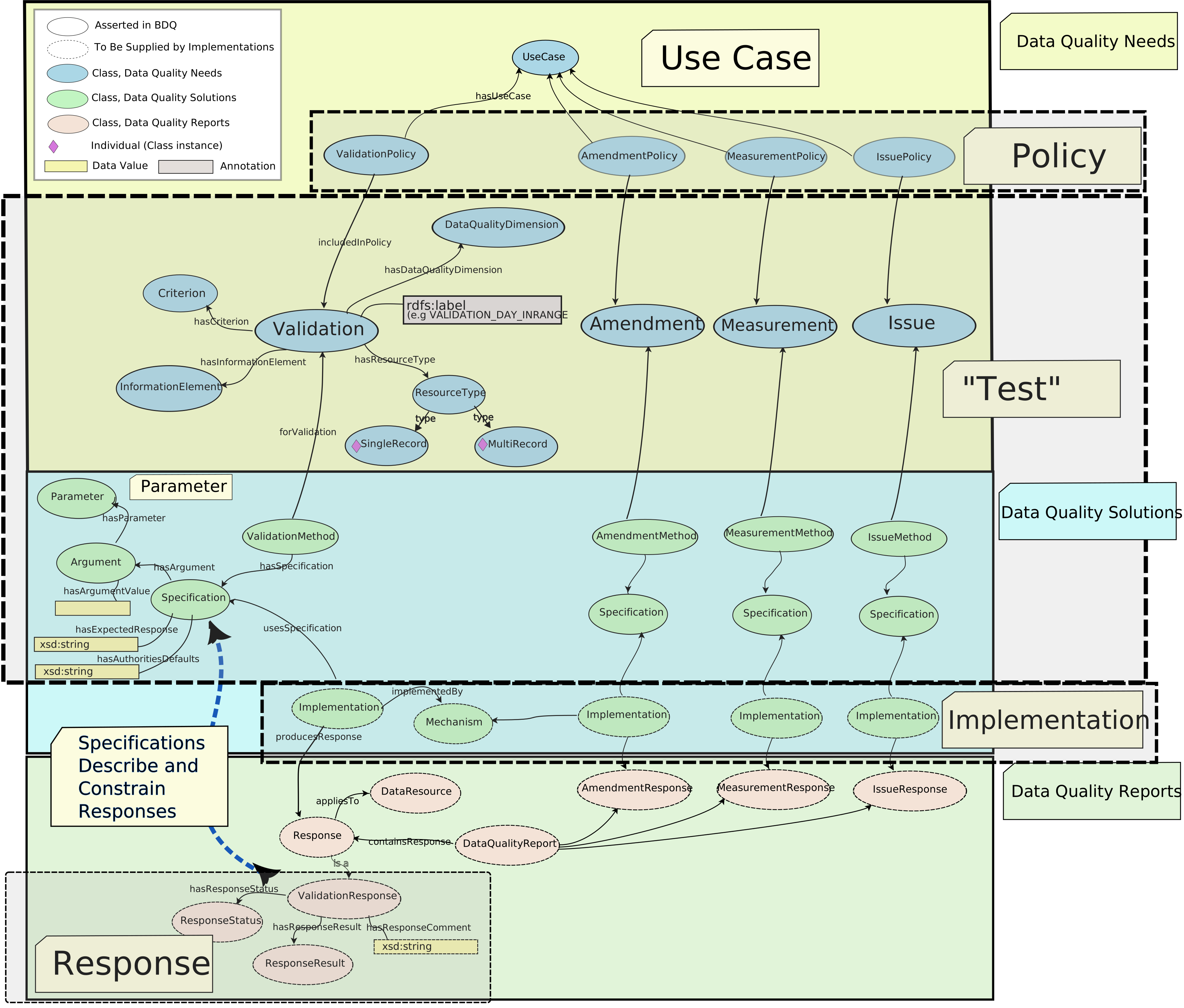
This section defines the capitalized term "Test" as used in the BDQ standard and how it is constructed within the Fitness-for-Use framework. We use the capitalized term "Test" to mean something specific in the BDQ Standard. A Test is any instance of a subclass of bdqffdq:DataQualityNeed (e.g., bdqffdq:Validation) composed with an instance of a subclass of bdqffdq:Method (e.g., bdqffdq:ValidationMethod) composed with an instance of bdqffdq:Specification. When run by a bdqffdq:Implementation, each BDQ Test can produce a bdqffdq:DataQualityReport consisting of bdqffdq:Responses. See the diagram in BDQ Tests: An Operational Perspective below.
The scope of each BDQ Test is largely provided by the properties of a bdqffdq:Specification. The Darwin Core Terms (Darwin Core Maintenance Group 2021) used in the specification are included in the Information Elements (bdqffdq:InformationElement). The specification also includes references to external authorities (external to the Test specification, and usually also external to the Darwin Core standard, Wieczorek et al. 2012) that are required to implement the Test, for example, references to an ISO standard or a GBIF maintained controlled vocabulary. Such authoritative references are listed under sourceAuthority (bdqval:sourceAuthority) with a link to the authority and optionally, a link to a specific online resource required for the implementation of the Test.
Each BDQ Test is defined to operate on a Single Record or a Multi Record. The Framework allows Multi Record Tests to take data as input, for example to identify outliers within a dataset, or for Multi Record Tests that take the output of Single Record Tests as their input to provide an assessment of quality across the dataset. No BDQ Multi Record Tests have been defined to take data as input (but such could be defined). No BDQ Single Record Tests have been defined to use data in other records within a dataset to evaluate the quality of data in a Single Record (but such could be defined). The only Multi Record Tests included in BDQ accumulate the outputs of other Tests.
2.1.1 Conceptual map: how BDQ uses the term "Test" (non-normative)
In BDQ, a Test is described using the Fitness For Use Framework (bdqffdq:) and can be understood as a vertical concept family that connects three layers: Data Quality Needs (what "fit for use" means for a Use Case), Data Quality Solutions (how a Need is evaluated via a Specification implemented in a Mechanism), and Data Quality Reports (the resulting Responses). The BDQ Tests vocabulary (bdqtest:) provides standardized descriptors for each Test, while the Framework vocabulary (bdqffdq:) provides the conceptual model that relates Use Case, Policy, Specification, Implementation, and Response.
2.2 Use Cases (non-normative)
BDQ Tests are designed to be applied in the context of particular uses of data. The BDQ standard defines a set of Use Cases that represent common uses of biodiversity data. Each Use Case is associated with one or more Tests that can be used to evaluate whether data meet that need. By applying the appropriate Tests for a given Use Case, users can assess the fitness of their data for that particular use and identify areas for improvement.
BDQ initially defines four Use Cases. Some of these use cases were based on the work of Data Quality Task Group 3 (Data Quality Use Cases). The BDQ Tests can only relate to the concept of ‘quality’ as a consequence of their application to a specific use case. The four use cases included in the BDQ standard were intended to cover a range of applications that were considered in common use, but they are far from comprehensive. The use cases were intended as a template or guide for those who may want to generate other use cases for their environments. See Section 8 Creating New Use Cases and see the Tutorial for a step-by-step example of how to define a Use Case and select appropriate Tests for that Use Case.
The initial BDQ Use Cases are:
- bdquc:Alien-Species (Included Tests)
- bdquc:Spatial-Temporal_Patterns (Included Tests)
- bdquc:Species-Distribution-Modeling-Trees (Included Tests)
- bdquc:Taxon-Management (Included Tests)
Under the principle that data has quality only with respect to use, each of the BDQ Tests is allocated to at least one Use Case. Note that there is a many-to-many relationship here: One BDQ Test can be in multiple Use Cases and one Use Case may have many associated BDQ Tests, with Policies relating Tests to Use Cases. See Compliance depends on Use Case in the Implementer's Guide for further explanation.
3 Test Types (non-normative)
The concept of "Test" in the context of BDQ include four distinct types: Validation (bdqffdq:Validation); Issue (bdqffdq:Issue); Amendment (bdqffdq:Amendment) and Measure (bdqffdq:Measure).
A Response serves as the formal output of a Test and consists of three primary components: Response.status, Response.result and Response.comment See Structure of Response (normative).
3.1 Validation Tests (normative)
Each Validation Test is composed of an instance of bdqffdq:Validation (which expresses a data quality need in the abstract) with an instance of bdqffdq:ValidationMethod linking it to an instance of a bdqffdq:Specification (which gives details of how that data quality need is to be concretely assessed).
The response of a Validation Test (i.e., an instance of a bdqffdq:ValidationResponse) MUST take one of three forms.
- A
Response.statusof "EXTERNAL_PREREQUISITES_NOT_MET" when an external resource (e.g., a bdqval:sourceAuthority) is unavailable. Running the same Test on the same data at a different time may result in a different result. In this case, the Response.result MUST be empty. - A
Response.statusof "INTERNAL_PREREQUISITES_NOT_MET" when the values of one or more of theInformation Elements(bdqffdq:InformationElement) are such that the Test cannot be meaningfully run. In this case, the Response.result MUST be empty. - A
Response.statusof "RUN_HAS_RESULT" when the prerequisites for running the Test have been met, and in this situation:- A
Response.resultof either "COMPLIANT" if the values of theInformation Elements(bdqffdq:InformationElement) meet theCriteria, or "NOT_COMPLIANT" if they do not.
- A
In each case, a Response.comment MUST be present with text explaining to consumers of the Data Quality Report why the Test produced this response in this case.
3.2 Issue Tests (normative)
Each Issue Test is composed of an instance of bdqffdq:Issue (which expresses a data quality need in the abstract) with an instance of bdqffdq:IssueMethod, which links it to an instance of a bdqffdq:Specification (which gives details of how that data quality need is to be concretely assessed).
Issue Tests are a form of warning flag where the Test is drawing attention to potential problem with the value of an Information Element for at least one use of the data.
We have used Issue Tests for a small number of cases where we wished to flag a value that might indicate a record is not fit for some purpose, but the evaluation of these cases would take human review. For example, the Test ISSUE_ANNOTATION_NOTEMPTY is informing the tester than there is at least one annotation associated with a record and this should be evaluated before using the record. Similarly for the two Issue Tests
where some form of transformation has occurred: ISSUE_DATAGENERALIZATIONS_NOTEMPTY, and for the Test ISSUE_ESTABLISHMENTMEANS_NOTEMPTY where the value needs to be assessed for utility and the Test ISSUE_COORDINATES_CENTEROFCOUNTRY which signals a likely high uncertainty for a georeference.
The response of an Issue Test (an instance of a bdqffdq:IssueResponse) MUST take one of three forms.
- A
Response.statusof "EXTERNAL_PREREQUISITES_NOT_MET" when an external resource (e.g., abdqval:sourceAuthority) is unavailable. Running the same Test on the same data at a different time may result in a different result. In this case, theResponse.resultMUST be empty. - A
Response.statusof "INTERNAL_PREREQUISITES_NOT_MET" when the values of one or more of theInformation Elementsare such that the Test cannot be meaningfully run. In this case, theResponse.resultMUST be empty. - A
Response.statusof "RUN_HAS_RESULT" when the prerequisites for running the Test have been met, and in this case:- A
Response.result="POTENTIAL_ISSUE", aResponse.result="NOT_ISSUE", or aResponse.result="IS_ISSUE".
- A
In each case, a Response.comment MUST be present with text explaining to consumers of the Data Quality Report why the Test produced this response in this case.
None of the initially defined BDQ Issue Tests return a Response.result of IS_ISSUE.
3.3 Measure Tests (normative)
Each Measure Test is composed of an instance of bdqffdq:Measure (which expresses how to measure fitness of data for a data quality need in the abstract) with an instance of bdqffdq:MeasurementMethod, which links it to an instance of a bdqffdq:Specification (which gives details of how that data quality is to be measured).
Measure Tests return a Response.result of either a numeric value or one of the values "COMPLETE" or "NOT_COMPLETE". Measure Tests may directly measure properties of data. Alternatively, Measure Tests may measure the outputs of other Tests, for example, a Measure may count the number of Response.results from all COMPLIANT Validation Tests run on a bdqffdq:SingleRecord.
The only Measure defined in the initial BDQ standard that directly examines data is the Test MEASURE_EVENTDATE_DURATIONINSECONDS. This Test returns a Response.result measuring the amount of time represented by the value in dwc:eventDate, and can be used in Quality Assurance under specific research Data Quality Needs to identify dwc:Occurrences where the date observed or collected is known well enough for particular analytical needs (e.g., to at least one day for phenology studies, to at least one year for other purposes). The Test basically interprets the results of running the Validation and Amendment Tests and provides an indication of the length of the period of the value of dwc:eventDate.
Most Single Record Measure Tests defined in the BDQ standard count the number of Validation or Amendment Tests with a specified Response.result from a Single Record Test.
The response of a Measure Test (an instance of a bdqffdq:MeasurementResponse) MUST take one of three forms.
- A
Response.statusof "EXTERNAL_PREREQUISITES_NOT_MET" when an external resource (e.g., abdqval:sourceAuthority) is unavailable. Running the same Test on the same data at a different time may result in a different result. In this case, theResponse.resultMUST be empty. - A
Response.statusof "INTERNAL_PREREQUISITES_NOT_MET" when the values of one or more of theInformation Elementsare such that the Test cannot be meaningfully run. In this case, theResponse.resultMUST be empty. - A
Response.statusof "RUN_HAS_RESULT" when the prerequisites for running the Test have been met, and in this case either:- a
Response.result="COMPLETE", or aResponse.result="NOT_COMPLETE". or - a
Response.resultcontaining a single number.
- a
In each case, a Response.comment MUST be present with text explaining to consumers of the Data Quality Report why the Test produced this response in this case.
3.4 Amendment Tests (normative)
Each Amendment Test is composed of an instance of bdqffdq:Amendment (which expresses how to improve data to fit a data quality need in the abstract) with an instance of bdqffdq:AmendmentMethod, which links it to an instance of a bdqffdq:Specification (which gives details of how proposals could be made to improve data for that need).
An Amendment Test MAY propose a change to one or more Darwin Core term values, or MAY propose to fill in missing values. The Response produced by an Amendment is intended to improve one or more components of the quality of the record. The Response.result from an Amendment MUST always be treated as a proposal for a change, and MUST NOT be blindly applied to a database of record when a Data Quality Report is used for Quality Control of an existing database of record. Consumers of Data Quality Reports under Quality Assurance uses MAY choose to accept all proposed Amendments as part of a pipeline in preparing data for an analysis. Amendments, under the Fitness For Use Framework, may also propose changes to procedures rather than to data values, we have not framed any in this form in the BDQ Tests at the time of first release.
The response of an Amendment Test (an instance of a bdqffdq:AmendmentResponse) MUST take one of four forms.
- A
Response.statusof "EXTERNAL_PREREQUISITES_NOT_MET" when an external resource (e.g.,bdqval:sourceAuthority) is unavailable. Running the same Test on the same data at a different time may result in a different result. In this case, the Response.result MUST be empty. - A
Response.statusof "INTERNAL_PREREQUISITES_NOT_MET" when the values of one or more of theInformation Elementsare such that the Test cannot be meaningfully run. In this case, the Response.result MUST be empty. - A
Response.statusof "FILLED_IN" when the prerequisites for running the Test have been met and a proposal is made to fill in a value for one or more input terms that wereEmpty, and in this situation:- A
Response.resultcontaining a list of key-value pairs of the terms for which values are to be filled in, and the proposed new values for those terms.
- A
- A
Response.statusof "AMENDED" when the prerequisites for running the Test have been met and a proposal is made to change a value for one or more input terms that were Empty, and in this situation:- A
Response.resultcontaining a list of key-value pairs of the terms for which new values are proposed, and the proposed new values for those terms.
- A
In each case, a Response.comment MUST be present with text explaining to consumers of the Data Quality Report why the Test produced this response in this case.
3.5 Single Record and Multi Record Tests (non-normative)
Tests may operate on a Single Record (e.g., one row of Simple Darwin Core) or on a Multi Record (a dataset).
The BDQ Fitness For Use Framework allows for Tests of all types to operate on either (bdqffdq:hasResourceType) Single Record or Multi Record. In the BDQ standard, the only Multi Record Tests that have been defined are Measures. We refer to these as Multi Record Measures (instances of bdqffdq:Measure that are the subject of a bdqffdq:hasResourceType property whose object is bdqffdq:MultiRecord).
The focus of the BDQ Tests are the Single Record Tests. To allow for standard means for summarizing the results of these Tests, and for filtering data under Quality Assurance, we have also defined two sets of Multi Record Measures.
In the BDQ standard, for each Single Record Validation Test, we have defined a Multi Record Measure Test that returns a Response.result="COMPLETE" when all records in the Multi Record have a Response.result="COMPLIANT", and a Response.result="NOT_COMPLETE" when they are not. Under Quality Assurance, these Measure Tests are the key criterion for identifying data that have quality for a Use Case. Under Quality Assurance, a Multi Record is filtered to remove records that do not fit the Multi Record Measure Tests for completeness, such that a filtered Multi Record has Response.result="COMPLETE" for all Multi Record Measure Tests.
In the BDQ standard, for each Single Record Validation Test, we have also defined a Multi Record Measure Test that returns a Response.result counting the number of Response.results from that Validation Test that are COMPLIANT (or in a few cases, COMPLIANT or INTERNAL_PREREQUISITES_NOT_MET). Under Quality Control, these Multi Record Measures allow calculation of how much the quality of a dataset would be improved by accepting changes proposed by Amendments, and allow identification of areas in the data where quality improvement is most needed to fit the needs of some Use Case.
See the Fitness For Use Framework Summary of Mathematical Formalization (normative) for the formal expression of how Measures are intended to be used in Quality Control and Quality Assurance, and User's Guide section 2 Context for Quality, Uses and Purposes (non-normative) for a further explanation.
4 Use of Terms (normative)
The technical (normative) details of the BDQ Test terms (those in the bdqtest: namespace) are found in the BDQ Tests List of Terms.
The technical definitions of the bdqtest: terms are supported by terms in several additional namespaces in the BDQ standard, namely bdqval:, bdquc, bdqffdq:, bdqdim:, bdqenh:, and bdqcrit:. For the details and rationale, see Chapman et al. (2017).
| Abbreviation | Technical List of Terms |
|---|---|
| bdqval: | BDQ Controlled Vocabulary List of Terms |
| bdquc: | BDQ Use Case Controlled Vocabulary |
| bdqtest: | BDQ Tests List of Terms |
| bdqcrit: | Data Quality Criterion Controlled Vocabulary List of Terms |
| bdqdim: | Data Quality Dimension Controlled Vocabulary List of Terms |
| bdqenh: | Data Quality Enhancement Controlled Vocabulary List of Terms |
| bdqffdq: | Fitness For Use Framework Ontology List of Terms |
4.1 Structure of Response (normative)
Output from each of the Tests MUST be structured data, and MUST NOT be simple pass/fail flags. The output from a Test is a Response, which can form part of a Data Quality Report or be wrapped in an Annotation, and MUST include the following three components:
Response.resultis the returned result for the Test, i.e., a strictly controlled vocabulary value (consisting of "COMPLIANT" or "NOT_COMPLIANT" only) forValidationTests; a strictly controlled vocabulary value ("NOT_ISSUE" or "POTENTIAL_ISSUE" only) forIssueTests; a numeric value or a strictly controlled vocabulary value (consisting of exactly "COMPLETE" or "NOT_COMPLETE" forMeasureTests; and a data structure (e.g., a list of key value pairs) for proposed changes forAmendmentTests.Response.statusprovides a controlled vocabulary, metadata concerning the success, failure, or problems with the Test. The Status also serves as a link to information about warning type values and where, with future development, probabilistic assertions about the likeliness of the value could be made.Response.commentsupplies human-readable text describing reasons for the Test result output.
A Response MUST be represented as either RDF or as a data structure.
When responses are in the form of RDF, the RDF MUST meet the following conditions:
- The
ResponseMUST be an instance of bdqffdq:Response or one of its subclasses (bdqffdq:ValidationResponse, bdqffdq:IssueResponse, bdqffdq:MeasurementResponse, bdqffdq:AmendmentResponse). An instance of a subclass ofbdqffdq:ResponseSHOULD be used. - The
ResponseMUST have exactly one bdqffdq:hasResponseStatus object property linking it to one of the named individuals that has type bdqffdq:ResponseStatus (bdqffdq:INTERNAL_PREREQUISITES_NOT_MET, bdqffdq:EXTERNAL_PREREQUISITES_NOT_MET, bdqffdq:NOT_AMENDED, bdqffdq:AMENDED, bdqffdq:FILLED_IN, or bdqffdq:RUN_HAS_RESULT). - The
ResponseMUST have a bdqffdq:hasResponseResult object property or bdqffdq:hasResponseResultValue data property, unless the object of thebdqffdq:hasResponseStatusindicates that none should be present.- If the object of the
bdqffdq:hasResponseStatusisbdqffdq:RUN_HAS_RESULT, then the instance of theResponseMUST have one and only onebdqffdq:hasResponseResultobject property linking it to one of the named individuals that has type bdqffdq:ResponseResult (bdqffdq:COMPLETE, bdqffdq:COMPLIANT, bdqffdq:IS_ISSUE, bdqffdq:NOT_COMPLETE, bdqffdq:NOT_COMPLIANT, bdqffdq:NOT_ISSUE, or bdqffdq:POTENTIAL_ISSUE).- Unless the
bdqffdq:Responseis abdqffdq:MeasurementResponsethat returns a numeric value, in which case theResponseMUST have one and only onebdqffdq:hasResponseResultValuedata property linking it to a numeric value.
- Unless the
- If the object of the
bdqffdq:hasResponseStatusis one ofbdqffdq:AMENDEDorbdqffdq:FILLED_IN, then the instance of theResponseMUST have one and only onebdqffdq:hasResponseResultValuedata property linking it to structured data presenting the result of theAmendment. The string in thebdqffdq:hasResponseResultValueSHOULD be a JSON list of key:value pairs, where the keys are specificInformation Elements(e.g.,dwc:eventDate), and the values are the new values proposed by theAmendment. - If the object of the
bdqffdq:hasResponseStatusis one ofbdqffdq:INTERNAL_PREREQUISITES_NOT_MET,bdqffdq:EXTERNAL_PREREQUISITES_NOT_MET,bdqffdq:NOT_AMENDED, then nobdqffdq:hasResponseResultSHOULD be present.
- If the object of the
- The
ResponseMUST have at least one bdqffdq:hasResponseComment data property. Thisbdqffdq:hasResponseCommentmust provide a human readable text explanation of why the conclusion expressed in theResponsewas reached. Thebdqffdq:hasResponseCommentMAY be repeated to provide the comment in different languages. Eachbdqffdq:hasResponseCommentSHOULD be a independent and complete explanation. - The
ResponseMAY have a bdqffdq:hasResponseQualifier object property.
When the Response is represented as a data structure in a form other than RDF, the data structure MUST:
- Have properties corresponding to
Response.status,Response.result, andResponse.comment. These properties SHOULD have these labels. - Have one
Response.statusproperty, containing a string constant that MUST be one of the local names of one of the named individuals inbdqffdq:with a typebdqffdq:ResponseStatus("INTERNAL_PREREQUISITES_NOT_MET", "EXTERNAL_PREREQUISITES_NOT_MET", "NOT_AMENDED", "AMENDED", "FILLED_IN", or "RUN_HAS_RESULT""). - Have one
Response.resultproperty.- If the
Response.statusis "RUN_HAS_RESULT" then the value of theResponse.resultproperty MUST be a string constant that is one of the local names of one of the named individuals of typebdqffdq:ResponseResult("COMPLETE", "COMPLIANT", "IS_ISSUE", "NOT_COMPLETE", "NOT_COMPLIANT", "NOT_ISSUE", or "POTENTIAL_ISSUE").- Unless the
Responseis from aMeasureTest that returns a numeric value, in which case the value of theResponse.resultproperty MUST be a numeric value.
- Unless the
- If the
Response.statusis one of "AMENDED" or "FILLED_IN" then the value of theResponse.resultproperty MUST be structured data presenting the result of theAmendment. The string in theResponse.resultSHOULD be a JSON list of key:value pairs, where the keys are specificInformation Elements(e.g.,dwc:eventDate), and the values are the new values proposed by theAmendment. - If the
Response.statusis one of "INTERNAL_PREREQUISITES_NOT_MET", "EXTERNAL_PREREQUISITES_NOT_MET", or "NOT_AMENDED", then theResponse.resultMUST be empty or null.
- If the
- Have one
Response.commentproperty. ThisResponse.commentmust provide a human readable text explanation of why the conclusion expressed in theResponsewas reached. Internationalization of content of theResponse.commentMAY be provided, nothing in this section should be taken as a constraint on how that may be accomplished. - A
Response.qualifierproperty may be included to provide additional information.
Nothing in this section should be taken as:
- constraining how
Data Quality Reportsare presented to consumers of those reports, so long as all three elements ofResponse.result,Response.status, andResponse.commentcan be accessed. - constraining internationalization and languages of labels applied to human readable presentations of Responses from Tests.
- a requirement for a particular format or serialization of
bdqffdq:Responses. Implementations MAY serializeResponsesin any appropriate form for the context. WhenResponsesare wrapped inoa:Annotationsor presented as linked open data, an RDF representation SHOULD be used. - a requirement to how
bdqffdq:Responsesare to be presented to consumers ofData Quality Reports. Implementations MAY present the results of Tests in any form appropriate for their consumers, so long as none of the required information is suppressed.
4.2 Resource Types (normative)
Tests operate on data. Data may be understood as representing a single record or multiple records. Each BDQ Test is defined to apply to one or the other, not both.
A Single Record (bdqffdq:SingleRecord) BDQ Test:
- MAY be applied to a single Simple Darwin Core record,
- MAY be applied to a single instance of a Darwin Core
dwc:Occurrence,dwc:Taxon,dwc:Event, or other class, - MAY extend across one to many relations from that class instance to instances of classes of other types in a structured representation of Darwin Core data (Wieczorek et al. 2012).
- For example, input Darwin Core data in RDF should be presented to a BDQ
Single RecordTest onedwc:Occurrenceat a time, although thedwc:Occurrencecould be linked to multiple other instances of other classes such asdwc:Identifications. - Handling of multiplicity of related rows in a
Single Recordis a responsibility of Test execution frameworks. - See the disscussion of
Single Recordin relation to the Darwin Core Data Package (Dawin Core Maintinance Group, 2026) format below.
- For example, input Darwin Core data in RDF should be presented to a BDQ
- SHOULD NOT take multiple rows from a flat file (e.g. Simple Darwin Core) as input.
- SHOULD NOT take multiple objects of the same core type in structured Darwin Core as input
The BDQ Test ISSUE_ANNOTATION_NOTEMPTY similarly operates on a single Simple Darwin Core record, or a single core Darwin Core class instance, and asks whether Annotations exist related to that class, here this standard encourages the implementation of a standard for annotating dwc:Occurrence records beyond the Darwin Core Terms (Darwin Core Maintenance Group 2021).
BDQ Multi Record (bdqffdq:MultiRecord) Tests operate on a dataset as a whole. The initial BDQ Multi Record Tests in bdqtest: sum up results across all records for each bdqffdq:SingleRecord Test.
4.2.1 Single Record in Darwin Core Data Package (normative)
While BDQ is independent of data encodings such as Darwin Core, we illustrate a basic principle here using the Darwin Core Data Package (DwC-DP) as an example. DwC-DP data are represented as a set of normalized, interrelated tables rather than as discrete, self-contained records. As a consequence, the concept of a “Single Record” for the purposes of Biodiversity Data Quality (BDQ) Tests does not correspond directly to a single row in any table. Instead, a Single Record in a DwC-DP context SHOULD be understood as a derived record view, constructed as a projection (view) over the relational structure of the data package.
4.2.1.1 Definition of Single Record View (normative)
A Single Record view is defined by four elements:
-
A focal entity instance
A single row identified by its primary key in a specified table (e.g., occurrence, event, material). -
A traversal specification
A defined set of relationships (foreign keys) that determine which related tables may be consulted to obtain additional values. -
A term mapping
A mapping from Darwin Core terms (e.g.,dwc:country,dwc:eventDate,dwc:scientificName) to fields in the focal table or in related tables reachable through the traversal. -
A multiplicity resolution strategy
A deterministic rule for handling cases in which traversal yields multiple related rows for a given term.
The result of applying these elements is a denormalized, record-shaped set of Information Elements that serves as input to a BDQ Test.
4.2.1.2 Interpretation for BDQ Tests (non-normative)
For a BDQ Single Record Test:
- The unit of evaluation is the Single Record view, not an individual row.
- The Information Elements are the values obtained through the term mapping applied to the focal entity and any traversed relationships.
- The DwC-DP serves as the source graph, while the Single Record view is a derived representation used solely for test execution.
- The derived Single Record view is the object of a bdqffdq:appliesTo property of a
bdqffdq:Responseresulting from aSingle RecordTest.
4.2.1.3 Handling of Multiplicity (normative)
Multiplicity arises when a focal entity is related to more than one row in a linked table (e.g., a dwc:Occurrence with multiple dwc:Identifications).
Implementations MUST define a deterministic strategy for handling such cases.
Example strategies include:
-
Selection (cardinality reduction)
Selecting a single related row based on a defined criterion (e.g., most recent, preferred flag, most specific, etc.). -
Expansion (record multiplication)
Generating multiple Single Record instances, each incorporating one of the related rows, and executing the Test independently on each view.
The chosen strategy MUST be explicitly documented and consistently applied, as it directly affects Test outcomes and reproducibility.
4.2.1.4 Implications and Summary (non-normative)
- A DwC-DP does not inherently define “records” suitable for BDQ
Single RecordTests; such records are constructed. - Different traversal or multiplicity strategies may yield different
Single Recordview instances from the same underlying data; therefore, test results are only comparable when these strategies are aligned. - Test execution frameworks are responsible for defining and enforcing the rules that produce Single Record views.
A BDQ Single Record Test over a DwC-DP operates on a deterministically defined, denormalized projection of the relational data model. The correctness, reproducibility, and interpretability of test results depend on explicit definitions of focal entities, relationship traversal, term mapping, and multiplicity handling.
4.3 Parameterizing the Tests (normative)
Where a Test is parameterized, a Parameter (e.g., bdqval:sourceAuthority) is specified in the text of the bdqffdq:hasExpectedResponse data type property of the instance of the bdqffdq:Specification for the Test. Such a bdqffdq:Specification MUST also have a bdqffdq:hasArgument object property linking it to an instance of a bdqffdq:Argument, which MUST have a bdqffdq:hasArgumentValue data type property carrying the default value for the Parameter, and this bdqffdq:Argument MUST have a bdqffdq:hasParameter object property linking it to a bdqffdq:Parameter. The bdqffdq:Parameter SHOULD be a class instance in the bdqval: namespace (e.g., bdqval:sourceAuthority).
An instance of the bdqffdq:Specification SHOULD have a bdqffdq:hasAuthoritiesDefaults data type property containing the parameters, default values, and references to resources, including API endpoints that would provide access to values in the authority.
These elements MUST be understood in concert.
Values of bdqffdq:hasAuthoritiesDefaults SHOULD be a text string listing Parameters in the form of a semicolon-delimited list of one or more of the following:
- parameter default = "default value"
- parameter default = "default value" {[resource]}
- parameter default = "default value" {[resource]} {API endpoint [resource]}
4.3.1 There can be a Source Authority without a Parameter (normative)
The bdqffdq:hasAuthoritiesDefaults data property MAY be used without corresponding bdqffdq:Arguments and bdqffdq:Parameters when a Test is not parameterized, but a bdqval:sourceAuthority is mentioned within a bdqffdq:hasExpectedResponse for the bdqffdq:Specification and the bdqffdq:hasAuthoritiesDefaults provides details on this sourceAuthority. This usage allows for simpler and easier-to-read expected responses.
4.3.2 Explaining Source Authorities without a Parameter (non-normative)
If there is only one source authority, it does not make sense to make the Test parameterized, but it is still important for clarity to be explicit about what that source authority is, and to provide details about it. In this case, the bdqffdq:hasAuthoritiesDefaults data property can be used to provide this information without the need for a parameter and argument.
For example: AMENDMENT_DCTYPE_STANDARDIZED has the following values for Expected Response (hasExpectedResponse) and Source Authorities/Defaults (hasAuthoritiesDefaults):
EXTERNAL_PREREQUISITES_NOT_MET if the bdqval:sourceAuthority is not available; INTERNAL_PREREQUISITES_NOT_MET if the value of dc:type is bdqval:Empty; AMENDED the value of dc:type if it can be unambiguously interpreted as a term name in the bdqval:sourceAuthority; otherwise NOT_AMENDEDbdqval:sourceAuthority = "DCMI Type Vocabulary" {[http://purl.org/dc/terms/DCMIType]} {"DCMI Type Vocabulary List of Terms" [https://www.dublincore.org/specifications/dublin-core/dcmi-type-vocabulary/2010-10-11/]}
AMENDMENT_DCTYPE_STANDARDIZED does not take a Parameter for the source authority, because there is only one source authority for the DCMI Type Vocabulary. However, it is still important to be explicit about what that source authority is, and to provide details about it. Placing this information in (by convention) structured form in bdqffdq:hasAuthoritiesDefaults rather than in the hasExpectedResponse allows for clearer and more readable expected responses, and allows for the information about the source authority to be more easily extracted and used by implementations.
Section 2.3.2 Reading a Specification (non-normative) of the BDQ Implementer's Guide contains additional guidance for handling parameters in BDQ Test implementations.
4.3.3 Parameter Examples (non-normative)
Example values for bdqffdq:hasAuthoritiesDefaults:
     bdqval:earliestValidDate default ="1582-11-15"

     bdqval:sourceAuthority default = "GBIF Backbone Taxonomy" {[https://doi.org/10.15468/39omei]} {API endpoint [https://api.gbif.org/v1/species?datasetKey=d7dddbf4-2cf0-4f39-9b2a-bb099caae36c&name=]}
Example RDF fragment showing use of Arguments and bdqffdq:hasAuthoritiesDefaults:
<rdf:Description rdf:about="urn:uuid:f41be58e-2e1e-409e-a322-1de95df2ce0b">
<rdf:type rdf:resource="https://rs.tdwg.org/bdqffdq/terms/Argument"/>
<rdfs:label>Default value for bdqval:maximumValidDepthInMeters:"11000"</rdfs:label>
<bdqffdq:hasArgumentValue>11000</bdqffdq:hasArgumentValue>
<bdqffdq:hasParameter rdf:resource="https://rs.tdwg.org/bdqval/terms/maximumValidDepthInMeters"/>
</rdf:Description>
<rdf:Description rdf:about="urn:uuid:edf69c59-056d-4c8a-b1fb-647ea684eb18">
<rdf:type rdf:resource="https://rs.tdwg.org/bdqffdq/terms/Argument"/>
<rdfs:label>Default value for bdqval:minimumValidDepthInMeters:"0"</rdfs:label>
<bdqffdq:hasArgumentValue>0</bdqffdq:hasArgumentValue>
<bdqffdq:hasParameter rdf:resource="https://rs.tdwg.org/bdqval/terms/minimumValidDepthInMeters"/>
</rdf:Description>
<rdf:Description rdf:about="urn:uuid:cebc8ba0-ca02-4f1e-830e-ec693bc628e4">
<rdf:type rdf:resource="https://rs.tdwg.org/bdqffdq/terms/Specification"/>
<rdfs:label>Specification for: VALIDATION_MAXDEPTH_INRANGE</rdfs:label>
<dcterms:description>INTERNAL_PREREQUISITES_NOT_MET if dwc:maximumDepthInMeters is bdqval:Empty or is not interpretable as a number greater than or equal to zero; COMPLIANT if the value of dwc:maximumDepthInMeters is within the range of bdqval:minimumValidDepthInMeters to bdqval:maximumValidDepthInMeters inclusive; otherwise NOT_COMPLIANT bdqval:minimumValidDepthInMeters default="0",bdqval:maximumValidDepthInMeters default="11000"</dcterms:description>
<skos:example>dwc:maximumDepthInMeters="1200": Response.status=RUN_HAS_RESULT, Response.result=COMPLIANT, Response.comment="dwc:maximumDepthInMeters is in range (<11,000)"</skos:example>
<skos:example>dwc:maximumDepthInMeters="99999": Response.status=RUN_HAS_RESULT, Response.result=NOT_COMPLIANT, Response.comment="dwc:maximumDepthInMeters is not in range (>11,000)"</skos:example>
<bdqffdq:hasArgument rdf:resource="urn:uuid:edf69c59-056d-4c8a-b1fb-647ea684eb18"/>
<bdqffdq:hasArgument rdf:resource="urn:uuid:f41be58e-2e1e-409e-a322-1de95df2ce0b"/>
<bdqffdq:hasAuthoritiesDefaults>bdqval:minimumValidDepthInMeters default="0",bdqval:maximumValidDepthInMeters default="11000"</bdqffdq:hasAuthoritiesDefaults>
<bdqffdq:hasExpectedResponse>INTERNAL_PREREQUISITES_NOT_MET if dwc:maximumDepthInMeters is bdqval:Empty or is not interpretable as a number greater than or equal to zero; COMPLIANT if the value of dwc:maximumDepthInMeters is within the range of bdqval:minimumValidDepthInMeters to bdqval:maximumValidDepthInMeters inclusive; otherwise NOT_COMPLIANT</bdqffdq:hasExpectedResponse>
</rdf:Description>
Example RDF Fragment showing the Specification for VALIDATION_COUNTRYCODE_STANDARD, where bdqffdq:hasAuthoritiesDefaults is present to provide a bdqval:sourceAuthority for the Specification, but the Test is not parameterized, so no bdqffdq:hasArgument properties are present:
<rdf:Description rdf:about="urn:uuid:01b96157-e4a1-4884-95d7-3bcfc5f3c047">
    <rdf:type rdf:resource="https://rs.tdwg.org/bdqffdq/terms/Specification"/>
    <rdfs:label>Specification for: VALIDATION_COUNTRYCODE_STANDARD</rdfs:label>
    <dcterms:description>EXTERNAL_PREREQUISITES_NOT_MET if the bdqval:sourceAuthority is not available; INTERNAL_PREREQUISITES_NOT_MET if the dwc:countryCode is bdqval:Empty; COMPLIANT if dwc:countryCode can be unambiguously interpreted as a valid ISO 3166-1-alpha-2 country code in the bdqval:sourceAuthority; otherwise NOT_COMPLIANT bdqval:sourceAuthority default = "ISO 3166 Country Codes" {[https://www.iso.org/iso-3166-country-codes.html]} {ISO 3166-1-alpha-2 Country Code search [https://www.iso.org/obp/ui/#search]}</dcterms:description>
    <skos:example>dwc:countryCode="GL": Response.status=RUN_HAS_RESULT, Response.result=COMPLIANT, Response.comment="dwc:countryCode is a valid ISO (ISO 3166-1-alpha-2 country codes) value"</skos:example>
    <skos:example>dwc:countryCode="GRL": Response.status=RUN_HAS_RESULT, Response.result=NOT_COMPLIANT, Response.comment="dwc:countryCode is NOT a valid ISO (ISO 3166-1-alpha-2 country codes) value"</skos:example>
    <bdqffdq:hasAuthoritiesDefaults>bdqval:sourceAuthority default = "ISO 3166 Country Codes" {[https://www.iso.org/iso-3166-country-codes.html]} {ISO 3166-1-alpha-2 Country Code search [https://www.iso.org/obp/ui/#search]}</bdqffdq:hasAuthoritiesDefaults>
    <bdqffdq:hasExpectedResponse>EXTERNAL_PREREQUISITES_NOT_MET if the bdqval:sourceAuthority is not available; INTERNAL_PREREQUISITES_NOT_MET if the dwc:countryCode is bdqval:Empty; COMPLIANT if dwc:countryCode can be unambiguously interpreted as a valid ISO 3166-1-alpha-2 country code in the bdqval:sourceAuthority; otherwise NOT_COMPLIANT</bdqffdq:hasExpectedResponse></rdf:Description>
5 Design of the Tests (normative)
BDQ Tests are designed with a clear boundary of responsibility: they take a defined set of input Information Elements (and optional Parameters) and return a structured Response describing the outcome. This standardization of inputs and outputs means a Test implementation can be treated as a small, self-contained component whose behavior is determined by its Specification and is consistent across programming languages and environments. The surrounding execution framework is responsible for obtaining and binding raw data to the required Information Elements, selecting which Tests to run (e.g., by Use Case via Policies), and assembling the resulting Responses into Data Quality Reports. In this way, BDQ separates the semantics of Test behavior (what is evaluated and how results are expressed) from the mechanics of test execution (how data are accessed, orchestrated, filtered, and reported).
5.1 BDQ Tests: An Operational Perspective (non-normative)
A Test is a defined evaluation that takes specific inputs and produces a structured output. A Test is defined using a set of bdqffdq: classes and properties that specify the inputs to the Test (the relevant Information Elements and any Parameters) and how those input values are to be evaluated under a Specification to produce a structured output (a Response) that can be interpreted consistently across implementations. The Test definitions are provided in the bdqtest: vocabulary, and the semantics of the terms used in those definitions are provided by the bdqffdq: vocabulary and supporting vocabularies.
This section explains how Tests are expressed in BDQ vocabularies and how they behave when executed by an implementation. A Test is not a software implementation; it is a formal definition of an evaluation that can be implemented in software. In the Fitness For Use Framework, each Test is an instance of a subtype of Data Quality Need that identifies what is being evaluated (through its required Information Elements and its Resource Type) and why it matters (through its association with one or more Use Cases via Policies). The Test is linked to a Data Quality Method, which in turn links to a Specification that describes expected behavior and expected outcomes (e.g., via hasExpectedResponse), and may reference Parameters and source authorities that further constrain or parameterize execution. When an Implementation runs a Test, it produces one or more Responses that can be assembled into Data Quality Reports for interpretation, filtering, and aggregation.
Conceptually, Tests can be viewed in two complementary ways: vertically, they connect the Data Quality Needs and Data Quality Solutions layers and produce outputs in the Data Quality Reports layer; and horizontally by type, BDQ defines four main categories of Tests—Validation, Issue, Measure, and Amendment—each of which produces corresponding kinds of Responses.
5.2 Data Quality Control, Data Quality Assurance (normative)
The BDQ standard draws a distinction between Quality Control and Quality Assurance. Quality Control (bdqffdq:QualityControl) processes seek to assess the quality of data for some purpose, then identify changes to the data or to processes around the data for improving the quality of the data. Quality Assurance (bdqffdq:QualityAssurance) processes seek to filter some set of data to a subset that is fit for some purpose, that is to assure that data used for some purpose are fit for that purpose. Implementations of the BDQ Tests MAY be used to perform Quality Control, Quality Assurance, or both. The mathematical formalization of the Fitness for Use Ontology provides a formal definition of Quality Control and Quality Assurance, and how Test Responses SHOULD be used for each.
5.3 When to Run Tests (normative)
The BDQ Tests are designed to be run at any point in the life cycle of biodiversity data.
- They MAY be run at the point of initial collection or observation of organisms.
- They MAY be run to support data transcription.
- They MAY be run in loading data into databases of record from field or transcription sources.
- They MAY be run in preparing data from databases of record for aggregation.
- They MAY be run during data aggregation and the presentation of aggregated data.
- They MAY be run in workflows for analysis of data for research purposes.
5.4 Results of Test Executions (normative)
The BDQ standard is agnostic about the format of presentation of results from BDQ Tests. BDQ does, however, specify that Test implementations and presentations MUST return structured data with at least Response.status, Response.result, and Response.comment. Responses MAY also contain more information in Response.qualifier.
See the Implementer's Guide section on Presentation of Results for further normative and non-normative guidance about result presentation. See Structure of a Response in the BDQ Tests: Concepts and Use document for normative guidance on Responses as RDF or as data structures.
The results of the execution of implementations of the BDQ Tests MAY be presented as Data Quality reports. The Framework Ontology provides vocabulary and structure that MAY be used for such data quality reports.
The bdqffdq: vocabulary enables the wrapping of the results of BDQ Tests within annotations. The bdqffdq: vocabularies in particular are intended to support the framing of Responses from Tests within annotations that follow the W3C Web Annotation Data Model (Sanderson et al. 2017), and are suitable for inclusion in semantic data stores. See the Implementer's Guide section on Annotations for more guidance.
5.5 Test Execution Environments and Workflows (non-normative)
Neither the Test descriptions nor the framework impose constraints on environments or workflows for execution.
One possible workflow is to run:
- A pre-amendment phase where all
Validationsplus allMulti RecordMeasuresare executed - then an amendment phase where all
Amendmentsare executed - then a post-amendment phase where all
Validationsplus allMulti RecordMeasuresare executed again, this time on a modified copy of the input data to which all proposed changes to the data fromAmendmentshave been applied.
A single validation step, with Measures evaluating the results of Validations performed on the raw input data could look like the diagram below.

A workflow with a single validation step, with Measures evaluating the results of Validations performed on the raw input data. Colors highlight cells that are populated in the input data, and Response values in a Data Quality Report.
Subsequent to this initial validation step, in an amendment phase, Amendments can be executed on the raw input data and their Response.results applied to modify the data (modified only locally in the test execution environment).
Then, in a post-amendment step and these amended data can undergo a second phase of validation, with Measures again evaluating the results of the Validations, but this time not on the raw input data, but on the data as if all changes proposed by Amendments were accepted (i.e., a hypothetical ‘all-amendments-applied’ view).
A comparison of the results of the Measures in the first validation phase with those in the second validation phase can be used to evaluate the impact of the proposed changes from the Amendments, that is, how much could the quality of the data be improved for the specific Use Case by accepting the proposed changes from the Amendments.
One expected outcome of such a three phase (pre-amendment, amendment, post-amendment) workflow is a Data Quality Report, which supports both Quality Control and Quality Assurance purposes. The Data Quality Report can be used for Quality Control purposes by evaluating the number and distribution of quality issues in the data, as well the potential impact of proposed changes. For Quality Assurance purposes, the Measures from the second validation phase can be used to filter the data for downstream use, retaining only those records that are fit for a particular purpose (the purpose specified by the Use Case).

A workflow with a pre-amendment validation+measure phase, followed by an amendment phase, followed by a post-amendment validation+measure phase.
6 Example RDF description of a Test (non-normative)
A complete description of BDQ Tests can be found in the RDF representation of this vocabulary. Following the Fitness For Use Framework Ontology (bdqffdq:), a Test is composed of an instance of a subclass of a bdqffdq:DataQualityNeed (e.g., bdqffdq:Validation), an instance of a bdqffdq:ActedUpon Information Element, optionally an instance of a bdqffdq:Consulted Information Element, an instance of a subclass of bdqffdq:Method (e.g., bdqffdq:ValidationMethod), and an instance of a bdqffdq:Specification. Most of the information associated with a bdqtest: term is expressed in other vocabularies, in particular bdqffdq:. This structure and dependence on other vocabularies can be seen in the formal example description of VALIDATION_COUNTRYCODE_STANDARD, below.
<rdf:Description rdf:about="https://rs.tdwg.org/bdqtest/terms/0493bcfb-652e-4d17-815b-b0cce0742fbe-2025-03-07">
<rdf:type rdf:resource="https://rs.tdwg.org/bdqffdq/terms/Validation"/>
<bdqffdq:hasResourceType rdf:resource="https://rs.tdwg.org/bdqffdq/terms/SingleRecord"/>
<skos:note>Locations outside of a jurisdiction covered by a country code may have a value in the field dwc:countryCode, the ISO user defined codes include XZ used by the UN for installations on the high seas and recommended in Darwin Core to designate the high seas. Also available in the ISO user defined codes is ZZ, used by Darwin Core and GBIF to mark unknown countries. This Test should accept both XZ and ZZ as COMPLIANT country codes. This Test must return NOT_COMPLIANT if there is leading or trailing whitespace or there are leading or trailing non-printing characters.</skos:note>
<bdqffdq:hasDataQualityDimension rdf:resource="https://rs.tdwg.org/bdqdim/terms/Conformance"/>
<dcterms:description>Is the value of dwc:countryCode a valid ISO 3166-1-alpha-2 country code?</dcterms:description>
<bdqffdq:hasCriterion rdf:resource="https://rs.tdwg.org/bdqcrit/terms/Standard"/>
<bdqffdq:hasActedUponInformationElement rdf:resource="urn:uuid:c3620a97-65d6-4f9c-8a03-32e0d240a423"/>
<dcterms:issued rdf:datatype="http://www.w3.org/2001/XMLSchema#date">2025-03-07</dcterms:issued>
<dcterms:references rdf:resource="https://www.iso.org/iso-3166-country-codes.html"/>
<dcterms:references rdf:resource="https://en.wikipedia.org/wiki/ISO_3166-1_alpha-2"/>
<dcterms:references rdf:resource="https://datahub.io/core/country-list"/>
<dcterms:references rdf:resource="https://doi.org/10.15468/doc-gg7h-s853"/>
<skos:historyNote>https://github.com/tdwg/bdq/issues/20</skos:historyNote>
<rdfs:label>VALIDATION_COUNTRYCODE_STANDARD</rdfs:label>
<dcterms:isVersionOf rdf:resource="https://rs.tdwg.org/bdqtest/terms/0493bcfb-652e-4d17-815b-b0cce0742fbe"/>
<skos:prefLabel>Validation dwc:countryCode Standard for SingleRecord</skos:prefLabel>
</rdf:Description>
<rdf:Description rdf:about="https://rs.tdwg.org/bdqcrit/terms/Standard">
<rdf:type rdf:resource="https://rs.tdwg.org/bdqffdq/terms/Criterion"/>
<rdfs:label>Standard</rdfs:label>
</rdf:Description>
<rdf:Description rdf:about="https://rs.tdwg.org/bdqdim/terms/Conformance">
<rdf:type rdf:resource="https://rs.tdwg.org/bdqffdq/terms/DataQualityDimension"/>
<rdfs:label>Conformance</rdfs:label>
</rdf:Description>
<rdf:Description rdf:about="urn:uuid:c3620a97-65d6-4f9c-8a03-32e0d240a423">
<rdf:type rdf:resource="https://rs.tdwg.org/bdqffdq/terms/ActedUpon"/>
<bdqffdq:composedOf rdf:resource="http://rs.tdwg.org/dwc/terms/countryCode"/>
<rdfs:label>Information Element ActedUpon dwc:countryCode</rdfs:label>
<skos:prefLabel>Information Element ActedUpon dwc:countryCode</skos:prefLabel>
</rdf:Description>
<rdf:Description rdf:about="https://rs.tdwg.org/bdqffdq/terms/SingleRecord">
<rdf:type rdf:resource="https://rs.tdwg.org/bdqffdq/terms/ResourceType"/>
<rdfs:label>SingleRecord</rdfs:label>
</rdf:Description>
<rdf:Description rdf:about="urn:uuid:02f5a440-a473-42cf-a3f1-6c10334d5eb8">
<rdf:type rdf:resource="https://rs.tdwg.org/bdqffdq/terms/ValidationMethod"/>
<skos:note>Example Implementations: Kurator/FilteredPush geo_ref_qc Library (Morris & Lowery 2025b)</skos:note>
<skos:note>Example Implementations Source Code: https://github.com/FilteredPush/geo_ref_qc/blob/v2.0.1/src/main/java/org/filteredpush/qc/georeference/DwCGeoRefDQ.java#L99</skos:note>
<skos:note>TG2 Validation SPACE CODED Test VOCABULARY Conformance ISO/DCMI STANDARD CORE</skos:note>
<bdqffdq:hasSpecification rdf:resource="urn:uuid:01b96157-e4a1-4884-95d7-3bcfc5f3c047"/>
<skos:historyNote>Source: TG2</skos:historyNote>
<rdfs:label>ValidationMethod: VALIDATION_COUNTRYCODE_STANDARD with Specification for: VALIDATION_COUNTRYCODE_STANDARD</rdfs:label>
<skos:prefLabel>ValidationMethod: VALIDATION_COUNTRYCODE_STANDARD with Specification for: VALIDATION_COUNTRYCODE_STANDARD</skos:prefLabel>
<bdqffdq:forValidation rdf:resource="https://rs.tdwg.org/bdqtest/terms/0493bcfb-652e-4d17-815b-b0cce0742fbe-2025-03-07"/>
</rdf:Description>
<rdf:Description rdf:about="urn:uuid:01b96157-e4a1-4884-95d7-3bcfc5f3c047">
<rdf:type rdf:resource="https://rs.tdwg.org/bdqffdq/terms/Specification"/>
<skos:example>dwc:countryCode="GL": Response.status=RUN_HAS_RESULT, Response.result=COMPLIANT, Response.comment="dwc:countryCode is a valid ISO (ISO 3166-1-alpha-2 country codes) value"</skos:example>
<skos:example>dwc:countryCode="GRL": Response.status=RUN_HAS_RESULT, Response.result=NOT_COMPLIANT, Response.comment="dwc:countryCode is NOT a valid ISO (ISO 3166-1-alpha-2 country codes) value"</skos:example>
<bdqffdq:hasAuthoritiesDefaults>bdqval:sourceAuthority default = "ISO 3166 Country Codes" {[https://www.iso.org/iso-3166-country-codes.html]} {ISO 3166-1-alpha-2 Country Code search [https://www.iso.org/obp/ui/#search]}</bdqffdq:hasAuthoritiesDefaults>
<bdqffdq:hasExpectedResponse>EXTERNAL_PREREQUISITES_NOT_MET if the bdqval:sourceAuthority is not available; INTERNAL_PREREQUISITES_NOT_MET if the dwc:countryCode is bdqval:Empty; COMPLIANT if dwc:countryCode can be unambiguously interpreted as a valid ISO 3166-1-alpha-2 country code in the bdqval:sourceAuthority; otherwise NOT_COMPLIANT</bdqffdq:hasExpectedResponse>
<rdfs:label>Specification for: VALIDATION_COUNTRYCODE_STANDARD</rdfs:label>
<dcterms:description>EXTERNAL_PREREQUISITES_NOT_MET if the bdqval:sourceAuthority is not available; INTERNAL_PREREQUISITES_NOT_MET if the dwc:countryCode is bdqval:Empty; COMPLIANT if dwc:countryCode can be unambiguously interpreted as a valid ISO 3166-1-alpha-2 country code in the bdqval:sourceAuthority; otherwise NOT_COMPLIANT bdqval:sourceAuthority default = "ISO 3166 Country Codes" {[https://www.iso.org/iso-3166-country-codes.html]} {ISO 3166-1-alpha-2 Country Code search [https://www.iso.org/obp/ui/#search]}</dcterms:description>
</rdf:Description>
<rdf:Description rdf:about="urn:uuid:0348eccf-fc7f-49b3-88b6-1d911e98cbbb">
<rdf:type rdf:resource="https://rs.tdwg.org/bdqffdq/terms/ValidationPolicy"/>
<bdqffdq:includedInPolicy rdf:resource="https://rs.tdwg.org/bdqtest/terms/0493bcfb-652e-4d17-815b-b0cce0742fbe-2025-03-07"/>
<rdfs:label>ValidationPolicy: (50) validations in UseCase bdquc:Spatial-Temporal_Patterns</rdfs:label>
<bdqffdq:hasUseCase rdf:resource="https://rs.tdwg.org/bdquc/terms/Spatial-Temporal_Patterns"/>
<skos:prefLabel>ValidationPolicy: (50) validations in UseCase bdquc:Spatial-Temporal_Patterns</skos:prefLabel>
</rdf:Description>
<rdf:Description rdf:about="https://rs.tdwg.org/bdquc/terms/Spatial-Temporal_Patterns">
<rdf:type rdf:resource="https://rs.tdwg.org/bdqffdq/terms/UseCase"/>
<rdfs:label>bdquc:Spatial-Temporal_Patterns</rdfs:label>
</rdf:Description>
7 Creating New Tests (non-normative)
The Tests in the BDQ Standard are a subset of all the possible tests that could be developed for testing biodiversity data quality, even within the Darwin Core environment. 2.1 Definition of Core in the BDQ Supplemental Information provides the context as to why the current suite of Tests were chosen. Note that we used the concept of CORE as a GitHub tag to identify the subset of all tests we created that form the BDQ standard.
Users and communities are free to define, implement, and use their own Tests for their own purposes, and may propose Tests for inclusion within the BDQ Standard.
When considering development of a new Test, users are urged to first review existing Test proposals in GitHub that may be related to their intended Test. In particular, there are a number of Tests that were proposed but not included in BDQ and tagged "Supplementary", as well as Tests that were proposed but rejected and tagged "DO_NOT_IMPLEMENT".
The Supplementary Tests may provide a close match for a specific Use Case, or may provide a useful template to build from, and should be reviewed before proposing a new Test from scratch. The DO_NOT_IMPLEMENT Tests document proposals that were judged to be problematic; the accompanying comments describe the rationale for rejection and reviewing them can help avoid re-proposing Tests with similar issues.
Implementers are free to implement a subset of the CORE Tests, or Supplementary Tests, or new Tests when there is a particular data quality need within their domain - e.g., testing for a value of sub-genus against a taxonomic name authority or testing for a valid depth against maximum depth around the location of an observation. Note however, that an implementation of BDQ will only be compliant with the standard if all Tests for at least one Use Case are implemented.
7.1 Elements of a New Test (non-normative)
Formally, the description of a Test is complex. Informally, there are a few central elements that describe a Test and what it does.
- First, a Test serves some purpose. A Test evaluates some way in which data are fit for some purpose, thus each Test starts from one or more
Use Cases. - Second, a Test operates on specific inputs, specific elements of data, these are the
Information Elements. - Third, a Test has some specific purpose, described in simple language. This is the Test Description.
- Fourth, this plain language description of the Test must be expanded into specific language that allows an implementer to understand exactly what code implementing a Test should do, and what outputs it should provide for different possible input values, this is the
Expected Response. - Fifth, it is important to be clear whether a Test evaluates a
Single Recordor operates over multiple records in a data set (aMulti RecordTest).
Tests may be expected to form related clusters, for example, a Validation that assesses whether the value of ac:variantLiteral in a Single Record is found in as a controlled value string in the Audiovisual Core variant: List of Terms, combined with an Amendment that proposes changes to values of ac:variantLiteral to conform them to that controlled vocabulary, combined with a Multi Record Measure that counts the number of COMPLIANT values for the Validation evaluated for each record in a data set. Under QualityControl, this Measure can evaluate how much the data set could be improved for some purpose if all the proposed changes from the Amendment were accepted (by running the Tests in pre-amendment, amendment, and post-amendment phases)
See the Tutorial for a worked out example of the definition of a new Test.
7.2 Proposing to add a Test to the BDQ Standard (non-normative)
To propose to add a Test to the BDQ Standard, follow the instructions provided by the BDQ Maintenance Group.
8 Creating New Use Cases (non-normative)
BDQ is based on Use Cases: An evaluation of data quality must be within the context of a Use Case. In the Fitness For Use Framework, Use Cases are needs-layer concepts. A Use Case is linked to sets of relevant Tests through Policies (e.g., ValidationPolicy, IssuePolicy, MeasurementPolicy, and AmendmentPolicy). Together, these Policies identify which Tests should be run for a given Use Case and, therefore, which Responses about data quality are expected from running that set of Tests. See the Tutorial for a worked out example of the definition of a new Use Case. See the Tutorial for a worked out example of the definition of a new Use Case.
8.1 Elements of a New Use Case (non-normative)
A 'Use Case' has a Name, a Definition, a statement of Fitness Requirements (bdqffdq:hasFitnessRequirements) and a list of associated Tests. The list of Tests is expressed as four Policies, a ValidationPolicy comprised of the Validations related to the Use Case, an AmendmentPolicy listing related Amendments, a MeasurementPolicy listing related Measures, and an IssuePolicy listing any related Issues.
The Definition for a new Use Case should include a concise statement of the application. The Fitness Requirements should provide a succinct summary of the significant Information Elements needed for that application. It may be helpful to identify what are the primary information elements (InformationElements ActedUpon) and what informationElements may support the application (Information Elements Consulted). For example, dwc:eventDate may be required for the Use Case, but dwc:year, dwc:month and dwc:day may be required to populate an empty dwc:eventDate. It may help to focus on the VALIDATION Type Tests and then on AMENDMENT Type Tests required to support that application.
The selection of relevant Information Elements and the selection of Tests will likely be an iterative process.
8.2 Defining a New Use Case (non-normative)
A Use Case can be defined outside of the BDQ standard. Users are encouraged to define Use Cases for their own purposes.
See the Tutorial for a worked out example of the definition of a new Use Case.
8.3 Proposing to add a Use Case to the BDQ Standard (non-normative)
To propose to add a new Use Case to the BDQ Standard, follow the instructions provided by the BDQ Maintenance Group.
Glossary (non-normative)
A glossary of acronyms and terms additional to those in the various namespaces can be found in the Glossary (non-normative) section of the Biodiversity Data Quality (BDQ) landing page.
References (non-normative)
The references for the BDQ standard can be found in the References (non-normative) section of the Biodiversity Data Quality (BDQ) landing page.
Cite BDQ (non-normative)
To cite BDQ in general, use the peer-reviewed article:
Chapman AD, Belbin L, Zermoglio PF, Wieczorek J, Morris PJ, Nicholls M, Rees ER, Veiga AK, Thompson A, Saraiva AM, James SA, Gendreau C, Benson A, Schigel D (2020). Developing Standards for Improved Data Quality and for Selecting Fit for Use Biodiversity Data. Biodiversity Information Science and Standards 4: e50889. https://doi.org/10.3897/biss.4.50889
To cite this document specifically, use the following:
TDWG Biodiversity Data Quality Interest Group Task Group 2: Data Quality Tests and Assertions. 2026. BDQ Tests: Concepts and Use. Biodiversity Information Standards (TDWG). https://rs.tdwg.org/bdq/docs/guide/bdqtest/2026-06-03
Biodiversity Information Standards (TDWG)
This content made open by Biodiversity Information Standards (TDWG) is licensed under a Licensed under a Creative Commons Attribution 4.0 International (CC BY) License.