

Fitness For Use Framework Ontology: Concepts and Use
Title
Fitness For Use Framework Ontology: Concepts and Use
Date version issued
2026-06-03
Date created
2025-05-10
Part of TDWG Standard
http://example.org/to_be_determined
This version
https://rs.tdwg.org/bdq/doc/bdqffdq2026-06-03
Latest version
https://rs.tdwg.org/bdq/doc/bdqffdq
Previous version
Abstract
This document is a guide for the BDQ standard, describing the organization of the bdqffdq: ontology and providing normative guidance on its use. The Fitness For Use Framework ontology formally describes the terms and relationships between them for evaluating the quality of biodiversity data. Because of its comprehensive nature, the Fitness For Use Framework supports varied interpretations and uses by different stakeholders. The Framework also provides a base for the bdqval: and bdqtest: namespace vocabularies.
Authors
Lee Belbin (Blatant Fabrications), Arthur D. Chapman (Australian Biodiversity Information Services), Paul J. Morris (Museum of Comparative Zoology, Harvard University), John Wieczorek (Rauthiflor LLC)
Creator
TDWG Biodiversity Data Quality Interest Group Task Group 2: Data Quality Tests and Assertions
Bibliographic citation
TDWG Biodiversity Data Quality Interest Group Task Group 2: Data Quality Tests and Assertions. 2026. Fitness For Use Framework Ontology: Concepts and Use. Biodiversity Information Standards (TDWG). https://rs.tdwg.org/bdq/doc/bdqffdq2026-06-03
Status
Draft Standard for Review
Table of Contents
-
2 Framework for describing data quality (non-normative)
- 2.1 Introduction and Context (non-normative)
- 2.2 Description of the Fitness For Use Framework ontology (non-normative)
- 2.3 Extending to Data Quality Mechanisms and Data Quality Reports (non-normative)
- 2.4 Responses (non-normative)
- 2.4.1 Properties of Responses (normative)
- 2.5 Organization of the bdqffdq: classes (non-normative)
- 2.6 Example representation of a BDQ Test (non-normative)
- 2.7 Some Other Related Standards (non-normative)
- 2.7.1 The W3C Web Annotation Data Model (non-normative)
- 2.7.2 Relating BDQ Test Results with the PROV Ontology (non-normative)
- 2.7.3 The W3C Data Quality Vocabulary (non-normative)
- 2.7.4 Publishing dataset metadata with DCAT (non-normative)
- 2.7.5 Validating RDF graphs with SHACL (non-normative)
- 2.7.6 Other TDWG vocabularies as sources of Information Elements (non-normative)
-
3 Use of Ontology Terms (normative)
- 3.1 Use of Properties (normative)
- 3.1.1 Relating Classes and Properties (non-normative)
- 3.1.2 Properties Relating to Data Quality Needs (normative)
- 3.1.3 Properties Relating Data Quality Needs to Data Quality Solutions (normative)
- 3.1.4 Properties Relating to Data Quality Solutions Provided in a Test Description (normative)
- 3.1.5 Properties relating to data quality solutions provided by an implementation (normative)
- 3.1.6 Properties relating Data Quality Reports (normative)
- 3.2 Identifying the Test that produced a Response (normative)
- 3.3 Properties that should be one-to-one (normative)
- 3.3.1 Cardinality of bdqffdq: terms (non-normative)
- 3.1 Use of Properties (normative)
-
4 Fitness For Use Framework Summary of Mathematical Formalization (normative)
- 4.1 Fundamental Concepts (normative)
- 4.2 Properties (normative)
- 4.3 Notation (normative)
- 4.4 Derived Concepts (normative)
- 4.4.1 General (normative)
- 4.4.2 Data Quality Needs (normative)
- 4.4.2.1 Validation Policy and Issue Policy (normative)
- 4.4.2.2 Measurement Policy (normative)
- 4.4.2.3 Amendment Policy (normative)
- 4.4.2.4 Data Quality Profile (normative)
- 4.4.2.5 Use Case Coverage (normative)
- 4.4.2.6 Valuable Information Elements (normative)
- 4.4.2.7 Acceptable Data Quality Measure (normative)
- 4.4.2.8 Improvement Target (normative)
- 4.4.3 Data Quality Solutions (normative)
- 4.4.4 Data Quality Reports (normative)
- 4.4.4.1 Data Resource (normative)
- 4.4.4.2 ValidationResponse and IssueResponse (normative)
- 4.4.4.3 MeasurementResponse (normative)
- 4.4.4.4 AmendmentResponse (normative)
- 4.4.4.5 Data Quality Report (normative)
- 4.4.4.6 Quality Control (normative)
- 4.4.4.7 Quality Assurance (normative)
- 4.4.4.8 Identifying External Prerequisite Failures in Data Quality Reports (normative)
- 4.5 Relationship between the mathematical formalization and the ontology (non-normative)
-
6 List of Terms with axioms in the Fitness For Use Framework ontology (normative)
1 Introduction (non-normative)
1.1 Purpose (non-normative)
The purpose of this document is to present the formal ontology of the Biodiversity Data Quality Fitness For Use Framework (the Framework), represented by the bdqffdq: vocabulary. This ontology defines the classes, properties, and relationships used to express data quality concepts in a structured and interoperable way, emphasizing that data quality is always relative to a particular purpose (Use Case) and the specific Information Elements and expectations that apply to that use.
This document combines two complementary roles. First, it provides a practical, explanatory guide to understanding the Framework concepts and how they support the structure and semantics of BDQ Tests, with context and illustrative examples for interpretation and implementation. Second, it serves as the normative companion for use of the ontology: it consolidates the normative guidance on how bdqffdq: terms are intended to be used together in RDF/OWL (and, where relevant, in non-RDF representations), including guidance that reflects the open world assumptions of RDF/OWL modeling.
Normative statements in this document specify expected patterns for relating key concepts such as Use Case, Specification, Criterion, Data Quality Dimension, Enhancement, Mechanism, and Response in consistent ways that support interoperable Data Quality Reports and workflows. The normative definitions of individual terms (e.g., labels, definitions, and axioms for each class or property) are provided in the bdqffdq: term-list document, vocabulary extension document, and the OWL ontology itself; this document focuses instead on the normative rules and explanatory rationale for using those terms together coherently.
1.2 Audience (non-normative)
This guide is intended for users who need a technical understanding of the Fitness For Use Framework and its ontology. It will be particularly useful for:
- Ontology engineers and information modelers incorporating the BDQ standard into semantic systems.
- Standards developers seeking to align other vocabularies with the BDQ standard.
- Implementers generating or consuming RDF data that describes BDQ Tests or their results.
- Implementers needing to understand how BDQ Tests are formally structured and classified.
- Researchers modeling
Use Casesfor biodiversity data quality assessments. - Advanced users exploring the logical foundation behind BDQ Test design.
Readers should be familiar with ontology concepts, RDF/OWL syntax, and open world reasoning.
1.3 Associated Documents (non-normative)
For the list and links to all associated documents see The Biodiversity Data Quality (BDQ) Standard.
Information about the Fitness For Use Framework ontology, its usage, and its extensions can be found in the following subset of BDQ resources:
- Fitness For Use Framework Ontology: Concepts and Use - Provides a visual and narrative introduction to the concepts and application of the ontology along with normative guidance (this document).
- Fitness For Use Framework Ontology List of Terms - The term list document, which enumerates and describes the vocabulary terms.
- Fitness For Use Framework Ontology Vocabulary Extension - Defines additional axioms extending the core vocabulary.
- Biodiversity Data Quality Fitness For Use Framework (Ontology) - The ontology, which provides the formal RDF/OWL representation of the vocabulary.
1.4 Status of the Content of this Document (normative)
Sections may be either normative (defines what is required to comply with the standard) or non-normative (supports understanding but is not binding) and are marked as such.
Any sentence or phrase beginning with "For example" or "e.g.", whether in a normative section or a non-normative section, is non-normative.
Figures are non-normative.
1.5 RFC 2119 key words (normative)
The key words "MUST", "MUST NOT", "REQUIRED", "SHALL", "SHALL NOT", "SHOULD", "SHOULD NOT", "RECOMMENDED", "MAY", and "OPTIONAL" in this document are to be interpreted as described in RFC 2119.
1.6 Namespace abbreviations (non-normative)
The following namespace abbreviations are used in this document:
| Abbreviation | Namespace |
|---|---|
| bdqcrit: | https://rs.tdwg.org/bdqcrit/terms/ |
| bdqdim: | https://rs.tdwg.org/bdqdim/terms/ |
| bdqenh: | https://rs.tdwg.org/bdqenh/terms/ |
| bdqffdq: | https://rs.tdwg.org/bdqffdq/terms/ |
| bdqtest: | https://rs.tdwg.org/bdqtest/terms/ |
| bdquc: | https://rs.tdwg.org/bdquc/terms/ |
| bdqval: | https://rs.tdwg.org/bdqval/terms/ |
| dcat: | http://www.w3.org/ns/dcat# |
| dcmitype: | http://purl.org/dc/dcmitype/ |
| dcterms: | http://purl.org/dc/terms/ |
| dqv: | http://www.w3.org/ns/dqv# |
| dwc: | http://rs.tdwg.org/dwc/terms/ |
| ldqd: | http://www.w3.org/2016/05/ldqd# |
| oa: | http://www.w3.org/ns/oa# |
| owl: | http://www.w3.org/2002/07/owl# |
| prov: | http://www.w3.org/ns/prov# |
| rdf: | http://www.w3.org/1999/02/22-rdf-syntax-ns# |
| rdfs: | http://www.w3.org/2000/01/rdf-schema# |
| skos: | http://www.w3.org/2004/02/skos/core# |
| xsd: | http://www.w3.org/2001/XMLSchema# |
1.7 Referring to Terms (normative)
In any technical treatment of the BDQ standard, a precise reference to a class or property term SHOULD be made using its qualified name (the namespace prefix followed by the term local name; e.g., bdqffdq:InformationElement) and the namespace IRI corresponding to the namespace prefix (e.g., https://rs.tdwg.org/bdqffdq/terms/ for bdqffdq:) MUST be provided. In less formal descriptions where the technical precision is not needed, the preferred label (skos:prefLabel, e.g., Information Element) or the term local name (e.g., InformationElement) MAY be used. The BDQ documents use all these methods.
2 Framework for describing data quality (non-normative)
2.1 Introduction and Context (non-normative)
The bdqffdq: portion of the BDQ standard is a specification for a framework for describing data quality. This Fitness For Use Framework (often referred to simply as "The Framework") is based on a mathematical formulation, using set theory (Veiga, 2016), and is represented as an OWL ontology. This document describes the organization and use of the OWL ontology. While the Fitness For Use Framework is described within a Biodiversity Data Quality context, the concepts and structure of the Framework are applicable to data quality in any domain.
This document provides a background for understanding the bdqtest: Test descriptions. Each of the Tests in the bdqtest: namespace have been designed and described within this Framework and are framed using the terms and concepts from the Framework. The Fitness For Use Framework provides the context for each Test, and has shaped decisions made about each Test.
This document provides a concise description and normative information about the bdqffdq: ontology and a summary of the mathematical formalization. See the Fitness For Use Framework Ontology List of Terms document for the list of terms in the bdqffdq: vocabulary. See the Fitness For Use Framework Ontology Vocabulary Extension for documentation on additional axioms. See the Biodiversity Data Quality Fitness For Use Framework (Ontology) for the formal representation of the vocabulary as an OWL ontology. The mathematical formalization provides a description of inferences and reasoning that may be made with the terms in the vocabulary.
2.2 Description of the Fitness For Use Framework ontology (non-normative)
The Fitness For Use Framework defines data quality in relation to a specified use, emphasizing that data quality is not abstract but purpose-dependent. It provides a formal way to describe a Use Case (bdqffdq:UseCase) and the criteria for evaluating whether a dataset is fit for that purpose. By linking data quality explicitly to use, the Framework enables consistent assessment and assurance of fitness for a given purpose.
The Framework can be conceptually divided into three horizontal layers: Data Quality Needs, Data Quality Solutions, and Data Quality Reports. Needs describe what it means for data to have quality for some use, Solutions describe tools to evaluate quality, and Reports are produced by Solutions to describe the evaluation of quality in particular datasets. Data Quality Solutions (the Solutions layer) are realized by Mechanisms via Implementations.
The Framework can also be conceptually divided into four vertical themes, four sets of related concepts that carry through the Needs, Solutions, and Reports layers. These concepts are Validation, Issue, Measure, and Amendment.
In BDQ, "Test" is used as an informal umbrella term to describe these four vertical concept families (Validation, Issue, Measure, Amendment), as they connect and involve terms in both the Data Quality Needs and Data Quality Solutions layers. See the diagram in BDQ Tests: An Operational Perspective.
Data Quality Needs begin with a Use Case, a formal description of a purpose for which data may be used. Each Use Case includes a set of Policies, which in turn relate to Data Quality Needs. The Data Quality Needs (i.e., Validation, Measure, Amendment, Issue) specify the data quality requirement (Need), the relevant Information Elements (such as specific Darwin Core terms), and the Resource Type the requirement applies to. A 'Data Quality Needdefines the properties data must have to be considered fit for use and may include ways to improve unfit data. The Tests described in this standard are formal specifications of suchData Quality Needs` for BDQ purposes.
Data Quality Mechanisms are formal descriptions of software or other tools that implement the Tests. They execute the Specifications defined in the Needs layer.
Data Quality Reports are the outputs generated when Mechanisms are applied to data. The Tests include formal specifications of Responses that are expected to appear in these Reports.
We can visualize the Framework's Needs, Solutions, and Reports layers, and then follow the Test concepts vertically through each layer (see Figure 3 in Veiga et al., 2017). Below is a diagram that brings together the horizontal Needs, Solutions, and Reports layers with the vertical Test concepts (Validations, Issues, Measures and Amendments), with Validation-related concepts expanded to show all related entities in the Fitness For Use Framework.
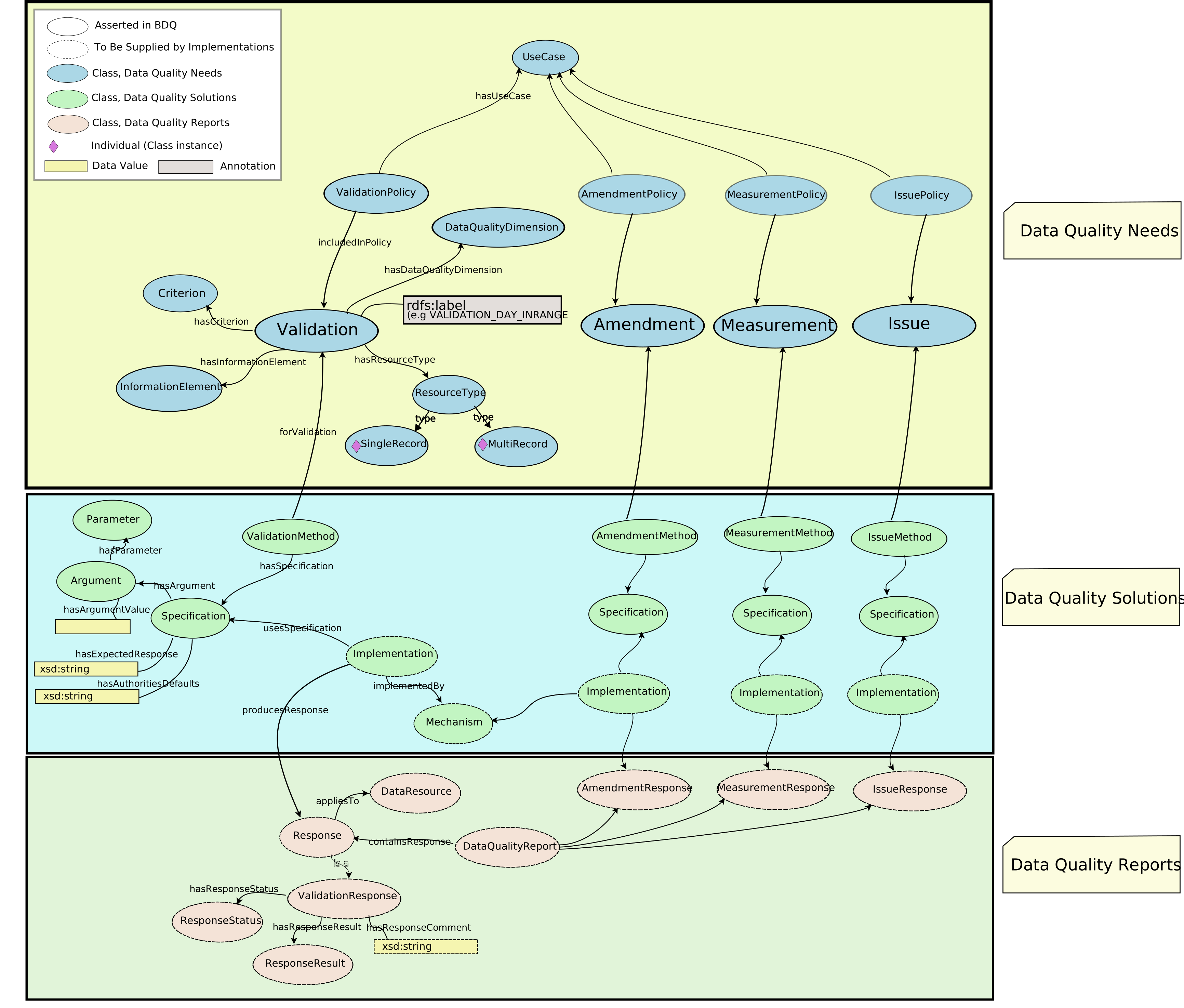
All four Tests concepts in the Needs Solutions, and Reports levels.
2.2.1 Data Quality Control and Data Quality Assurance (non-normative)
The Framework draws a distinction between Quality Control and Quality Assurance. Quality Control processes seek to assess the quality of data for some purpose, then identify changes to the data or to processes around the data to improve their quality. Quality Assurance processes seek to filter some set of data to a subset that is fit for some purpose, that is, to assure that data used for some purpose are fit for that purpose.
For Quality Assurance, the Framework defines Measures that operate on Multi Records and return a Response.result of COMPLETE or NOT_COMPLETE. A Multi Record Measure may be COMPLETE if all aggregated instances of a related Single Record Validation are COMPLIANT.
For Quality Control, Multi Record Measures can return numeric summaries of the results of other Tests (e.g. count of COMPLIANT results for a Validation), thereby indicating how fit a dataset is for its intended purpose and how many adjustments are needed to make it fully fit.
It is important to recognize that BDQ does not standardize complete Quality Control or Quality Assurance workflows (e.g., user roles, review and remediation procedures, pipelines, thresholds, or reporting formats). Instead, BDQ standardizes the semantics of Tests and their Responses and provides Measure patterns that can be used to support Quality Control and Quality Assurance workflows in a consistent way.
2.2.2 Information Elements (non-normative)
Information Elements are the inputs to a Test, they identify the specific data elements that are evaluated in a Test. Information Elements are the properties of data that are examined to determine if the data meet the quality requirements for a given Use Case.
The Framework has both an abstract and concrete concept of Information Elements. To frame Tests on Darwin Core terms in a usable way, we list specific Darwin Core terms as the concrete Information Elements in each Test.
2.2.3 Concepts in the Framework, Test Types: Validation, Issue, Measure, Amendment (non-normative)
The Framework defines four central concepts for describing and evaluating Data Quality Needs: Validation, Issue, Measure, and Amendment.
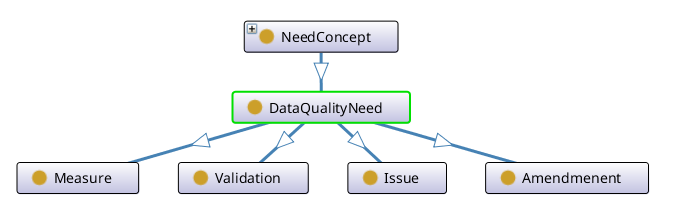
The 4 central DataQualityNeed types in the Framework - Validation, Issue, Measure, and Amendment.
A Validation assesses compliance with a need. Data have quality if they are compliant with the requirements of the Validation Test. A Validation relates Information Elements and Resource Types with a Specification of exactly how to assess fitness of the data under some narrow Criteria, and themselves are assembled into Validation Policies, which are linked to other Policies to cover a description of the Data Quality Needs of a Use Case. Data have quality only with respect to some use, so Validations must be composed with Use Cases to be able to assess fitness for use.
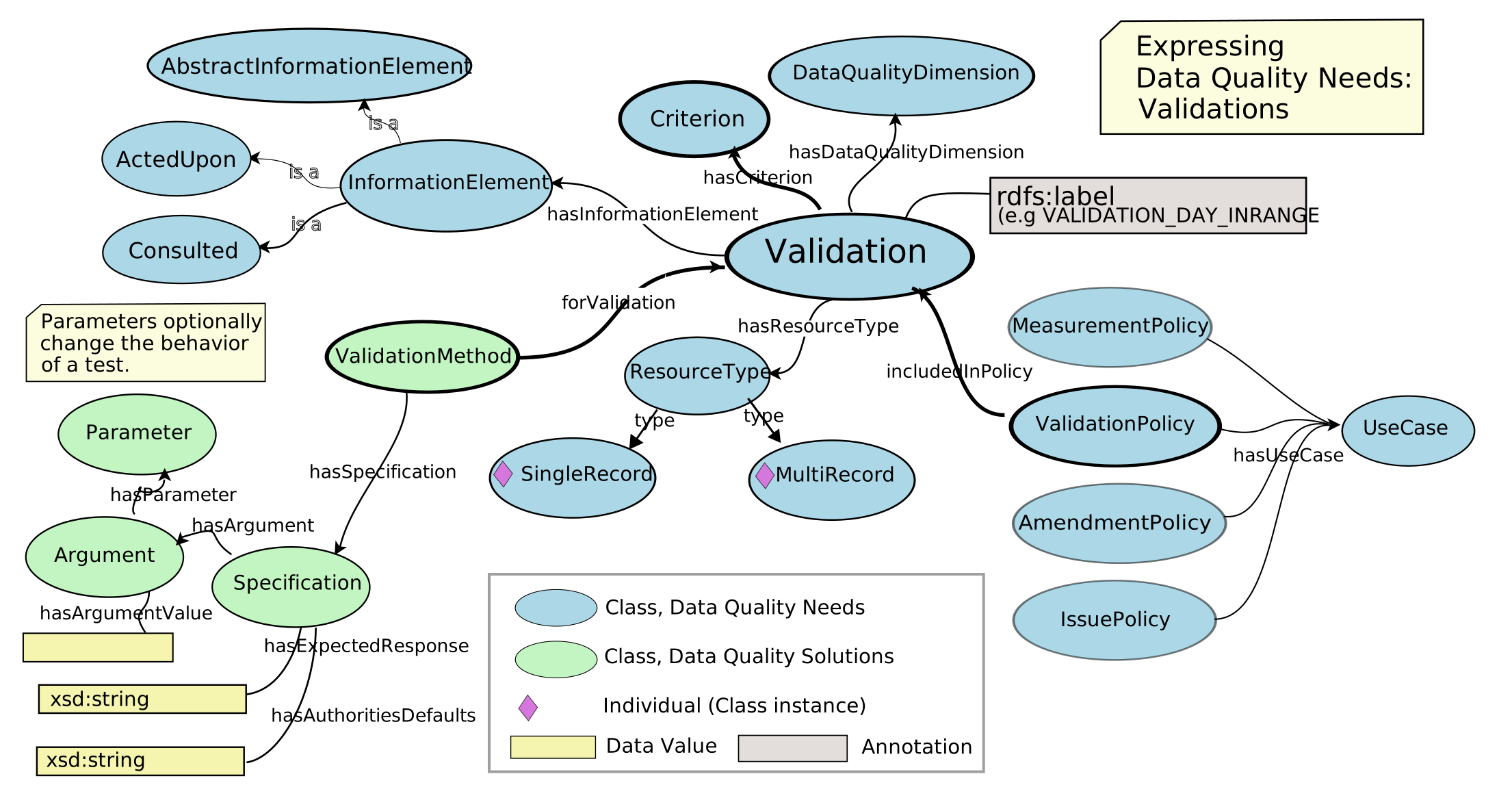
Expressing Data Quality Needs: Validations.
Issues are the converse of Validations. Data lack quality if an Issue identifies a potential problem in the data that would require further human review to determine if the data have quality for some purpose. Like Validations, Issues relate Information Elements and Resource Types with a Specification of exactly how to assess fitness of the data under some Use Case. No illustration is provided here, as the Issue concept is very similar to the Validation concept, but with a different focus on identifying potential problems rather than confirming compliance.
Validations, Measures, Amendments, and Issues all share a similar set of relationships to other classes in the Framework. The following diagrams for Measures and Amendments highlight these similarities, with classes and relationships that differ called out with thicker line weights.
Measures make an aggregate summary of some specific aspect of data quality.
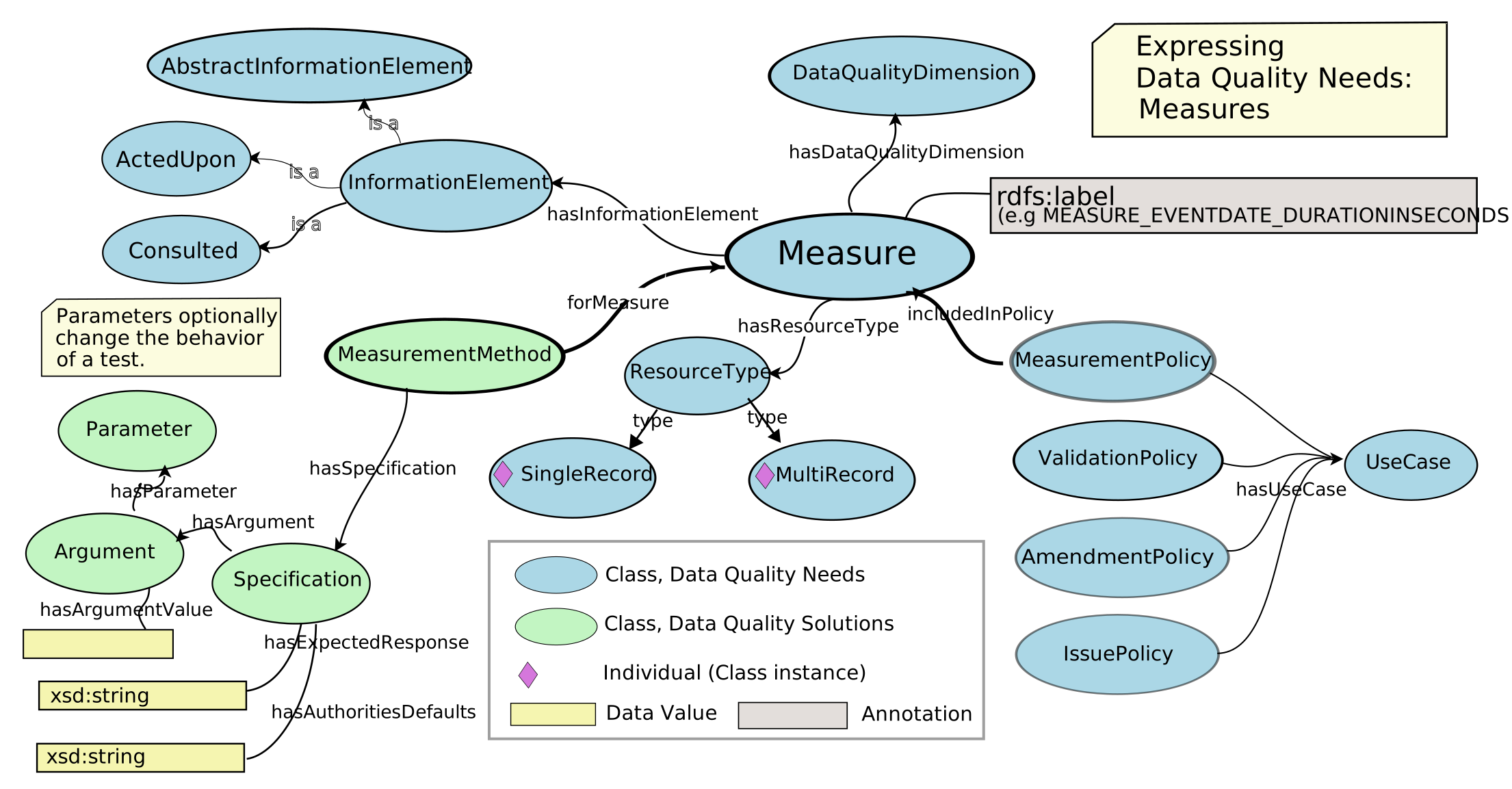
Expressing Data Quality Needs: Measures.
Amendments propose changes to data or processes that, if accepted, may improve the fitness of data for a specific use.
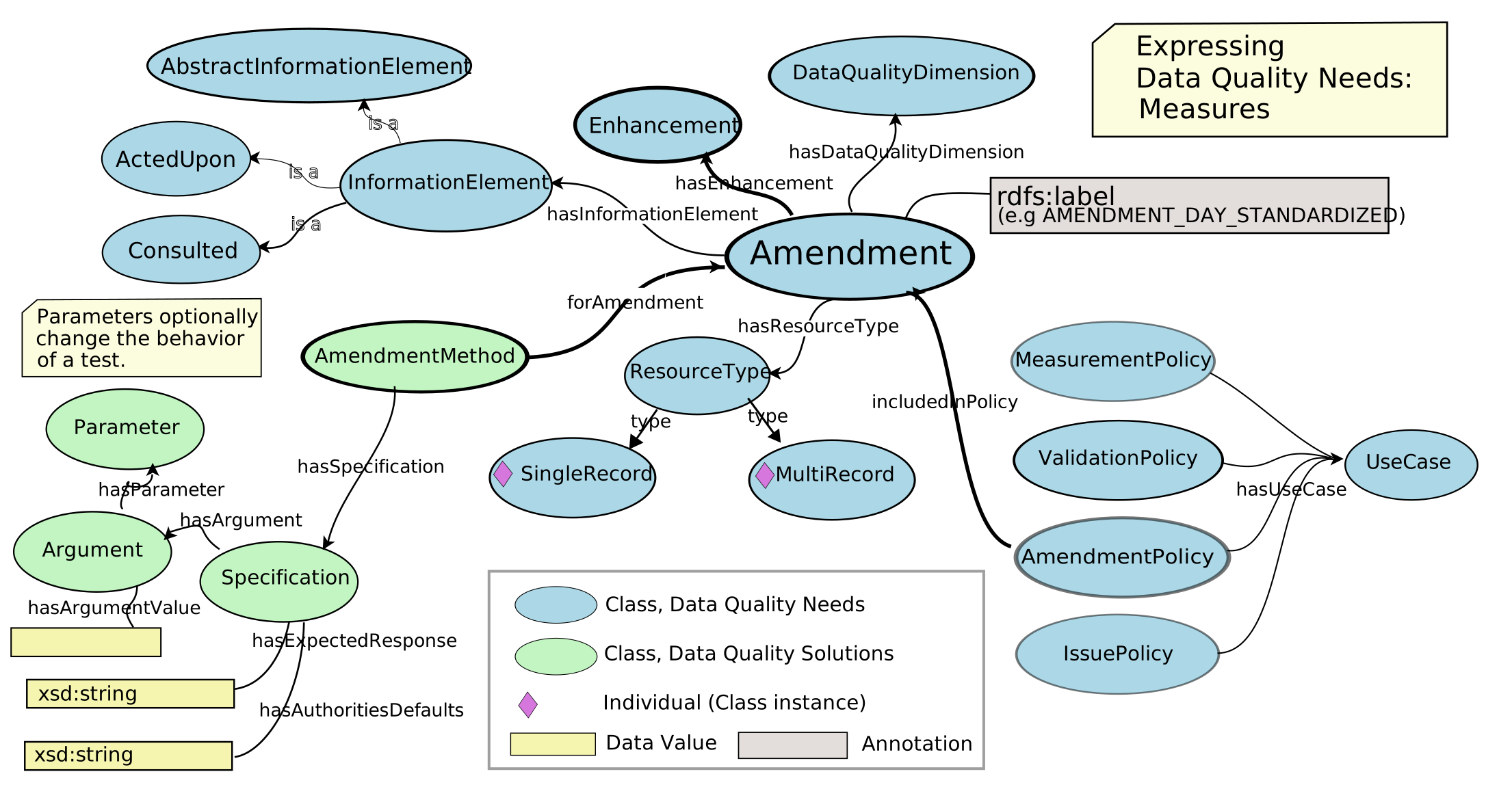
Expressing Data Quality Needs: Amendments.
Formally, in the Data Quality Needs level, the Framework starts with a Use Case, a framing of some use to which data may be put. Use Cases are related to the formal description of Data Quality Needs through Policies. Data Quality Needs, such as a Validation are related to the Information Elements that need to be examined, and to the Resource Type that is operated on. Methods such as ValidationMethod relate the Data Quality Needs to Specifications for the evaluation of those needs. The Data Quality Need specifies in general terms what properties data must have to have quality, and the related Specification provides a formal description of how to evaluate that aspect of quality.
Each of the Tests described in the BDQ standard has a formal specification that includes each of these elements.
Data Quality Needs can relate to the data quality of single records (bdqffdq:SingleRecord) or of datasets (bdqffdq:MultiRecord).
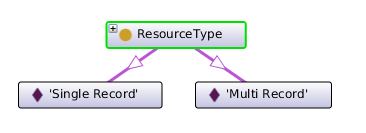
Representation of Single Record and Multi Record as named individual instances of the Resource class.
2.3 Extending to Data Quality Mechanisms and Data Quality Reports (non-normative)
Software that implements one or more tests is a Mechanism. A Mechanism is a formal description of a software tool that implements one or more Tests. Each of those Tests has an Implementation in that Mechanism, which is a formal description of how the Mechanism implements the Test. An Implementation is linked via bdqffdq:usesSpecification to the specification of a Test. An Implementation also produces Responses that are linked to the Implementation via bdqffdq:producesResponse and may be assembled into Data Quality Reports.
The property bdqffdq:usesSpecification draws a separation between the specification of how a Test is defined and an actual concrete implementation of that Test in software. This separation allows for multiple implementations of the same Test, and for implementations to evolve independently of the Test specifications.
A Test, conceptually, is a set of classes and properties that provide a formal description of what outputs a software implementation should produce for given inputs. The classes are a Specification linked through a Data Quality Method (Validation Method, Issue Method, Measure Method, and Amendment Method) to a Data Quality Need (Validation, Issue, Measure, or Amendment). The properties associated with the Data Quality Need provide a general description of what aspect of data quality the Test assesses (and what its inputs are), while the properties associated with the Specification provide the specific details of the expected behavior of the Test needed for a developer to implement the Test. The bdqtest: vocabulary provides these specific details for each Test, independent of any particular software implementation.
On the other side of bdqffdq:usesSpecification, a software implementation of a Test produces Responses. These are the outputs of Test execution, and provide an assessment of the fitness of some data for some use. Thus The Fitness For Use Framework divides responsibilities between the specification of what is needed for data to have quality (Use Cases and Tests) and the software implementations of those Tests with the actual assertions about data quality in Responses produced by those implementations.
Below is a diagram of the composition of Validation, Validation Method, and Validation Response illustrating the Data Quality Needs, Solutions, and Reports layers of the Fitness For Use Framework, identifying the responsibilities of bdqtest: (shown with solid lines), and implementations (shown with dashed lines).
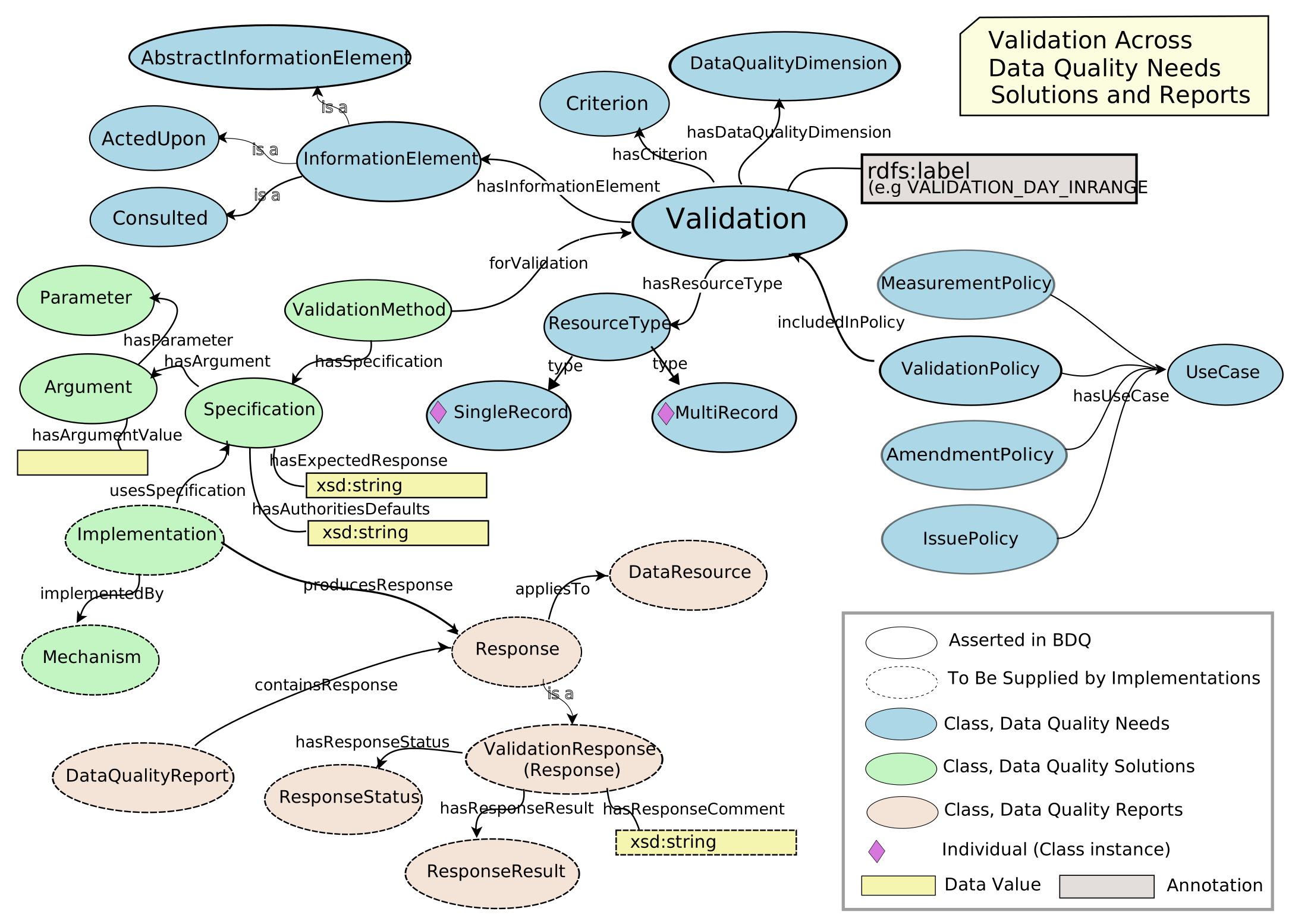
Validation concepts in the Needs, Solutions, and Reports levels.
2.4 Responses (non-normative)
The content of this section is non-normative, related normative guidance is in section 5.1 The Response Object (normative) of the BDQ Implementer's Guide.
A Response is a formal description of the output of a Test, including the status of the Test execution, the result of the Test, and any comments or qualifiers that provide additional information about the result. Responses can be assembled into Data Quality Reports that summarize the results of applying one or more Tests to a dataset.
Responses are typed as Validation Response, Issue Response, Measure Response, or Amendment Response depending on the type of Test that produced them.
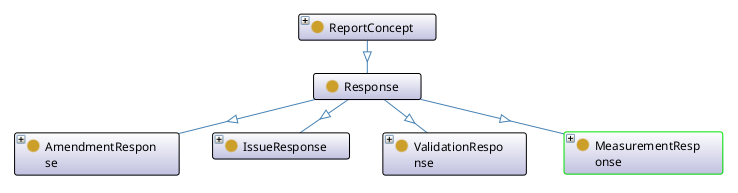
The 4 Response types in the Framework - ValidationResponse, IssueResponse, MeasurementResponse and AmendmentResponse.
Response objects may be represented in an RDF context as a combination of object properties and data properties on a Response resource. In a non-RDF context, such as JSON or a tabular format, a Response might be represented as an object with properties or as a row with columns for each of the properties. The key properties of a Response are Response.status, Response.result, Response.comment, and optionally, Response.qualifier. In a non-RDF context, these may be simple fields in a structured data format, while in an RDF context, these would be represented using the appropriate properties from the bdqffdq: vocabulary (e.g., bdqffdq:hasResponseStatus, bdqffdq:hasResponseResult, bdqffdq:hasResponseComment, and bdqffdq:hasResponseQualifier) where the distinction between categorical values (e.g. using bdqffdq:hasResponseResult) and literal values (e.g. using bdqffdq:hasResponseResultValue) is important.
It is expected that instances of Response objects will involve, in RDF, a combination of object properties and data properties on a Response. In an object oriented language like Java, a Response might be an object with properties, and in a tabular format, a Response might be a row with columns for each of the properties. The following table gives an overview of the expected properties of a Response object, and the corresponding terms in the bdqffdq: vocabulary.
| Shorthand Concept | bdqffdq: Term(s) | Description |
|---|---|---|
| Response | bdqffdq:Response | The report from a single execution of a single Test, consisting of a Response.status, a Response.result, a Response.comment, and optionally, a Response.qualifier. |
| Response.status | bdqffdq:ResponseStatus, bdqffdq:hasResponseStatus | A metadata element in a Response indicating whether a particular Test (bdqffdq:Validation, bdqffdq:Issue, bdqffdq:Measure, or bdqffdq:Amendment) was able to be performed or not. |
| Response.result | bdqffdq:ResponseResult, bdqffdq:hasResponseResult, bdqffdq:hasResponseResultValue | The element in a Response containing the value returned by a Test (bdqffdq:Validation, bdqffdq:Issue, bdqffdq:Measure, or bdqffdq:Amendment) |
| Response.comment | bdqffdq:hasResponseComment | A human readable interpretation of the results of the Test. |
| Response.qualifier | bdqffdq:ResponseQualifier, bdqffdq:hasResponseQualifier | Additional structured information that qualifies the Response, intended as an extension point for uncertainty. |
See 4.1 Structure of a Response (normative) in BDQ Tests: Concepts and Use for further normative guidance on Responses as RDF or as data structures in non-RDF settings.
2.4.1 Properties of Responses (normative)
In an RDF context, the status property of a Response MUST be represented using an IRI (e.g., bdqffdq:RUN_HAS_RESULT) as the object of bdqffdq:hasResponseStatus.
In an RDF context, the result property of a Response MUST be represented using:
bdqffdq:hasResponseResultwhen the result is categorical and comes from the controlled set of bdqffdq:ResponseResult named individuals (e.g., bdqffdq:COMPLIANT, bdqffdq:NOT_COMPLIANT, bdqffdq:COMPLETE, bdqffdq:NOT_COMPLETE, bdqffdq:POTENTIAL_ISSUE, bdqffdq:NOT_ISSUE); orbdqffdq:hasResponseResultValuewhen the result is a literal payload (e.g., a numeric measurement, a string, or structured text such as JSON for anAmendmentproposal). The value ofbdqffdq:hasResponseResultValueMUST be a literal and SHOULD use an appropriate datatype (e.g.,xsd:integer,rdf:JSON).
In a non-RDF structured-data context (JSON, database, CSV), where bdqffdq:ResponseStatus and bdqffdq:ResponseResult are represented as strings, controlled values MUST be used and the values MUST be the local names (e.g., RUN_HAS_RESULT, COMPLIANT), unless the result is a literal value (corresponding to use of bdqffdq:hasResponseResultValue in RDF), in which case the value MUST be that literal.
Labels MAY be used purely for display.
This section summarizes representation choices. Full normative constraints on the response structure of Responses is found in 4.1 Structure of Response (normative) of the BDQ Tests: Concepts and Use document.
2.4.1.1 Table of Representations of Response Properties (non-normative)
Summary of the expected properties of a Response object, and the corresponding terms in the bdqffdq: vocabulary, with examples of RDF and non-RDF representations.
| Context | Informal Response property | RDF predicate / field | Required representation | Example |
|---|---|---|---|---|
| RDF | Response.status (categorical) |
bdqffdq:hasResponseStatus |
IRI of a named individual | bdqffdq:RUN_HAS_RESULT |
| RDF | Response.result (categorical) |
bdqffdq:hasResponseResult |
IRI of a named individual | bdqffdq:COMPLIANT |
| RDF | Response.result (literal) |
bdqffdq:hasResponseResultValue |
Literal (SHOULD use an appropriate datatype) | "17"^^xsd:integer |
| RDF | Response.comment (literal) |
bdqffdq:hasResponseComment |
Literal (string; MAY be language-tagged) | "Provided value 11 is a valid dwc:day."@en |
| Non-RDF structured data (categorical) | Response.status |
string corresponding to bdqffdq:ResponseStatus |
controlled value local name string | RUN_HAS_RESULT |
| Non-RDF structured data (categorical) | Response.result |
string corresponding to bdqffdq:ResponseResult |
controlled value local name string | COMPLIANT |
| Non-RDF structured data (literal) | Response.result |
field corresponding to bdqffdq:hasResponseResultValue |
literal | 17 |
| Non-RDF structured data (literal) | Response.comment |
field corresponding to bdqffdq:hasResponseComment |
literal (string) | Provided value 11 is a valid dwc:day. |
A bdqffdq:hasResponseStatus is always categorical, a bdqffdq:hasResponseComment is always literal, a Response.result may be either a categorical bdqffdq:hasResponseResult or a literal bdqffdq:hasResponseResultValue.
It is precisely because of this potential for results to be represented as RDF or as non-RDF structured data that the Named Individuals such as bdqffdq:COMPLIANT used in results are given labels in all upper case with underscores to facilitate their use and recognition as string constant values in non-RDF contexts.
2.5 Organization of the bdqffdq: classes (non-normative)
Following is a knowledge graph showing the is-a relationships between the classes in the Fitness For Use Framework:
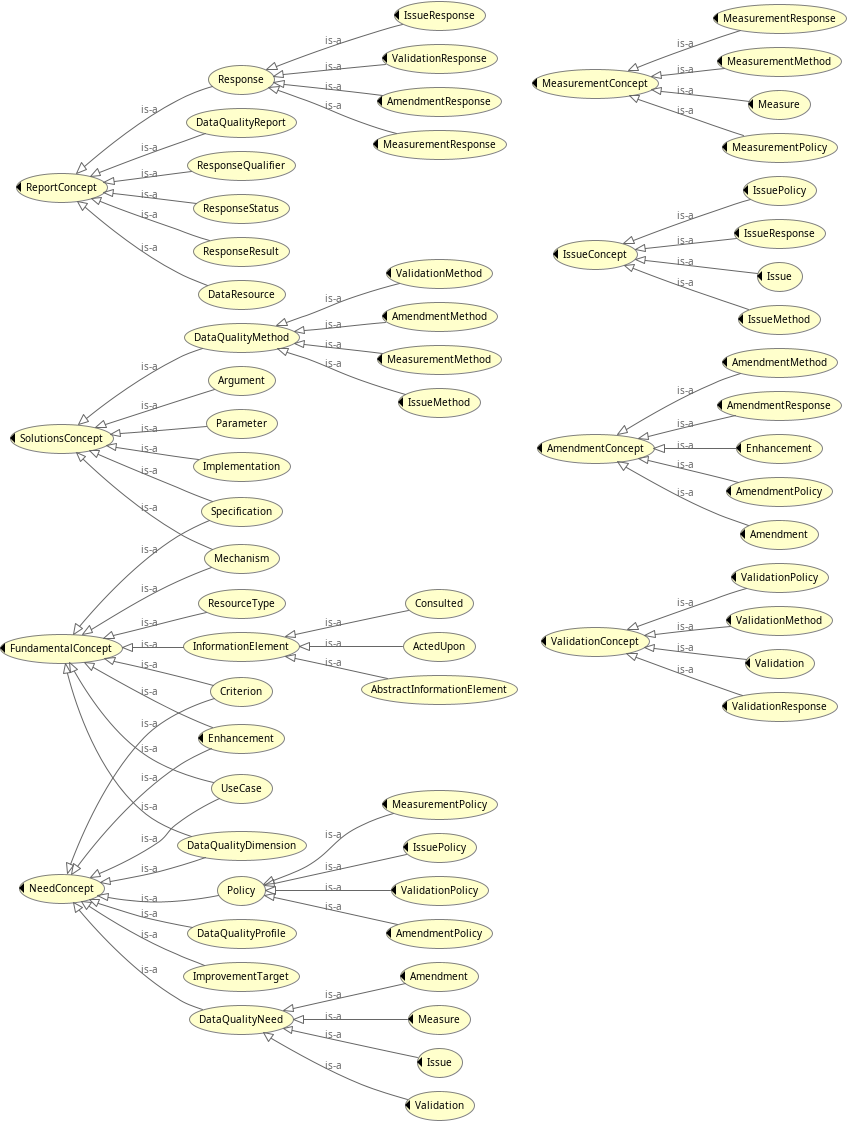 Diagram showing the relationships among the bdqffdq: classes.
2.6 Example representation of a BDQ Test (non-normative)
Below is a fragment in Turtle describing VALIDATION_COUNTRY_FOUND, composed of a Validation, linking an Acted Upon Information Element, a Criterion, and the Resource Type Single Record, with the Validation linked to a Validation Method, and from there a Specification. Also shown is a Validation Policy linking this Validation to a Use Case, but not all of the bdqffdq:includedInPolicy properties of that Validation Policy.
bdqtest:69b2efdc-6269-45a4-aecb-4cb99c2ae134-2025-03-07 a bdqffdq:Validation ;
    rdfs:label "VALIDATION_COUNTRY_FOUND" ;
    dcterms:description "Does the value of dwc:country occur in the bdqval:sourceAuthority?" ;
    dcterms:isVersionOf bdqtest:69b2efdc-6269-45a4-aecb-4cb99c2ae134 ;
    dcterms:issued "2025-03-07"^^xsd:date ;
    dcterms:references <https://doi.org/10.15468/doc-gg7h-s853>,
        <https://www.getty.edu/research/tools/vocabularies/tgn/index.html> ;
    skos:historyNote "https://github.com/tdwg/bdq/issues/21" ;
    skos:note "Non-country information such as \"high seas\" will fail this Test (high seas should use dwc:countryCode = \"XZ\" and have dwc:country empty). Getty Place Types for administrative level \"nation\" are 81010 nation, 81011 independent sovereign nation, and 81012 independent nation. Multiple values in the dwc:country field (whether to signify on a border or in a list of possibilities) will fail this Test. Locations outside of a jurisdiction covered by a country code should not have a value in the field dwc:countryCode. This Test should find any matches at the Getty \"nation\" level including internationalized names and historical representations of that nation (where boundaries are same). This Test must return NOT_COMPLIANT if there is leading or trailing whitespace or there are leading or trailing non-printing characters." ;
    skos:prefLabel "Validation dwc:country Found for SingleRecord" ;
    bdqffdq:hasActedUponInformationElement <urn:uuid:30db5994-81fa-4684-ac54-cfc226209d27> ;
    bdqffdq:hasCriterion bdqcrit:Found ;
    bdqffdq:hasDataQualityDimension bdqdim:Conformance ;
    bdqffdq:hasResourceType bdqffdq:SingleRecord .

bdqcrit:Found a bdqffdq:Criterion ;
    rdfs:label "Found" .

bdqdim:Conformance a bdqffdq:DataQualityDimension ;
    rdfs:label "Conformance" .

<urn:uuid:30db5994-81fa-4684-ac54-cfc226209d27> a bdqffdq:ActedUpon ;
    rdfs:label "Information Element ActedUpon dwc:country" ;
    skos:prefLabel "Information Element ActedUpon dwc:country" ;
    bdqffdq:composedOf dwc:country .

bdqffdq:SingleRecord a bdqffdq:ResourceType ;
    rdfs:label "SingleRecord" .

<https://doi.org/10.15468/doc-gg7h-s853> a dcterms:BibliographicResource ;
    dcterms:bibliographicCitation "Chapman AD and Wieczorek JR (2020) Georeferencing Best Practices. Copenhagen: GBIF Secretariat. https://doi.org/10.15468/doc-gg7h-s853" .

<https://www.getty.edu/research/tools/vocabularies/tgn/index.html> a dcterms:BibliographicResource ;
    dcterms:bibliographicCitation "Getty Research Institute (2017) Getty Thesaurus of Geographic Names Online. https://www.getty.edu/research/tools/vocabularies/tgn/index.html" .

<urn:uuid:04cee4e0-0c83-40cc-8de2-e7391f0a97a9> a bdqffdq:ValidationMethod ;
    rdfs:label "ValidationMethod: VALIDATION_COUNTRY_FOUND with Specification for: VALIDATION_COUNTRY_FOUND" ;
    skos:historyNote "Source: ALA, GBIF" ;
    skos:note "Example Implementations Source Code: https://github.com/FilteredPush/geo_ref_qc/blob/v2.0.1/src/main/java/org/filteredpush/qc/georeference/DwCGeoRefDQ.java#L158",
        "Example Implementations: Kurator/FilteredPush geo_ref_qc Library (Morris & Lowery 2025b)",
        "TG2 Validation SPACE CODED Test VOCABULARY Conformance Parameterized CORE" ;
    skos:prefLabel "ValidationMethod: VALIDATION_COUNTRY_FOUND with Specification for: VALIDATION_COUNTRY_FOUND" ;
    bdqffdq:forValidation bdqtest:69b2efdc-6269-45a4-aecb-4cb99c2ae134-2025-03-07 ;
    bdqffdq:hasSpecification <urn:uuid:051f6ad7-1a4b-4e6c-8a1d-2af76de24848> .

<urn:uuid:051f6ad7-1a4b-4e6c-8a1d-2af76de24848> a bdqffdq:Specification ;
    rdfs:label "Specification for: VALIDATION_COUNTRY_FOUND" ;
    dcterms:description "EXTERNAL_PREREQUISITES_NOT_MET if the bdqval:sourceAuthority is not available; INTERNAL_PREREQUISITES_NOT_MET if dwc:country is bdqval:Empty; COMPLIANT if value of dwc:country is a place type equivalent to administrative entity of \"nation\" in the bdqval:sourceAuthority; otherwise NOT_COMPLIANT bdqval:sourceAuthority default = \"The Getty Thesaurus of Geographic Names (TGN)\" {[https://www.getty.edu/research/tools/vocabularies/tgn/index.html]}" ;
    skos:example "dwc:country=\"Eswatini\": Response.status=RUN_HAS_RESULT, Response.result=COMPLIANT, Response.comment=\"dwc:country is a valid country name in the bdqval:sourceAuthority\"",
        "dwc:country=\"Tasmania\": Response.status=RUN_HAS_RESULT, Response.result=NOT_COMPLIANT, Response.comment=\"Tasmania is not found at the level of national in the bdqval:sourceAuthority\"" ;
    bdqffdq:hasArgument <urn:uuid:3e00109a-13d3-416d-9a91-127c99b47473> ;
    bdqffdq:hasAuthoritiesDefaults "bdqval:sourceAuthority default = \"The Getty Thesaurus of Geographic Names (TGN)\" {[https://www.getty.edu/research/tools/vocabularies/tgn/index.html]}" ;
    bdqffdq:hasExpectedResponse "EXTERNAL_PREREQUISITES_NOT_MET if the bdqval:sourceAuthority is not available; INTERNAL_PREREQUISITES_NOT_MET if dwc:country is bdqval:Empty; COMPLIANT if value of dwc:country is a place type equivalent to administrative entity of \"nation\" in the bdqval:sourceAuthority; otherwise NOT_COMPLIANT" .

<urn:uuid:3e00109a-13d3-416d-9a91-127c99b47473> a bdqffdq:Argument ;
    rdfs:label "Default value for bdqval:sourceAuthority:\"The Getty Thesaurus of Geographic Names (TGN)\"" ;
    bdqffdq:hasArgumentValue "The Getty Thesaurus of Geographic Names (TGN)" ;
    bdqffdq:hasParameter bdqval:sourceAuthority .

bdqval:sourceAuthority a bdqffdq:Parameter .

<urn:uuid:0348eccf-fc7f-49b3-88b6-1d911e98cbbb> a bdqffdq:ValidationPolicy ;
    rdfs:label "ValidationPolicy: (50) validations  in UseCase bdquc:Spatial-Temporal_Patterns" ;
    skos:prefLabel "ValidationPolicy: (50) validations  in UseCase bdquc:Spatial-Temporal_Patterns" ;
    bdqffdq:hasUseCase <https://rs.tdwg.org/bdquc/terms/Spatial-Temporal_Patterns> ;
    bdqffdq:includedInPolicy bdqtest:69b2efdc-6269-45a4-aecb-4cb99c2ae134-2025-03-07 .

<https://rs.tdwg.org/bdquc/terms/Spatial-Temporal_Patterns> a bdqffdq:UseCase ;
    rdfs:label "bdquc:Spatial-Temporal_Patterns" .
2.7 Some Other Related Standards (non-normative)
This section is non-normative and is intended only to highlight standards that can be used alongside the Fitness For Use Framework ontology and the other BDQ vocabularies to support interoperable representation, publication, and validation of BDQ Tests and their results in RDF.
2.7.1 The W3C Web Annotation Data Model (non-normative)
The bdqffdq: OWL representation of the Fitness For Use Framework and the framing of the BDQ Tests in RDF using that ontology make Test results particularly amenable to being wrapped in oa:Annotation instances following the W3C Web Annotation Data Model (Sanderson et al. 2017).
See 7.2 Annotations in the Implementers Guide for an example and normative guidance on how to represent Test results as Web Annotations.
2.7.2 Relating BDQ Test Results with the PROV Ontology (non-normative)
PROV-O: The PROV Ontology (W3C 2013) is a W3C recommendation that provides a framework for representing provenance information in RDF. PROV-O defines a set of classes and properties for representing the entities, activities, and agents involved in the production of data and other resources, as well as the relationships between them.
A bdqffdq:DataQualityReport is a formal description of the results produced by a bdqffdq:Implementation implemented by a bdqffdq:Mechanism applying one or more Tests to a bdqffdq:DataResource.
In PROV-O, a bdqffdq:DataQualityReport and a bdqffdq:DataResource may be represented as prov:Entity instances. An execution of a Test implementation may be represented as a prov:Activity, and a bdqffdq:Mechanism (or an agent operating a mechanism) may be represented as a prov:Agent. The relationships between these entities can be represented using PROV properties such as prov:wasGeneratedBy, prov:used, and prov:wasAssociatedWith.
A bdqffdq:Response produced by a Test can be related to PROV-O through the use of prov:wasGeneratedBy to relate a bdqffdq:Response to the prov:Activity that produced it, and through the use of prov:used to relate that prov:Activity to the bdqffdq:Specification that it used. This allows the provenance of a bdqffdq:Response to be traced back to the particular Test specification that was executed and the software mechanism that executed it, with the ability to add additional metadata about the provenance beyond the scope of the Fitness For Use Framework ontology.
The above is intended only as a simple exploration of how some of the core concepts of the Fitness For Use Framework could be related to PROV-O.
2.7.3 The W3C Data Quality Vocabulary (non-normative)
The W3C Data Quality Vocabulary (DQV) (Albertoni and Isaac, 2016; Albertoni and Isaac 2020) provides a metadata model for describing data quality information in RDF. DQV defines (and reuses) a set of classes and properties for representing the quality of datasets and their distributions. DQV is deliberately designed as a high-level, cross-domain interoperable vocabulary. DQV representations of metrics and dimensions can be used to report on data quality, where quality is understood to depend on the needs of the data consumer.
The W3C Data Quality Vocabulary can be used in conjunction with the bdqffdq: and bdqtest: vocabularies to provide metadata describing the quality of some bdqffdq:DataResource as asserted in a bdqffdq:DataQualityReport.
The W3C Data Quality Vocabulary defines (mostly by reuse of ldqd: terms) a set of data quality dimensions. The dqv:Dimension class is defined, in part, as "Represents criteria relevant for assessing quality". This concept is similar to (skos:broader than) bdqffdq:DataQualityDimension. See Section 2.1 Mapping to DQV Dimension (non-normative) in the bdqdim: term list document for potential mappings.
There are at least three ways in which bdqffdq:Responses could be related to DQV data quality metadata representations.
Supported by the generality and flexibility of DQV and its extension of the Web Annotation Data Model, any bdqffdq:Response could be wrapped in an oa:Annotation, and that annotation subclassed as a dqv:QualityAnnotation.
At a high level, a bdqffdq:DataQualityReport containing bdqffdq:Responses from (specific, bdqtest:) bdqffdq:MultiRecord bdqffdq:Measures that reported COMPLIANT results could produce a DQV dqv:QualityCertificate related to a bdqffdq:DataResource modeled as a dcat:Dataset through a dqv:QualityAnnotation that also asserts that the dcat:Dataset dcterms:conformsTo a dcterms:Standard modeling a bdqffdq:UseCase.
At a lower level, bdqffdq:MultiRecord bdqffdq:Measures that produce numeric results could be modeled as a DQV quality metric (dqv:Metric). A bdqffdq:MeasurementResponse resulting from such a bdqffdq:MultiRecord bdqffdq:Measure could be modeled as a dqv:QualityMeasurement.
As the definition of dqv:Metric includes the phrase "a value in a given unit", it is not clear whether bdqffdq:Validation and bdqffdq:Issue Tests that produce categorical results, or bdqffdq:Amendment Tests that propose changes to data, can be modeled as DQV dqv:Metric.
2.7.4 Publishing dataset metadata with DCAT (non-normative)
The Data Catalog Vocabulary (DCAT) (W3C 2024) is a W3C recommendation for describing datasets and distributions. Where bdqffdq:DataQualityReports are published as resources associated with datasets, DCAT can be used to describe the dataset being assessed (e.g., dcat:Dataset) and to relate the dataset to related distributions, documentation, and quality metadata. In combination with DQV, this can support discovery and reuse of published data quality information.
2.7.5 Validating RDF graphs with SHACL (non-normative)
The Shapes Constraint Language (SHACL) (W3C 2017) is a W3C recommendation for expressing constraints and validation rules over RDF graphs. SHACL can be used alongside the open-world design of the bdqffdq: ontology to validate that RDF data representing BDQ Tests, bdqffdq:Responses, and bdqffdq:DataQualityReports follows expected structural patterns (e.g., expected cardinalities and required relationships).
Formal constraints could be useful for validating RDF data produced by bdqffdq:Mechanisms, and for testing conformance of RDF representations to the normative guidance in this standard. We have not included SHACL shapes for validating RDF representations of BDQ concepts in the BDQ Standard, but an experimental set of SHACL shapes is available along with python code to run it for validating RDF representations of bdqtest: Tests and bdquc: Use Cases. This validation currently passes, and the python code and SHACL shapes are available to test RDF reports produced by bdqffdq:Mechanisms for conformance to the normative guidance in this standard.
2.7.6 Other TDWG vocabularies as sources of Information Elements (non-normative)
Future BDQ Tests are expected to apply to bdqffdq:Information Elements drawn from additional TDWG vocabularies beyond Darwin Core. In particular, terms from Latimer Core and Audiovisual Core are likely to provide bdqffdq:Information Elements for future Tests as the BDQ standard expands to cover additional kinds of biodiversity data and collection objects.
3 Use of Ontology Terms (normative)
This guidance describes the use of the Framework Ontology (the Fitness for Use bdqffdq: vocabulary terms) in an RDF context. This guidance MAY be used to develop models of the Fitness For Use Framework in more constrained forms, including UML object models, information models, classes in a programming language, or database schemas.
See also the Use of Terms (normative) in the bdqffdq: term-list document.
3.1 Use of Properties (normative)
3.1.1 Relating Classes and Properties (non-normative)
The (non-normative) diagram below illustrating Validation related concepts across needs, solutions, and reports areas of the framework is intended to help understand the normative statements in 3 Use of Ontology Terms (normative). The diagram shows the expected relationships among Validation, ValidationMethod, and Specification classes, as well as their expected connections to other subclasses of Data Quality Need, Data Quality Solution, and Data Quality Report. Section 3 Use of Ontology Terms (normative) provides normative guidance on how properties are expected to be used to relate instances of these classes in a consistent way, as expectations limiting the open world assumptions of the RDF/OWL modeling of the bdqffdq: vocabulary.

The use of classes and properties in the bdqtest: vocabulary (see BDQ Tests as RDF) follow the guidance provided in this section. The Data Quality Needs (blue here; Need Concept) and Data Quality Solutions (green here; Solutions Concept) concepts in this diagram illustrate how this guidance is used in bdqtest: to relate the set of terms used to define a Validation. The Data Quality Reports (tan here; Report Concept) concepts in the diagram illustrate how a Validation Response in a Data Quality Report can be related to a Validation and its Specification. The minimal use of rdfs:range and other global axioms in bdqffdq: aligns with best practices for ontologies intended for reuse, integration, and extension. This approach trades strict, machine-enforceable validation and inference for flexibility, extensibility, and a low barrier to adoption. The normative guidance in this document mitigates the risk of inconsistent usage that is allowed by the open world design of bdqffdq:.
This section describes normative expectations for the use of object and datatype properties to related instances of bdqffdq: classes in their intended ways given the open world limited use of domains, ranges, and other axioms in the Biodiversity Data Quality Fitness For Use Framework (Ontology) ontology. This guidance builds on the normative definitions of bdqffdq: object properties and datatype properties to describe how bdqffdq: terms can be composed in a useful and consistent way.
Section 3.2 Identifying the Test that produced a Response (normative) highlights the importance of using the object properties with the correct cardinality to preserve the relationship between a Response produced by a Test and the particular Test that produced it.
3.1.2 Properties Relating to Data Quality Needs (normative)
Each description of a data quality Test SHOULD include the properties and related instances described in the following paragraphs.
Each instance of bdqffdq:UseCase SHOULD have one bdqffdq:hasFitnessRequirements datatype property enumerating the general fitness requirements of data for that use.
The bdqffdq:hasUseCase object property SHOULD have an individual with a type that is a subclass of bdqffdq:Policy as its subject.
The bdqffdq:hasUseCase object property MAY have an individual from the bdquc: vocabulary that represents a bdqffdq:UseCase as its object.
An axiom types the range of bdqffdq:hasUseCase as a bdqffdq:UseCase.
The bdqffdq:includedInPolicy object property SHOULD have an individual that is a subclass of bdqffdq:Policy as its subject.
The bdqffdq:includedInPolicy object property SHOULD have an individual that is a subclass of bdqffdq:DataQualityNeed as its object.
The four subclasses of bdqffdq:DataQualityNeed are bdqffdq:Validation, bdqffdq:Issue, bdqffdq:Measure and bdqffdq:Amendment.
Each individual that is a subclass of bdqffdq:DataQualityNeed SHOULD have at least one bdqffdq:includedInPolicy relationship to an instance of a subclass of bdqffdq:Policy, which is in turn related to an instance of a bdqffdq:UseCase.
User communities MAY provide new Use Cases and MAY compose instances that are subtypes of bdqffdq:DataQualityNeed with instances of bdqffdq:Policy subclasses and instances of bdqffdq:UseCase with the object properties bdqffdq:includedInPolicy and bdqffdq:hasUseCase in new ways.
Each instance of a subclass of a bdqffdq:DataQualityNeed SHOULD have an rdfs:label in all upper case, with underscores separating components.
The rdfs:label of the instance of the subclass of bdqffdq:DataQualityNeed SHOULD be used by humans to identify Tests.
Labels of instances of subclasses of bdqffdq:DataQualityNeed SHOULD follow the following naming conventions:
- Tests that have a bdqffdq:hasResourceType of bdqffdq:SingleRecord SHOULD have an
rdfs:labelin all upper case as the first word, and a representation of the bdqffdq:AbstractInformationElement as a single word in all upper case as the second word, in the form TESTTYPE_INFORMATIONELEMENT_EVALUATION or TESTTYPE_INFORMATIONELEMENT_ACTION_INFORMATIONELEMENT. * For example: VALIDATION_COUNTRYCODE_STANDARD. -
Tests that have a
bdqffdq:hasResourceTypeof bdqffdq:MultiRecord SHOULD have "MULTIRECORD_" as the first element in theirrdfs:label, and MAY follow the pattern MULTIRECORD_TESTTYPE_COUNT_RESULT_INFORMATIONELEMENT_EVALUATION, or MULTIRECORD_TESTTYPE_QA_INFORMATIONELEMENT_EVALUATION. * For example: MULTIRECORD_MEASURE_COUNT_COMPLIANT_COUNTRY_NOTEMPTY and MULTIRECORD_MEASURE_QA_COUNTRY_NOTEMPTY. -
See Naming Conventions in the
bdqffdq:term list for more details on naming conventions.
Each instance of a subclass of bdqffdq:DataQualityNeed MUST have exactly one bdqffdq:hasResourceType object property linking it to a bdqffdq:SingleRecord or a bdqffdq:MultiRecord.
The bdqffdq:hasCriterion object property SHOULD have an individual with a type that is a bdqffdq:Validation or a bdqffdq:Issue as its subject.
The bdqffdq:hasCriterion object property MAY have an individual from the bdqcrit: vocabulary as its object.
An axiom types the range of bdqffdq:hasCriterion as a bdqffdq:Criterion.
The bdqffdq:hasEnhancement object property SHOULD have an individual with a type that is a bdqffdq:Amendment as its subject.
The bdqffdq:hasEnhancement object property MAY have an individual from the bdqenh: vocabulary as its object.
An axiom types the range of bdqffdq:hasEnhancement as a bdqffdq:Enhancement.
The bdqffdq:hasDataQualityDimension object property SHOULD have an individual with a type that is a subclass of bdqffdq:DataQualityNeed as its subject.
The bdqffdq:hasDataQualityDimension object property MAY have an individual in the bdqdim: vocabulary is its object.
An axiom types the range of bdqffdq:hasDataQualityDimension as a bdqffdq:DataQualityDimension.
Each individual instance of a bdqffdq:Validation SHOULD have exactly one bdqffdq:hasDataQualityDimension property and exactly one bdqffdq:Criterion property.
Each individual instance of a bdqffdq:Issue SHOULD have exactly one bdqffdq:hasDataQualityDimension property and exactly one bdqffdq:Criterion property.
Each individual instance of a bdqffdq:Measure SHOULD have exactly one bdqffdq:hasDataQualityDimension property.
Each individual instance of a bdqffdq:Amendment SHOULD have exactly one bdqffdq:hasDataQualityDimension property and exactly one bdqffdq:Enhancement property.
A subproperty of the bdqffdq:hasInformationElement object property SHOULD have an individual that is a subclass of bdqffdq:InformationElement as its object.
A subproperty of the bdqffdq:hasInformationElement object property SHOULD have an individual that is a subclass of bdqffdq:DataQualityNeed as its subject.
Each instance of a subclass of bdqffdq:DataQualityNeed SHOULD have exactly one bdqffdq:hasActedUponInformationElement property linking it to a bdqffdq:ActedUpon.
Each instance of bdqffdq:ActedUpon SHOULD have one to many bdqffdq:composedOf object properties linking it to specific Information Elements.
Each instance of a subclass of bdqffdq:DataQualityNeed SHOULD have zero or exactly one bdqffdq:hasConsultedInformationElement property linking it to a bdqffdq:Consulted.
Each instance of bdqffdq:Consulted SHOULD have one to many bdqffdq:composedOf object properties linking it to specific Information Elements.
Each instance of a subclass of bdqffdq:DataQualityNeed MAY have a bdqffdq:hasInformationElement property linking it to a bdqffdq:AbstractInformationElement.
Each instance of bdqffdq:AbstractInformationElement SHOULD have rdfs:label and rdfs:comment properties describing the scope of the Information Element with the rdfs:label corresponding to the INFORMATIONELEMENT portion of the rdfs:label for an instance of a subclass of bdqffdq:DataQualityNeed following the convention described above in this section.
3.1.2.1 Properties For MultiRecord Measures (normative)
Each instance of bdqffdq:Measure with a bdqffdq:hasResourceType of bdqffdq:MultiRecord that aggregates the Responses produced by one or more other Tests (e.g., to return COMPLETE/NOT_COMPLETE for Quality Assurance, or to return a numeric count or other metric for Quality Control) SHOULD have a bdqffdq:hasActedUponInformationElement relationship to an instance of bdqffdq:ActedUpon that represents the aggregated report inputs to that Measure.
When a Multi Record Measure acts on aggregated Responses from other Tests, the associated bdqffdq:ActedUpon instance SHOULD include bdqffdq:composedOf with bdqval:AggregatedTestResponseOutcomes to indicate that the acted-upon data are aggregated Response outcomes in a Data Quality Report, rather than raw source-data terms.
In this usage pattern, the associated bdqffdq:ActedUpon instance SHOULD include one to many bdqffdq:aggregatesResponsesFrom object properties linking it to the instance(s) of bdqffdq:DataQualityNeed whose Responses are aggregated as inputs to that Multi Record Measure.
The bdqffdq:aggregatesResponsesFrom property is intended to be used in the context of Multi Record Measures that aggregate Responses; however, consistent with the open world design of the bdqffdq: ontology and the limited use of global axioms, the ontology does not constrain the subject of bdqffdq:aggregatesResponsesFrom to be only a bdqffdq:Measure or only an bdqffdq:ActedUpon, and this document provides the normative pattern for its intended use.
For human readability, when an ActedUpon instance uses bdqffdq:aggregatesResponsesFrom, the rdfs:label and skos:prefLabel of that bdqffdq:ActedUpon instance MAY include the rdfs:label of the bdqffdq:DataQualityNeed instance identified by bdqffdq:aggregatesResponsesFrom (e.g., VALIDATION_COUNTRY_FOUND) to make explicit which Test’s aggregated Responses are being acted upon.
3.1.2.2 MultiRecord Measure Example (non-normative)
The following is an example of a bdqffdq:Measure with a bdqffdq:hasResourceType of bdqffdq:MultiRecord that aggregates the Responses produced by the Validation bdqtest:69b2efdc-6269-45a4-aecb-4cb99c2ae134 (VALIDATION_COUNTRY_FOUND) to produce a Quality Assurance result for a record set. The bdqffdq:hasActedUponInformationElement for this Measure links to an ActedUpon instance with bdqffdq:composedOf including bdqval:AggregatedTestResponseOutcomes, indicating that the acted-upon data are aggregated Response outcomes in a Data Quality Report rather than raw source-data terms. The ActedUpon instance includes bdqffdq:aggregatesResponsesFrom linking it to the Data Quality Need whose Responses are aggregated, and the rdfs:label and skos:prefLabel of the ActedUpon instance include the label of that upstream Data Quality Need for human readability.
bdqtest:388e74b3-2e18-4d78-8112-3142d1177e25-2025-03-07 a bdqffdq:Measure ;
  bdqffdq:hasResourceType bdqffdq:MultiRecord ;
  skos:note "For Quality Assurance, filter record set until this measure is COMPLETE." ;
  bdqffdq:hasDataQualityDimension bdqdim:Conformance ;
  dcterms:description "Measure if all VALIDATION_COUNTRY_FOUND in a record set are COMPLIANT." ;
  bdqffdq:hasActedUponInformationElement <urn:uuid:4d7d45ed-da78-44b0-8e93-e8c0423aa4a9> ;
  dcterms:issued "2025-03-07"^^xsd:date ;
  dcterms:references <https://doi.org/10.1371/journal.pone.0178731> ;
  skos:historyNote "https://github.com/tdwg/bdq/issues/295" ;
  rdfs:label "MULTIRECORD_MEASURE_QA_COUNTRY_FOUND" ;
  dcterms:isVersionOf bdqtest:388e74b3-2e18-4d78-8112-3142d1177e25 ;
  skos:prefLabel "Measurement over MultiRecord for QualityAssurance of Validation dwc:country Found for MultiRecord" .

<urn:uuid:4d7d45ed-da78-44b0-8e93-e8c0423aa4a9> a bdqffdq:ActedUpon ;
  bdqffdq:composedOf bdqval:AggregatedTestResponseOutcomes ;
  bdqffdq:aggregatesResponsesFrom bdqtest:69b2efdc-6269-45a4-aecb-4cb99c2ae134 ;
  rdfs:label "Information Element ActedUpon bdqval:AggregatedTestResponseOutcomes for bdqtest:VALIDATION_COUNTRY_FOUND.Response" ;
  skos:prefLabel "Information Element ActedUpon bdqval:AggregatedTestResponseOutcomes for bdqtest:VALIDATION_COUNTRY_FOUND.Response" ;
  skos:note "Aggregated Response outcomes produced by VALIDATION_COUNTRY_FOUND across a MultiRecord." .
3.1.3 Properties Relating Data Quality Needs to Data Quality Solutions (normative)
Each description of a data quality Test SHOULD include the properties and related instances given below.
The bdqffdq:forValidation object property SHOULD have an individual with a type that is a subclass of bdqffdq:ValidationMethod as its subject.
An axiom places an owl:restriction on the object of the bdqffdq:forValidation object property as a bdqffdq:Validation.
Each bdqffdq:Validation method SHOULD have exactly one bdqffdq:forValidation object property.
The bdqffdq:forAmendment object property SHOULD have an individual with a type that is a subclass of bdqffdq:AmendmentMethod as its subject.
An axiom places an owl:restriction on the object of the bdqffdq:forAmendment object property as a bdqffdq:Amendment.
Each bdqffdq:Amendment method SHOULD have exactly one bdqffdq:forAmendment object property.
The bdqffdq:forMeasure object property SHOULD have an individual with a type that is a subclass of bdqffdq:MeasureMethod as its subject.
An axiom places an owl:restriction on the object of the bdqffdq:forMeasure object property as a bdqffdq:Measure.
Each bdqffdq:Measure method SHOULD have exactly one bdqffdq:forMeasure object property.
The bdqffdq:forIssue object property SHOULD have an individual with a type that is a subclass of bdqffdq:IssueMethod as its subject.
An axiom places an owl:restriction on the object of the bdqffdq:forIssue object property as a bdqffdq:Issue.
Each bdqffdq:Issue method SHOULD have exactly one bdqffdq:forIssue object property.
3.1.4 Properties Relating to Data Quality Solutions Provided in a Test Description (normative)
Each description of a data quality Test SHOULD include the following properties and related instances.
The bdqffdq:hasSpecification object property SHOULD have an instance of a subclass of bdqffdq:DataQualityMethod as its subject.
An axiom places an owl:restriction on the object of the bdqffdq:hasSpecification object property as a bdqffdq:Specification.
An instance of bdqffdq:Specification SHOULD be the object of exactly one bdqffdq:hasSpecification property linking it to an instance of a subclass of bdqffdq:DataQualityMethod, which SHOULD be the subject of exactly one subproperty of a bdqffdq:forDataQualityNeed property linking it to a subclass of bdqffdq:DataQualityNeed.
The bdqffdq:hasArgument object property SHOULD have a bdqffdq:Specification as its subject.
An axiom types the object of the bdqffdq:hasArgument object as a bdqffdq:Argument.
Each instance of bdqffdq:Argument SHOULD have exactly one bdqffdq:hasArgumentValue literal providing the value of the argument that replaces the bdqffdq:Parameter in the bdqffdq:hasExpectedResponse of the bdqffdq:Specification.
Each instance of bdqffdq:Argument SHOULD have exactly one bdqffdq:hasParameter object property that denotes the parameter within the bdqffdq:hasExpectedResponse that is to be replaced by the value of the bdqffdq:hasArgumentValue.
Each instance of bdqffdq:Argument SHOULD be related to exactly one instance of a bdqffdq:Specification with the bdqffdq:hasArgument object property.
Each instance of a bdqffdq:Specification MAY have zero to many bdqffdq:hasArgument object properties relating it to zero to many bdqffdq:Argument instances.
Each instance of a bdqffdq:Specification with a bdqffdq:hasAuthoritiesDefaults value that references at least one parameter MUST have a corresponding bdqffdq:hasArgument object property. The instances of bdqffdq:Argument related through these bdqffdq:hasArgument object properties SHOULD have appropriate bdqffdq:hasArgumentValue and bdqffdq:hasParameter triples to express the actual and formal parameters for the bdqffdq:Specification instance.
The bdqffdq:hasParameter object property SHOULD have a bdqffdq:Argument as its subject.
An axiom types the object of the bdqffdq:hasParameter object property as a bdqffdq:Parameter.
3.1.5 Properties relating to data quality solutions provided by an implementation (normative)
Each data quality Mechanism that produces Data Quality Reports using the bdqffdq: vocabulary SHOULD include the following properties and related instances.
The bdqffdq:usesSpecification object property SHOULD have a bdqffdq:Implementation as its subject.
An axiom places an owl:restriction on the object of the bdqffdq:usesSpecification object property as a bdqffdq:Specification.
Each bdqffdq:Implementation SHOULD have one and only one bdqffdq:usesSpecification object property.
The bdqffdq:implementedBy object property SHOULD have a bdqffdq:Implementation as its subject.
An axiom places an owl:restriction on the object of the bdqffdq:implementedBy object property as a bdqffdq:Mechanism.
Each bdqffdq:Implementation SHOULD have a bdqffdq:implementedBy object property.
A bdqffdq:Implementation SHOULD have one and only one bdqffdq:implementedBy object property.
3.1.6 Properties relating Data Quality Reports (normative)
Each data quality Mechanism that produces Data Quality Reports using the bdqffdq: vocabulary SHOULD include the following properties and related instances.
Nothing in this section is to be construed as relaxing the normative statements in the User's Guide and Implementer's Guide concerning the expression of data quality responses in forms other than RDF. Each data quality Mechanism MUST produce results corresponding to bdqffdq:Responses with bdqffdq:hasResponseStatus, bdqffdq:hasResponseResult, and bdqffdq:hasResponseComment as specified in those guides.
The bdqffdq:producesResponse object property SHOULD have an instance of bdqffdq:Implementation as its subject.
The bdqffdq:producesResponse object property SHOULD have an instance of a subclass of bdqffdq:Response as its object.
Each instance of a bdqffdq:Implementation MAY have zero to many bdqffdq:producesResponse object properties.
Each instance of a bdqffdq:Response SHOULD be the object of exactly one bdqffdq:producesResponse object property.
3.2 Identifying the Test that produced a Response (normative)
Following the object properties from an instance of a bdqffdq:Response to an instance of a subclass of a bdqffdq:DataQualityNeed SHOULD identify one and only one instance of a subclass of a bdqffdq:DataQualityNeed for a single instance of a bdqffdq:Response. If this condition is not met, it is not possible to tell which Test with which Parameter argument values produced the Response.
For a bdqffdq:ValidationResponse, it SHOULD be possible to trace a single path to the bdqffdq:Validation that produced it, via one-to-one links:
- Each
bdqffdq:ValidationResponse- SHOULD be the object of exactly one
bdqffdq:producesResponsetriple from anbdqffdq:Implementation.
- SHOULD be the object of exactly one
- That
bdqffdq:Implementation- SHOULD have exactly one
bdqffdq:usesSpecificationtriple to abdqffdq:Specification.
- SHOULD have exactly one
- That
bdqffdq:Specification- SHOULD be the object of exactly one
bdqffdq:hasSpecificationtriple from abdqffdq:ValidationMethod.
- SHOULD be the object of exactly one
- That
bdqffdq:ValidationMethod- SHOULD have exactly one
bdqffdq:forValidationtriple to abdqffdq:Validation.
- SHOULD have exactly one
For a bdqffdq:IssueResponse, it SHOULD be possible to trace a single path to the bdqffdq:Issue that produced it, via one-to-one links:
- Each
bdqffdq:IssueResponse- SHOULD be the object of exactly one
bdqffdq:producesResponsetriple from anbdqffdq:Implementation.
- SHOULD be the object of exactly one
- That
bdqffdq:Implementation- SHOULD have exactly one
bdqffdq:usesSpecificationtriple to abdqffdq:Specification.
- SHOULD have exactly one
- That
bdqffdq:Specification- SHOULD be the object of exactly one
bdqffdq:hasSpecificationtriple from abdqffdq:IssueMethod.
- SHOULD be the object of exactly one
- That
bdqffdq:IssueMethod- SHOULD have exactly one
bdqffdq:forIssuetriple to abdqffdq:Issue.
- SHOULD have exactly one
For a bdqffdq:MeasurementResponse, it SHOULD be possible to trace a single path to the bdqffdq:Measure that produced it, via one-to-one links:
- Each
bdqffdq:MeasurementResponse- SHOULD be the object of exactly one
bdqffdq:producesResponsetriple from anbdqffdq:Implementation.
- SHOULD be the object of exactly one
- That
bdqffdq:Implementation- SHOULD have exactly one
bdqffdq:usesSpecificationtriple to abdqffdq:Specification.
- SHOULD have exactly one
- That
bdqffdq:Specification- SHOULD be the object of exactly one
bdqffdq:hasSpecificationtriple from a bdqffdq:MeasurementMethod.
- SHOULD be the object of exactly one
- That
bdqffdq:MeasurementMethod- SHOULD have exactly one
bdqffdq:forMeasuretriple to abdqffdq:Measure.
- SHOULD have exactly one
For a bdqffdq:AmendmentResponse, it SHOULD be possible to trace a single path to the bdqffdq:Amendment that produced it, via one-to-one links:
- Each
bdqffdq:AmendmentResponse- SHOULD be the object of exactly one
bdqffdq:producesResponsetriple from anbdqffdq:Implementation.
- SHOULD be the object of exactly one
- That
bdqffdq:Implementation- SHOULD have exactly one
bdqffdq:usesSpecificationtriple to abdqffdq:Specification.
- SHOULD have exactly one
- That
bdqffdq:Specification- SHOULD be the object of exactly one
bdqffdq:hasSpecificationtriple from abdqffdq:AmendmentMethod.
- SHOULD be the object of exactly one
- That
bdqffdq:AmendmentMethod- SHOULD have exactly one
bdqffdq:forAmendmenttriple to abdqffdq:Amendment.
- SHOULD have exactly one
Given a Response, the following query returns which Test was run with which argument values for which parameters by which mechanism to produce it. This query SHOULD only return a single row.
    PREFIX rdf: <http://www.w3.org/1999/02/22-rdf-syntax-ns#>
    PREFIX owl: <http://www.w3.org/2002/07/owl#>
    PREFIX rdfs: <http://www.w3.org/2000/01/rdf-schema#>
    PREFIX xsd: <http://www.w3.org/2001/XMLSchema#>
    PREFIX bdqffdq: <https://rs.tdwg.org/bdqffdq/terms/>
    SELECT ?test ?label ?description  (GROUP_CONCAT(DISTINCT ?params; separator='; ') as ?parameters) ?mechanism
    WHERE {
      ?test rdf:type bdqffdq:Validation . ?test rdfs:label ?label . ?method bdqffdq:forValidation ?test .
      ?method bdqffdq:hasSpecification ?specification . ?specification rdfs:comment ?description .
      OPTIONAL {
         ?specification bdqffdq:hasArgument ?argument . ?argument bdqffdq:hasArgumentValue ?argumentValue . ?argument bdqffdq:hasParameter ?parameter .
         BIND (CONCAT(STR(?parameter), "=" , ?argumentValue ) as ?params )
      } .
      ?implementation bdqffdq:usesSpecification ?specification . ?implementation bdqffdq:producesResponse ?assertion .
      ?implementation bdqffdq:implementedBy ?mechanism .
      FILTER (STR(?assertion) = "{id of assertion to look up}")
    }
    GROUP BY ?test ?label ?description ?mechanism
Where, in this query, the text {id of assertion to look up} is a placeholder to replace with the id of the instance of the bdqffdq:Response to look up.
3.3 Properties that should be one-to-one (normative)
Rules that are intended to apply in the same way across each Data Entry Need are repeated and are marked repeated.
These rules allow a Response to be traced back to a single Data Quality Need and a single Specification. These rules also allow the formulation of a definition of a Test as the combination of a Data Quality Need and a Specification, which is useful for human understanding and communication about Tests, even if the open world design of the ontology allows for more complex relationships between these entities.
Validation
- Each instance of a
bdqffdq:ValidationSHOULD be the object of one and only onebdqffdq:forValidationproperty. - Each instance of a
bdqffdq:ValidationMethodSHOULD be the subject of one and only onebdqffdq:forValidationproperty. - Each instance of a
bdqffdq:SpecificationSHOULD be the object of one and only onebdqffdq:hasSpecificationproperty. repeated - Each instance of a
bdqffdq:ImplementationSHOULD be the subject of one and only onebdqffdq:usesSpecificationproperty. repeated - Each instance of a
bdqffdq:SpecificationMAY be the object of zero to manybdqffdq:usesSpecificationproperties (normally one or more, when implementations are described). repeated - Each instance of a
bdqffdq:ImplementationMAY be the subject of zero to manybdqffdq:producesResponseproperties. repeated - Each instance of a
bdqffdq:ValidationResponseSHOULD be the object of one and only onebdqffdq:producesResponseproperty.
Issue
- Each instance of a
bdqffdq:IssueSHOULD be the object of one and only onebdqffdq:forIssueproperty. - Each instance of a
bdqffdq:IssueMethodSHOULD be the subject of one and only onebdqffdq:forIssueproperty. - Each instance of a
bdqffdq:SpecificationSHOULD be the object of one and only onebdqffdq:hasSpecificationproperty. repeated - Each instance of a
bdqffdq:ImplementationSHOULD be the subject of one and only onebdqffdq:usesSpecificationproperty. repeated - Each instance of a
bdqffdq:SpecificationMAY be the object of zero to manybdqffdq:usesSpecificationproperties (normally one or more, when implementations are described). repeated - Each instance of a
bdqffdq:ImplementationMAY be the subject of zero to manybdqffdq:producesResponseproperties. repeated - Each instance of a
bdqffdq:IssueResponseSHOULD be the object of one and only onebdqffdq:producesResponseproperty.
Measure
- Each instance of a
bdqffdq:MeasureSHOULD be the object of one and only onebdqffdq:forMeasureproperty. - Each instance of a
bdqffdq:MeasurementMethodSHOULD be the subject of one and only onebdqffdq:forMeasureproperty. - Each instance of a
bdqffdq:SpecificationSHOULD be the object of one and only onebdqffdq:hasSpecificationproperty. repeated - Each instance of a
bdqffdq:ImplementationSHOULD be the subject of one and only onebdqffdq:usesSpecificationproperty. repeated - Each instance of a
bdqffdq:SpecificationMAY be the object of zero to manybdqffdq:usesSpecificationproperties (normally one or more, when implementations are described). repeated - Each instance of a
bdqffdq:ImplementationMAY be the subject of zero to manybdqffdq:producesResponseproperties. repeated - Each instance of a
bdqffdq:MeasurementResponseSHOULD be the object of one and only onebdqffdq:producesResponseproperty.
Amendment
- Each instance of a
bdqffdq:AmendmentSHOULD be the object of one and only onebdqffdq:forAmendmentproperty. - Each instance of a
bdqffdq:AmendmentMethodSHOULD be the subject of one and only onebdqffdq:forAmendmentproperty. - Each instance of a
bdqffdq:SpecificationSHOULD be the object of one and only onebdqffdq:hasSpecificationproperty. repeated - Each instance of a
bdqffdq:ImplementationSHOULD be the subject of one and only onebdqffdq:usesSpecificationproperty. repeated - Each instance of a
bdqffdq:SpecificationMAY be the object of zero to manybdqffdq:usesSpecificationproperties (normally one or more, when implementations are described). repeated - Each instance of a
bdqffdq:ImplementationMAY be the subject of zero to manybdqffdq:producesResponseproperties. repeated - Each instance of a
bdqffdq:AmendmentResponseSHOULD be the object of one and only onebdqffdq:producesResponseproperty.
The definition of the bdqffdq:Method and its subclasses allows methods to serve as an associative entity between Data Quality Needs and Specifications, but thes constraints limit this so that a method SHOULD be associated with only one Data Quality Need and one Specification. If a method is associated with multiple Data Quality Needs or multiple Specifications, it may be difficult to determine which Data Quality Need or which Specification is relevant to a given Response, and this may result in an inability to use the Framework effectively.
3.3.1 Cardinality of bdqffdq: terms (non-normative)
The non-normative expectations expressed in this section are based on the mathematical formalization of the Fitness For Use Framework, and are intended to expand upon the normative statements above to provide additional explanatory guidance on how class instances in bdqffdq: are expected to be related to each other through properties, failure to follow these expectations may result in an inability to use the Framework effectively.
The expected relationships between classes in the Fitness For Use Framework can be expressed as cardinality statements. Selected cardinality statements are given here to provide additional explanatory guidance on how class instances in bdqffdq: are expected to be related to each other through object properties. Examples here are given for terms related to Validations.
A Policy is an associative entity relating a Use Case to a Data Quality Need.
Each Use Case has one-to-many Validation Policies.
Each Validation Policy is for one and only one Use Case.
Each Validation Policy has one and only one Validation included in the Policy.
Each Validation has one-to-many related Validation Policies.
Each Validation has one and only one Data Quality Dimension.
Each Validation has one and only one Criterion.
Each Validation has one and only one Acted Upon Information Element.
Each Acted Upon Information Element is composedOf one-to-many concrete Information Element terms.
Each Validation has zero or one Consulted Information Elements.
Each Consulted Information Element is composedOf one-to-many concrete Information Element terms.
Each Validation has one and only one Resource Type.
A Data Quality Method looks like, but is not, an associative entity relating a Data Quality Need to a Specification.
Each Validation has one and only one ValidationMethod.
Each ValidationMethod is for one and only one Validation.
Each ValidationMethod is for one and only one Specification.
Each Specification has one and only one related ValidationMethod.
Each Specification has one and only one hasExpectedResponse.
Each Specification has zero or one hasAuthoritiesDefaults.
Each Specification has zero-to-many Arguments.
Each Argument has one and only one Parameter.
Each Argument has one and only one hasArgumentValue.
An Implementation looks like, but is not, an associative entity relating Specifications, Mechanisms, and Responses.
Each Specification is used in zero-to-many Implementations.
Each Mechanism implements one-to-many Implementations.
Each Response is produced by one and only one Implementation.
Each Implementation uses one and only one Specification.
Each Implementation is implemented by one and only one Mechanism.
Each Implementation produces zero-to-many Responses (normally one or more, when an Implementation produces a Data Quality Report).
It is important that the chain of relationships from an instance of a Response to a Data Quality Need (e.g., an instance of a bdqffdq:Validation) be a chain of one-to-one relationships. To identify what Test with what Parameters made a Response, it must be possible to follow the chain of relationships from a Response to a single Implementation to a single Specification (with zero-to-many Parameters) to a single method to a single Data Quality Need (e.g., a Validation, with one-to-many Information Elements). Multiplicity should only be possible following on through Policy to Use Cases (a Response may pertain to multiple Use Cases), or when going from a Data Quality Need to Responses. It is expected that an instance of a Validation would produce many instances of Validation Responses, each of those Validation Responses must be able to be related to the sole Validation that produced it.
4 Fitness For Use Framework Summary of Mathematical Formalization (normative)
This formalization is derived from the original pp.89-108 in: Veiga, A.K. 2016. A conceptual framework on biodiversity data quality. Tese (Doutorado) [Doctoral Thesis] Escola Politécnica da Universidade de São Paulo. Departamento de Engenharia de Computação e Sistemas Digitais.156p.
The following changes have been made to the original formulation:
dcmitype:Datasetreplaced withMulti Record.Dimensionreplaced withData Quality Dimension.Data Quality Dimensioncan apply to classes other thanMeasure, that isValidation,Issue, andAmendmentcan haveData Quality Dimensions.Improvement Methodchanged toAmendment Method.Improvement Policychanged toAmendment Policy.Data Quality Improvementchanged toData Quality Amendment.Data Quality Assessmentchanged toData Quality Report.Issue,IssuePolicy,IssueMethod, andIssueResponseadded as converse ofValidation.Dimension in ContextrenamedMeasure.Criterion in ContextrenamedValidation.Enhancement in ContextrenamedAmendment(The fundamental concept remainsEnhancement, but the derived contextualized concept is now calledAmendment.AssertionrenamedResponse.- A new definition for 'Quality Assurance' as an operation reflecting current practice rather than as a set of tests.
- In Veiga (2016)
QA(dr) = {dqv(dr)}is defined as a set of assertions. We redefineQA(dr,u)as a filter producing Data Resource subsets. This is a real change of meaning.
- In Veiga (2016)
- A new definition for 'Quality Control' as an operation reflecting current practice rather than as a set of tests.
- In Veiga (2016)
QC(dr) = {dqv ⋃ dqi}is defined as a set of assertions. We redefineQC(dr,u)as a filter producing report subsets. This is a real change of meaning,
- In Veiga (2016)
- A new definition is provided for
Acceptable Data Quality Measureto support the use ofbdqffdq:Measurefor bothQuality AssuranceandQuality Controlpurposes.- Veiga (2016) Acceptable Measure
AM(cd) = {cc | cd ∈ CD ⋀ cc ⊂ CC}(criteria that bound a dimension) is replaced byMEaq(u)(categorical measures within a policy). This is conceptually related but not the same object.
- Veiga (2016) Acceptable Measure
- The set-builder expressions for parameterized derived concepts (e.g.,
VP(u),MM(me),I(s),DQV(dr)) are stated in terms of primitive associational relations (e.g.,rel_VP,rel_MM,rel_I,rel_DQV) introduced in §4.2.1, rather than with trivially-true parameter-typing conjuncts as in Appendix A of Veiga (2016). This makes the associations the expressions name (e.g., "theValidationsincluded in theValidation Policyforu") definitionally explicit; The worked examples of Appendix B of Veiga (2016) remain admissible extensional interpretations of these relations.
The Fitness For Use Framework ontology is framed with limited constraints and no rdfs:range axioms. Under open world principles, it could be used in ways other than the constraints framed by this mathematical formulation, but this formulation SHOULD be treated as a guide for how express concepts with that ontology, in particulary how to phrase Responses using bdqffdq: terms, and how a set of Responses made with those terms SHOULD be queried.
4.1 Fundamental Concepts (normative)
- U =
Use Case - D =
Dimension(e.g.,Completeness) - IE =
Information Element(e.g.,dwc:countryCode) - M =
Mechanism - C =
Criterion(e.g., "in controlled vocabulary") - E =
Enhancement(description of a means by which data could be improved, e.g., recommend replacement value from a controlled vocabulary). - S =
Specification(specification of how aCriterionis to be evaluated, e.g., "Iterate records and calculate the proportion of records with scientific name different from null").
4.2 Properties (normative)
- US = Usages
- ID = Identifier for a resource
- RT =
Resource Type{Single Record,Multi Record} - sr = instance of
Single Record - ds = instance of
Multi Record(dataset) - V = Data Resource Value
- R =
Response(result from aMechanism, ofValidation,Issue,Measurement, orAmendmenton a Resource).
4.2.1 Primitive Associational Relations (normative)
The set-builder expressions in §4.4 are parameterized by domain elements such as a Use Case u, a Validation va, or a Data Resource dr. The intended associations between such parameters and the elements they select (for example, "the Validations included in the Validation Policy for u") are not derivable from the type signatures of those parameters alone. They are realized in the bdqffdq: ontology by specific chains of object properties (for example, UseCase ← bdqffdq:hasUseCase – Policy – bdqffdq:includedInPolicy → Validation for rel_VP). The formalization therefore introduces the following primitive binary relations, each of which is realized extensionally either by Appendix B-style example stipulations or, in deployed bdqffdq: data, by the corresponding object-property chains in the ontology.
For policy relations rel_VP, rel_ISP, rel_MP, and rel_AP, the relation is the projection of the ontology chain through Policy; a single Policy individual mediates the association, while the relation here records its (UseCase, DataQualityNeed) projection.
Needs-layer associational relations:
rel_VP ⊆ U × VA(Validation Policyassociation)rel_ISP ⊆ U × IS(Issue Policyassociation)rel_MP ⊆ U × ME(Measurement Policyassociation)rel_AP ⊆ U × AM(Amendment Policyassociation)rel_UC ⊆ U × US(Use Case Coverageassociation)rel_VIE ⊆ U × IE(ValuableInformation Elementassociation)rel_IT ⊆ AM × (VA ∪ IS ∪ ME)(Improvement Targetassociation)
Solutions-layer associational relations:
rel_VM ⊆ VA × S(Validation Methodassociation)rel_ISM ⊆ IS × S(Issue Methodassociation)rel_MM ⊆ ME × S(Measurement Methodassociation)rel_AMM ⊆ AM × S(Amendment Methodassociation)rel_I ⊆ S × M(Implementationassociation)rel_MC ⊆ M × S(Mechanism Coverageassociation)
Reports-layer tuple types:
RespV = VA × S × M × R(ValidationResponsetuple type)RespI = IS × S × M × R(IssueResponsetuple type)RespM = ME × S × M × R(MeasurementResponsetuple type)RespA = AM × S × M × R(AmendmentResponsetuple type)
Reports-layer associational relations:
rel_DQV ⊆ DR × RespVrel_DQI ⊆ DR × RespIrel_DQM ⊆ DR × RespMrel_DQA ⊆ DR × RespA
4.3 Notation (normative)
- X: Domain (Uppercase symbols)
- x: instance (lowercase symbols)
- = equal to
- { } set (unordered collection of one or more elements)
- < > tuple (ordered grouping of elements taken together as a single instance)
- ⋃ union
- ⊂ subset of
- ⊆ subset of or equal to
- ⋀ and (logical conjunction)
- ⋁ or (logical disjunction)
- ∀ for all
- ∃ there exists
- ∈ is a member of
- 𝒫(X) powerset of X (the set of all subsets of X)
- Parameterized operators: symbols such as
VP(),MP(),VM(),MM(), etc., are parameterized operators (functions returning sets over the indicated domains), not domains themselves. They are written in uppercase by convention but are always applied to one or more arguments (e.g.,VP(u),QC(dr, u)); the corresponding lowercase forms (e.g.,vp(u1),qc(dr1, u1)) denote the value of the operator at a particular argument.
4.3.1 Use of upper and lower case symbols (normative)
Section 4 follows the notation style used in Appendix A of Veiga (2016), but Appendix A uses set-theoretic symbols in a way that differs from some common mathematical practice and can be ambiguous if read literally without reference to the examples. In particular, uppercase symbols denote domains (sets of instances of a concept), while lowercase symbols denote either a single instance of that domain or, in some expressions, a selection drawn from that domain. In concert, Veiga (2016) ambiguously overloads ⊂, which Appendix B's examples show was often meant as "set of instances," not "subset".
In the notation of Appendix A (of Veiga 2016):
x ∈ Xmeans thatxis a single instance (member) of the domainX.x ⊂ Xwas used in the source text wherexwas intended to range over multiple instances drawn from the domainX.
Read literally in standard set theory, x ⊂ X means that x is a subset of X. However, in Appendix A, some expressions written with x ⊂ X are clarified by the worked examples in Appendix B, which frequently treat the members of such sets as ordinary named instances rather than as subsets. For example, Appendix B gives expressions such as vp(u1) = {cc1, ..., cc19}, mp(u1) = {cd1, ..., cd18}, mm(cd1) = {s3}, and i(s1) = {m2}, which are naturally read as sets of instances, not as sets of subsets.
Accordingly, in the current formulation, Appendix B (of Veiga 2016) is used to interpret the intended semantics of the corresponding expressions from Appendix A (of Veiga 2016).
- Where the examples and usage show that a construction is intended to be a set of instances drawn from a domain, the current formulation uses
x ∈ X. - Where a construction is genuinely intended to range over subsets, the current formulation uses
x ∈ 𝒫(X). - The symbol
x ⊂ Xis retained only with its ordinary set-theoretic meaning, to state that one set is a subset of another.
Thus, the current formulation does not mechanically replace every original (Veiga 2016) use of x ⊂ X with x ∈ 𝒫(X). Instead, it distinguishes between two cases:
-
Instance-valued selections from a domain.
Where Appendix B shows that the members are intended to be instances, expressions are written withx ∈ X. For example, policy and method constructions such asVP(u),MP(u),VM(va),MM(me), andI(s)are treated as sets of instances ofVA,ME,S, orM, respectively. -
Subset-valued constructions.
Where the construction is genuinely about subsets, the current formulation usesx ∈ 𝒫(X). For example, in expressions such asQC(a, u)andQA(dr, u), the variablesa'anddr'are intended to denote filtered subsets of aData Quality Reportor aDataResource.
This approach preserves the intent of the source formalization while making the distinction between instances and subsets explicit where that distinction matters. The use of powerset notation therefore supplements the original upper/lower case convention rather than replacing it: x ∈ X denotes an instance in the domain X, while x ∈ 𝒫(X) denotes a subset of X.
4.3.2 Explanation of some set theoretic concepts (non-normative)
The following brief explanations are intended to help readers interpret the notation used in this discussion of the mathematical formalization of the Fitness For Use Framework.
- Braces
{ }denote a set, that is, an unordered collection of one or more elements, while angle brackets< >denote a tuple, that is, an ordered grouping of elements taken together as a single instance. Thus{a, b}and{b, a}denote the same set, but<a, b>and<b, a>denote different tuples because the order of the elements is significant in a tuple. - Uppercase symbols such as
U,ME, orDRdenote a domain, that is, the set of all instances of some concept, while lowercase symbols such asu,me, ordrdenote a particular instance, or in some expressions a subset of instances, drawn from that domain. - The symbol
∈means “is a member of”. Thus,x ∈ Xmeans thatxis a single instance in the domainX, whilex ∈ 𝒫(X)means thatxis a subset drawn from the domainXrather than a single instance. - The symbol
⊂means “is a subset of”, and is used for ordinary subset relations between sets. - The symbol
⊆means “is a subset of or equal to” for example,x ⊆ Xmeans thatxis a subset ofXor is equal toX. - An expression of the form
{ x | condition }is set-builder notation, meaning “the set of allxsuch that the stated condition holds”. - Expressions such as
VIE(u),QA(dr, u), orQC(a, u)should be read as named constructions that depend on the values in parentheses. For example,VIE(u)means the ValuableInformation Elementsfor a particularUse Caseu, andQA(dr, u)meansQualityAssurancefor a particularDataResourcedrandUse Caseu. - The symbol
∀means “for all”, and the symbol∃means “there exists”. For example,∀ me ∈ MEaq(u)means “for everyMeasureinMEaq(u)”, while∃ dqm ∈ DQM(dr')means “there exists aMeasurementResponseinDQM(dr')”.
4.3.3 Use of examples in this section (normative)
The sections which follow pair a formal set theoretic expression with an example to illustrate how the formalization relates to concrete cases. The examples are not intended to be normative, but rather to help readers understand the formalization. This may be followed by additional text examples explicitly identified as such.
VA = { va | va = < ie, c, d, rt >, ie ∈ IE, c ∈ C, d ∈ D ⋀ rt ∈ RT }  # Normative set theoretic expression

va1 = < ie1, c1, d1, rt1 >  # Set theoretic example, non-normative
- Example: "va1 is a tuple such as < dwc:countryCode, "in controlled vocabulary", Completeness, Single Record >"
- Example: "The value of dwc:basisOfRecord of single records must be in the controlled vocabulary"
4.4 Derived Concepts (normative)
4.4.1 General (normative)
4.4.1.1 Validation (normative)
A Validation assesses whether data comply with a Criterion. It is composed of an Information Element, a Criterion, a Data Quality Dimension, and a Resource Type, and yields a Response.result drawn from the disjoint result vocabulary RV_va = { COMPLIANT, NOT_COMPLIANT }
VA = { va | va = < ie, c, d, rt >, ie ∈ IE, c ∈ C, d ∈ D ⋀ rt ∈ RT }

va1 = < ie1, c1, d1, rt1 >
-
Example: va1 is a
Validationthat assesses whether theInformation Elementie1(e.g.,dwc:countryCode) complies with theCriterionc1(e.g., "in controlled vocabulary") for theData Quality Dimensiond1(e.g.,Completeness) on a resource of typert1(e.g.,Single Record). -
Example: "The value of dwc:basisOfRecord of single records must be in the controlled vocabulary"
A Validation is interpreted in the positive sense: it asserts the presence or absence of compliance with the Criterion c for the data identified by the Information Element ie on a resource of type rt, evaluated within the Data Quality Dimension d.
- Example competency question: "Which
Validationinstances exist, and for each one, what are itsActedUponInformation Elements,Criterion,Data Quality Dimension, andResource Type?" expressed as sparql:
PREFIX rdf: <http://www.w3.org/1999/02/22-rdf-syntax-ns#>
PREFIX bdqffdq: <https://rs.tdwg.org/bdqffdq/terms/>

SELECT ?va ?ie ?criterion ?dimension ?resourceType
WHERE {
  ?va rdf:type bdqffdq:Validation ;
      bdqffdq:hasActedUponInformationElement ?ie ;
      bdqffdq:hasCriterion ?criterion ;
      bdqffdq:hasDataQualityDimension ?dimension ;
      bdqffdq:hasResourceType ?resourceType .
}
ORDER BY ?va
4.4.1.2 Issue (normative)
An Issue has the same structural shape as a Validation (an Information Element, a Criterion, a Data Quality Dimension, and a Resource Type), but a distinct result vocabulary and a distinct interpretive stance.
IS = { is | is = < ie, c, d, rt >, ie ∈ IE, c ∈ C, d ∈ D ⋀ rt ∈ RT }

is1 = < ie1, c1, d1, rt1 >
- Example: "Potential issue if geographic coordinate is at 0,0"
Issue is modeled in the ontology using the same structural pattern as Validation, composed with a Criterion, but is interpreted in the negative or cautionary sense: an Issue reports the presence of a problem (or the possible presence of one), rather than the presence or absence of compliance.
Issue and Validation are disjoint
VA and IS have structurally identical definitions as sets of 4-tuples < ie, c, d, rt >, but they are disjoint, because they are intended to represent different interpretive stances toward the same underlying quality condition. Formally: VA and IS are defined as disjoint typed domains over a common tuple shape; their disjointness is by stipulation:
VA ∩ IS = ∅
Disjoint result vocabularies. A Validation and an Issue draw Response.result values from disjoint sets:
RV_va = { COMPLIANT, NOT_COMPLIANT }
RV_is = { NOT_ISSUE, IS_ISSUE, POTENTIAL_ISSUE }
RV_va ∩ RV_is = ∅
A ValidationResponse MUST NOT carry a result drawn from RV_is, and an IssueResponse MUST NOT carry a result drawn from RV_va.
Polarity map. A map φ relates Validation results to Issue results by polarity, covering all Validation result values but not all Issue result values. More formally: Let φ be a total but non-surjective function from the Validation result vocabulary to the Issue result vocabulary, relating result values by their shared orientation toward the same underlying quality condition (The non-surjectivity is the formally important property — it is what makes POTENTIAL_ISSUE unique to Issue):
φ : RV_va → RV_is
φ(COMPLIANT)     = NOT_ISSUE
φ(NOT_COMPLIANT) = IS_ISSUE
φ is total on RV_va but is not surjective onto RV_is: POTENTIAL_ISSUE ∉ range(φ). POTENTIAL_ISSUE is formally unique to Issue and has no analog in Validation. It is intended to express that there is a potential issue with the data that requires human judgement to resolve.
Independence of paired Tests. Under the polarity map, IS_ISSUE and NOT_COMPLIANT are oriented as converses: a Validation reporting NOT_COMPLIANT and an Issue reporting IS_ISSUE, when evaluated against the same Criterion on the same data, assert the same quality problem in opposite orientations — one asserts that quality is absent, the other asserts that a problem is present. However, an Issue and a Validation that share a Criterion are nonetheless independent Tests, each with its own Specification. The Framework does not require that, for every record q and Criterion c:
result( IS on c, q ) = φ( result( VA on c, q ) )
In particular:
∃ q, ( VA on c detects q as NOT_COMPLIANT )
   ⋀ ( IS on c does not detect q as IS_ISSUE )
This case is expected, because an Issue is typically scoped to a specific named problem pattern rather than to the full Criterion evaluated by the paired Validation. The natural witness is Response.result = POTENTIAL_ISSUE, where the Issue declines to assert a definite problem and defers to human review; disagreement via NOT_ISSUE is also permitted by the formalization, although it is expected to be uncommon in practice.
Consumers of Data Quality Reports MUST NOT mechanically derive IssueResponses from ValidationResponses (or vice versa) by applying φ. Producers of IssueResponses SHOULD produce them only from the Specification of an Issue.
4.4.1.3 Measure (normative)
A Measure produces an aggregate or descriptive metric for a Data Quality Dimension. It is composed of an Information Element, a Data Quality Dimension, and a Resource Type (it has no Criterion and no Enhancement).
ME = { me | me = < ie, d, rt >, ie ∈ IE, d ∈ D ⋀ rt ∈ RT }

me1 = < ie1, d1, rt1 >
- Example: "coordinate precision of single records"
A Measure may be interpreted either descriptively or judgmentally: it may report either how much of some property is present, or whether the data are fit. The Response.result of a Measure may be either categorical, drawn from RV_me_cat = { COMPLETE, NOT_COMPLETE } or as a numeric value.
For x ∈ ME, let resultType(x) denote the type of Response.result expected from execution of a Measure x.
resultType : ME → { categorical, numeric }
- resultType(me) = categorical means the Response.result for that Measure is drawn from the value set {COMPLETE, NOT_COMPLETE}
- resultType(me) = numeric means the Response.result is a literal numeric value
When resultType is applied to a DQM element (defined in 4.4.4.3 MeasurementResponse), it refers to the resultType of the ME component of that element.
resultType : ME ⋃ DQM → { categorical, numeric }
where for dqm = < me, s, m, r >, resultType(dqm) = resultType(me)
4.4.1.4 Amendment (normative)
An Amendment proposes a change to data that, if accepted, may improve fitness for use. It is composed of an Information Element, an Enhancement, a Data Quality Dimension, and a Resource Type.
AM = { am | am = < ie, e, d, rt >, ie ∈ IE, e ∈ E, d ∈ D ⋀ rt ∈ RT }

am1 = < ie1, e1, d1, rt1 >
- Example: "Recommend valid value for taxon name in single record"
An Amendment is interpreted as a proposal, not an assertion of compliance.
4.4.2 Data Quality Needs (normative)
4.4.2.1 Validation Policy and Issue Policy (normative)
Policies are associative entities relating a Use Case to a Data Quality Need. A Validation Policy relates a Use Case to one or more Validations, and an Issue Policy relates a Use Case to one or more Issues.
Validation Policy and Issue Policy are defined as follows:
VP(u) = { va | va ∈ VA ⋀ (u, va) ∈ rel_VP }

vp(u1) = {va1, va2}
vp(u1) = {< ie1, c1, d1, rt1>, < ie2, c2, d2, rt2> }
And for IssuePolicy:
ISP(u) = { is | is ∈ IS ⋀ (u, is) ∈ rel_ISP }

isp(u1) = {is1, is2}
isp(u1) = {< ie1, c1, d1, rt1>, < ie2, c2, d2, rt2> }
Example competency question for Validation Policy: "For a given Use Case, which Validation instances are included in its Validation Policy?" expressed as sparql:
PREFIX rdf: <http://www.w3.org/1999/02/22-rdf-syntax-ns#>
PREFIX bdqffdq: <https://rs.tdwg.org/bdqffdq/terms/>

SELECT ?useCase ?policy ?validation
WHERE {
  ?policy rdf:type bdqffdq:ValidationPolicy ;
          bdqffdq:hasUseCase ?useCase ;
          bdqffdq:includedInPolicy ?validation .
  ?validation rdf:type bdqffdq:Validation .
}
ORDER BY ?useCase ?validation
4.4.2.2 Measurement Policy (normative)
A Measurement Policy relates a Use Case to one or more Measures.
MP(u) = { me | me ∈ ME ⋀ (u, me) ∈ rel_MP }

mp(u1) = {me1, me2, me3, me4}
mp(u1) = {< ie1, d1, rt2 >, < ie1, d1, rt1 >, < ie2, d1, rt1 >, < ie2, d2, rt2 >}
4.4.2.3 Amendment Policy (normative)
An Amendment Policy relates a Use Case to one or more Amendments.
AP(u) = { am | am ∈ AM ⋀ (u, am) ∈ rel_AP }

ap(u1) = {am1, am2}
ap(u1) = {< ie1, e1, d1, rt1 >, < ie2, e2, d2, rt2 >}
4.4.2.4 Data Quality Profile (normative)
The Data Quality Profile for a Use Case u is the set of all Data Quality Profiles such that each Data Quality Profile is the union of a Measurement Policy, a Validation Policy, an Issue Policy, and an Amendment Policy for that Use Case.
DQP(u) = MP(u) ⋃ VP(u) ⋃ ISP(u) ⋃ AP(u),  where u ∈ U

dqp(u1) = mp(u1) ⋃ vp(u1) ⋃ isp(u1) ⋃ ap(u1)
dqp(u1) = {me1, me2, me3, me4, va1, va2, is1, is2, am1, am2}
Example competency question: "For a given Use Case, what is the full Data Quality Profile, i.e. the union of its Measures, Validations, Issues, and Amendments?" expressed as sparql:
PREFIX rdf: <http://www.w3.org/1999/02/22-rdf-syntax-ns#>
PREFIX bdqffdq: <https://rs.tdwg.org/bdqffdq/terms/>

SELECT ?useCase ?need ?type
WHERE {
  {
    ?policy rdf:type bdqffdq:MeasurementPolicy ;
            bdqffdq:hasUseCase ?useCase ;
            bdqffdq:includedInPolicy ?need .
    BIND("Measure" AS ?type)
  }
  UNION
  {
    ?policy rdf:type bdqffdq:ValidationPolicy ;
            bdqffdq:hasUseCase ?useCase ;
            bdqffdq:includedInPolicy ?need .
    BIND("Validation" AS ?type)
  }
  UNION
  {
    ?policy rdf:type bdqffdq:IssuePolicy ;
            bdqffdq:hasUseCase ?useCase ;
            bdqffdq:includedInPolicy ?need .
    BIND("Issue" AS ?type)
  }
  UNION
  {
    ?policy rdf:type bdqffdq:AmendmentPolicy ;
            bdqffdq:hasUseCase ?useCase ;
            bdqffdq:includedInPolicy ?need .
    BIND("Amendment" AS ?type)
  }
}
ORDER BY ?useCase ?type ?need
4.4.2.5 Use Case Coverage (normative)
The Use Case Coverage for a Use Case u is the set of all Usages associated with u.
UC(u) = { us | us ∈ US ⋀ (u, us) ∈ rel_UC }

uc(u1) = {us1, us2}
- Example: "A Use Case for Niche Modeling covers MAXENT and GARP modeling"
The property bdqffdq:hasFitnessRequirements is intended to allow this concept to be expressed in plain text for a Use Case, but the concept of Usages is not formally defined in the bdqffdq: ontology.
4.4.2.6 Valuable Information Elements (normative)
The Valuable Information Elements for a Use Case u are the Information Elements that are associated with u.
VIE(u) = { ie | ie ∈ IE ⋀ (u, ie) ∈ rel_VIE }

vie(u1) = {ie1, ie2}
vie(u1) = {dwc:countryCode, dwc:decimalLatitude}
- Example: "For a
Use Case, whatInformation Elementsare valuable." - Example: vie(u1) = {dwc:countryCode, dwc:decimalLatitude}, for
Use Caseu1, theInformation Elementsdwc:countryCodeanddwc:decimalLatitudeare valuable for thatUse Case.
However, Information Element has several subtypes. An Information Element may be an Abstract Information Element (such as "location"), or may be a concrete ActedUpon or Consulted Information Element that can be mapped to a particular term (e.g. dwc:country). This provides for a narrower meaning of Valuable Information Elements as just those which are Acted Upon.
For ie ∈ IE, let ieType(ie) denote whether the Information Element ie is typed as actedUpon or consulted in the context of a Test.
ieType : IE → { ActedUpon, Consulted }
ieType(ie) = actedUponmeans that theInformation Elementieis among theInformation Elementsdirectly evaluated or operated on by the Test.ieType(ie) = consultedmeans that theInformation Elementieis among theInformation Elementsused as supporting context by the Test but not directly evaluated or operated on.
The Valuable Information Elements that are Acted Upon for a Use Case u are the subset of VIE(u) consisting only of those Information Elements typed as actedUpon.
VIEact(u) = {ie | ie ∈ VIE(u) ⋀ ieType(ie) = ActedUpon }

vieact(u1) = {ie1}
vieact(u1) = {dwc:countryCode}
- Example:
vie(u1) = {dwc:countryCode, dwc:decimalLatitude}, forUse Caseu1, theInformation Elementsdwc:countryCodeanddwc:decimalLatitudeare valuable for thatUse Case. - Example:
vieact(u1) = {dwc:countryCode}, forUse Caseu1, theInformation Elementdwc:countryCodeis valuable and is typed asActedUpon.
See the SPARQL query competency question in the supplementary materials in Section 2.4.4 Finding Information Elements Acted Upon for an example of how to query for this sense of Valuable Information Elements that are Acted Upon in a Use Case.
Example competency question: "For a given Use Case, which Information Elements are valuable as ActedUpon?" expressed as sparql:
PREFIX rdf: <http://www.w3.org/1999/02/22-rdf-syntax-ns#>
PREFIX bdqffdq: <https://rs.tdwg.org/bdqffdq/terms/>

SELECT DISTINCT ?useCase ?ie
WHERE {
  ?policy bdqffdq:hasUseCase ?useCase ;
          bdqffdq:includedInPolicy ?need .
  ?need bdqffdq:hasActedUponInformationElement ?ie .
  ?ie rdf:type bdqffdq:ActedUpon .
}
ORDER BY ?useCase ?ie
4.4.2.7 Acceptable Data Quality Measure (normative)
The original formulation of this was MEaq(me) = {va | me ∈ ME ⋀ va ⊂ VA} meaq(me1) = {va1, va2} and was intended to express the idea that a Validation can be expressed as a Measure that returns COMPLETE or NOT_COMPLETE, with an example For the Measure coordinate completeness in a dataset, acceptable quality is met by all records having coordinates COMPLETE.
We have redefined this concept to more clearly express how Measures can be used as a filter in QualityAssurance (using resultType(x) defined in 4.4.1.3 Measure):
Let MEaq(u) be the set of Measures in the Measurement Policy for a Use Case u that are intended for QualityAssurance, that is, Measures whose Response.result is interpreted categorically as either COMPLETE or NOT_COMPLETE. These would typically be MultiRecord Measures, but a Resource Type of MultiRecord is not a formal requirement of the concept.
MEaq(u) = { me | me ∈ ME ⋀ me ∈ MP(u) ⋀ u ∈ U ⋀ resultType(me) = categorical }

meaq(u1) = {me1, me2}
- Example: For a Use Case, acceptable quality is met by all records having all categorical (COMPLETE/NOT_COMPLETE)
Measuresreporting COMPLETE.
In this formulation, MEaq(u) is the set of those Measure instances in the Measurement Policy for u whose Response.result is interpreted categorically as either COMPLETE or NOT_COMPLETE.
In the initial BDQ Tests, for a Use Case, MEaq(u) is the set of Multi Record Measures that define whether a filtered record set is acceptable for QualityAssurance, named with the convention MULTIRECORD_MEASURE_QA_.
Example comptency question: "Which Measure instances in a given Measurement Policy appear to be categorical QualityAssurance measures?" expressed as sparql (note that Measures in the bdqffdq: ontology are not subtyped as categorical or numeric, so this query heuristically evaluates this by examining the hasExpectedResponse):
PREFIX rdf: <http://www.w3.org/1999/02/22-rdf-syntax-ns#>
PREFIX bdqffdq: <https://rs.tdwg.org/bdqffdq/terms/>

SELECT ?useCase ?measure ?specification ?expectedResponse
WHERE {
  ?policy rdf:type bdqffdq:MeasurementPolicy ;
          bdqffdq:hasUseCase ?useCase ;
          bdqffdq:includedInPolicy ?measure .
  ?measure rdf:type bdqffdq:Measure .
  ?method rdf:type bdqffdq:MeasurementMethod ;
          bdqffdq:forMeasure ?measure ;
          bdqffdq:hasSpecification ?specification .
  ?specification bdqffdq:hasExpectedResponse ?expectedResponse .
  FILTER(CONTAINS(STR(?expectedResponse), "COMPLETE") || CONTAINS(STR(?expectedResponse), "NOT_COMPLETE"))
}
ORDER BY ?useCase ?measure
4.4.2.8 Improvement Target (normative)
Let IT be the set of Improvement Targets for an Amendment, such that each Improvement Target is the union of a Measure, a Validation, and an Issue for which acceptance of the Amendment may improve fitness for use.
IT(am) = { x | (x ∈ ME ⋁ x ∈ VA ⋁ x ∈ IS) ⋀ (am, x) ∈ rel_IT }

it(am1) = {me1, va2, is1}
- Example: "Recommending coordinates based on textual locality improves the coordinate completeness of
Single Recordsand may result in compliance with theCriteriondataset must have all records with coordinates." - Example:
it(am1) = {me1, va2, is1}means that acceptance of theAmendmentam1may improve theMeasureme1, theValidationva2, and theIssueis1.
The ImprovementTarget concept is intended to express that an Amendment may support improvement in more than one way. In particular, an Amendment may improve one or more Measures of data quality and may also help satisfy one or more Validations. The expression for IT(am) should therefore be read as identifying the set of Data Quality Needs that may be improved, satisfied, or brought closer to compliance through acceptance of the proposals made by a given Amendment.
In this notation, the use of union indicates that the ImprovementTarget for an Amendment may include elements drawn from the domains of Measure, Issue, and Validation. Thus, IT(am) identifies those Measures, Issues and Validations for which acceptance of the Amendment may improve the fitness for use of the data.
This formalization SHOULD NOT block the framing of Amendments that propose changes to processes or other things outside the scope of a data set.
Example competency question: "For a given Amendment, which Measures, Validations, or Issues does it target for improvement?" represented as sparql:
PREFIX rdf: <http://www.w3.org/1999/02/22-rdf-syntax-ns#>
PREFIX bdqffdq: <https://rs.tdwg.org/bdqffdq/terms/>

SELECT ?amendment ?target
WHERE {
  ?amendment rdf:type bdqffdq:Amendment .
  {
    ?amendment bdqffdq:improvedBy ?it .
    ?it (bdqffdq:targetedMeasure|bdqffdq:targetedValidation|bdqffdq:targetedIssue) ?target .
  }
}
ORDER BY ?amendment ?target
Example competency question: "For a given Amendment, which Measures, Validations, and Issues are identified as Improvement Targets for that Amendment?" expressed as sparql, using the Acted Upon Information Elements as a rough proxy for a Improvement Target relationship (note that this query could be used to build a list of candidates, but will cast too wide a net to directly infer bdqffdq:improvedBy relationships (e.g. an Amendment which conforms a value in some term to a format will not improved a Validation that tests the same term for bdqval:NotEmpty)):
PREFIX rdf: <http://www.w3.org/1999/02/22-rdf-syntax-ns#>
PREFIX bdqffdq: <https://rs.tdwg.org/bdqffdq/terms/>

SELECT DISTINCT ?amendment ?term ?target ?targetType
WHERE {
  ?amendment rdf:type bdqffdq:Amendment ;
             bdqffdq:hasActedUponInformationElement ?amIE .
  ?amIE bdqffdq:composedOf ?term .

  ?target bdqffdq:hasActedUponInformationElement ?targetIE ;
          rdf:type ?targetType .
  ?targetIE bdqffdq:composedOf ?term .

  FILTER(?targetType IN (bdqffdq:Measure, bdqffdq:Validation, bdqffdq:Issue))
  FILTER(?target != ?amendment)
}
ORDER BY ?amendment ?term ?targetType ?target
4.4.3 Data Quality Solutions (normative)
4.4.3.1 Validation Method and Issue Method (normative)
Validation Method: Let VM(va) be the set of Specifications for a Validation va.
VM(va) = { s | s ∈ S ⋀ (va, s) ∈ rel_VM }

vm(va1) = {s1, s2}
And Issue Method: Let ISM(is) be the set of Specifications for an Issue is.
ISM(is) = { s | s ∈ S ⋀ (is, s) ∈ rel_ISM }

ism(is1) = {s1, s2}

Example competency question for a `Validation Method`: "Which Specifications are the methods for a given Validation?" expressed as sparql:
```sparql
PREFIX rdf: <http://www.w3.org/1999/02/22-rdf-syntax-ns#>
PREFIX bdqffdq: <https://rs.tdwg.org/bdqffdq/terms/>

SELECT ?validation ?method ?specification
WHERE {
  ?method rdf:type bdqffdq:ValidationMethod ;
          bdqffdq:forValidation ?validation ;
          bdqffdq:hasSpecification ?specification .
}
ORDER BY ?validation ?specification
4.4.3.2 Measurement Method (normative)
A Measurement Method is the set of Specifications for a Measure me.
MM(me) = { s | s ∈ S ⋀ (me, s) ∈ rel_MM }

mm(me1) = {s1, s2}
4.4.3.3 Amendment Method (normative)
An Amendment Method is the set of Specifications for an Amendment am.
AMM(am) = { s | s ∈ S ⋀ (am, s) ∈ rel_AMM }

amm(am1) = {s1, s2}
4.4.3.4 Implementation (normative)
An Implementation of a Specification s is the set of Mechanisms that implement s.
I(s) = { m | m ∈ M ⋀ (s, m) ∈ rel_I }

i(s1) = {m1, m2}
- Example: "The software tool DwC-A Validator 2.0 implements the
Validationva1 by implementing theSpecifications1 and theValidationva2 by implementing theSpecifications2."
4.4.3.5 Mechanism Coverage (normative)
A Mechanism may implement one or more Specifications, and a Specification may be implemented by one or more Mechanisms. The Mechanism Coverage for a Mechanism m is the set of all Specifications implemented by m.
MC(m) = { s | s ∈ S ⋀ (m, s) ∈ rel_MC }

mc(m1) = {s1, s2}
4.4.4 Data Quality Reports (normative)
4.4.4.1 Data Resource (normative)
A Data Resource is a tuple of an identifier, a resource type, and a value. It is the subject of Responses in a Data Quality Report.
DR = { dr | dr = < id, rt, v >, id ∈ ID, rt ∈ RT ⋀ v ∈ V }

dr1 =< id1, rt1, v1 >
- Example: "dr1 is a Data Resource which represents the MultiRecord "3cc6171e-8c52-4f65-ad7a-32c74e395f29" which contains 251,744 records"
- Example: "dr1 is a Data Resource which represents the SingleRecord with identifier "urn:catalog:MCZ:Ent:1"."
4.4.4.2 ValidationResponse and IssueResponse (normative)
A ValidationResponse
DQV(dr) = { dqv | dqv ∈ RespV ⋀ (dr, dqv) ∈ rel_DQV }

dqv(dr1) = {< va1, s1, m1, r1 >}
- Example: A DQ
Validationasserts that theValidation"Geodetic Datum must be supplied" is COMPLIANT for a specific speciesdwc:Occurrenceand thisValidationwas performed by the software Darwin Test by checking if the fielddwc:geodeticDatumof the record wasbdqval:NotEmpty.
and IssueResponse:
DQI(dr) = { dqi | dqi ∈ RespI ⋀ (dr, dqi) ∈ rel_DQI }

dqi(dr1) = {< is1, s1, m1, r1 >}
- Example: "A DQ
Issueasserts that there is a POTENTIAL_ISSUE with theIssue"Data Generalizations should be empty" for a specific speciesdwc:Occurrencebecause the fielddwc:dataGeneralizationsof the record was not empty."
4.4.4.3 MeasurementResponse (normative)
 DQM(dr) = { dqm | dqm ∈ RespM ⋀ (dr, dqm) ∈ rel_DQM }

 dqm(dr1) = {< me1, s1, m1, r1 >}
- Example: Coordinate numerical precision of the dataset 3cc6171e-8c52-4f65-ad7a-32c74e395f29 is 6.16 and this value was assigned by the software DwC-A Validator 2.0 which calculated the value by the average of significant digits of each record of the dataset.
4.4.4.4 AmendmentResponse (normative)
 DQA(dr) = { dqa | dqa ∈ RespA ⋀ (dr, dqa) ∈ rel_DQA }

 dqa(dr1) = {< am1, s1, m1, r1 >}
- Example: An
Amendmentis proposed to replace the current value of thedwc:scientificNameby the value "Apis" because Apis is the most similar valid name based on the Levenshtein distance in the Catalog of Life database using the software DwC-A Validator 2.0.
4.4.4.5 Data Quality Report (normative)
A Data Quality Report is the set of MeasurementResponse, ValidationResponse, IssueResponse, and AmendmentResponse elements associated with a DataResource, and is the report-level basis for assessing fitness for use and for performing QualityControl.
A(dr) = DQM(dr) ⋃ DQV(dr) ⋃ DQI(dr) ⋃ DQA(dr),  where dr ∈ DR

a(dr1) = {dqm1, dqm2, dqm3, dqv1, dqi1, dqa1}
a(dr1) = {< me1, s1, m1, r1 >, < me2, s2, m2, r2 >, < me3, s3, m3, r3 >, < va1, s4, m4, r4 >, < is1, s5, m5, r5 >, < am1, s6, m6, r6 >}
- Example: "The Data Quality Report for the dataset 3cc6171e-8c52-4f65-ad7a-32c74e395f29 includes the
MeasurementResponsethat reports coordinate numerical precision of 6.16, theValidationResponsethat reports that theValidation"Geodetic Datum must be supplied" is COMPLIANT for a specific speciesdwc:Occurrence, theIssueResponsethat reports that there is a POTENTIAL_ISSUE with theIssue"Data Generalizations should be empty" for a specific speciesdwc:Occurrence, and theAmendmentResponsethat proposes to replace the current value of thedwc:scientificNameby the value "Apis"."
4.4.4.6 Quality Control (normative)
QualityControl is an operation on a Data Quality Report and a Use Case that yields the (maximal Quality Control relevant) set of filtered subsets of that assessment that are relevant to identifying, summarizing, prioritizing, or proposing remediation of data quality problems for that Use Case.
Let a ∈ A(dr) be a Data Quality Report for a DataResource dr, and let a' be a filtered subset of that assessment, that is, a subset of the MeasurementResponse, ValidationResponse, IssueResponse and AmendmentResponse elements in a selected for their relevance to QualityControl for a specified Use Case u.
Supporting accessors:
For x ∈ A(dr), let result(x) denote the value of Response.result for the report element x.
result(x)is the outcome asserted by theResponse. It may be categorical (for exampleCOMPLIANT,NOT_COMPLIANT,POTENTIAL_ISSUE,COMPLETE,NOT_COMPLETE) or literal (for example a numeric value or a structured amendment payload).
For x ∈ A(dr), let status(x) denote the value of Response.status for the report element x.
status(x)is the execution status asserted by theResponse, indicating whether the Test run produced a result or why it did not, or, for anAmendmentResponse, whether the Test resulted in a change state such asFILLED_INorAMENDED.
For x ∈ A(dr), let need(x) denote the first component of the response tuple x — the Data Quality Need element (VA, IS, ME, or AM) of the tuple, depending on which response type x belongs to:
need(x) ∈ VA when x ∈ DQV(dr)
need(x) ∈ IS when x ∈ DQI(dr)
need(x) ∈ ME when x ∈ DQM(dr)
need(x) ∈ AM when x ∈ DQA(dr)
- need(x) is the
Data Quality Needelement of the report elementx, which is a tuple of the form< need(x), s, m, r >whereneed(x)is aValidation,Issue,Measure, orAmendmentdepending on the type of Responsex.
For dr ∈ DR with dr.rt = Multi Record, let records(dr) denote the set of Single Record Data Resource elements whose values constitute the content of dr
records : DR → 𝒫(DR)
records(dr)is the set ofSingle RecordData Resourceelements whose values constitute the content of aMulti RecordData Resourcedr.
Also, resultType(x) is the type of Response.result for a report element x when x ∈ DQM(dr), as defined above in Section 4.4.1.3.
QC(dr, u) = { x ∈ A(dr) |
    (x ∈ DQV(dr) ⋀ need(x) ∈ VP(u)  ⋀ result(x) = NOT_COMPLIANT)
  ⋁ (x ∈ DQA(dr) ⋀ need(x) ∈ AP(u)  ⋀ status(x) ∈ {FILLED_IN, AMENDED})
  ⋁ (x ∈ DQI(dr) ⋀ need(x) ∈ ISP(u) ⋀ result(x) ∈ {IS_ISSUE, POTENTIAL_ISSUE})
  ⋁ (x ∈ DQM(dr) ⋀ need(x) ∈ MP(u)  ⋀ resultType(x) = numeric)
}

qc(dr1, u1) = {dqv2, dqa1, dqi1, dqm2}
where dqv2 is a ValidationResponse with Response.result = NOT_COMPLIANT, dqa1 is an AmendmentResponse with Response.status ∈ {FILLED_IN, AMENDED}, dqi1 is an IssueResponse with Response.result ∈ {IS_ISSUE, POTENTIAL_ISSUE}, and dqm2 is a numeric MeasurementResponse, each of which responses is associated (via need(x)) with the corresponding Policy for the Use Case u1.
QualityControlyields filtered subsets of aData Quality Reportthat can be used to identify and prioritize data cleanup, evaluate potential amendments, and guide improvements to data management processes and systems.
Implicit in Quality Control, but not formally expressed mathematically here, is that the consumer of a Data Quality Report then acts upon it to improve the quality of the data.
Quality Control was originally expressed as QC(dr) = {dqv(dr) ⋃ dqa(dr) | dqv ∈ DQV , dqa ∈ DQA ⋀ dr ∈ DR} and qc(dr1) = {dqv1, dqa1} but we have redefined it as an operation in parallel to Quality Assurance, but which yields filtered subsets of a Data Quality Report rather than filtered subsets of a DataResource.
4.4.4.7 Quality Assurance (normative)
QualityAssurance is an operation on a DataResource and a Use Case that yields the set of filtered DataResource subsets that satisfy all Multi Record Measures used for QualityAssurance for that Use Case.
Let MEaq(u) be the set of Multi Record Measures used for QualityAssurance for Use Case u, as defined above. Let dr' be a filtered DataResource, that is, a Multi Record subset of dr.
QA(dr, u) = { dr' | dr' ∈ DR ⋀ dr'.rt = ds
                   ⋀ records(dr') ⊆ records(dr)
                   ⋀ dr ∈ DR ⋀ dr.rt = ds
                   ⋀ u ∈ U
                   ⋀ ∀ me ∈ MEaq(u),
                       ∃ dqm ∈ DQM(dr') ( need(dqm) = me ⋀ result(dqm) = COMPLETE ) }

qa(dr1, u1) = { dr1' | dr1' ∈ DR ⋀ dr1'.rt = ds
                      ⋀ records(dr1') ⊆ records(dr1)
                      ⋀ ∀ me ∈ MEaq(u1),
                          ∃ dqm ∈ DQM(dr1') ( need(dqm) = me ⋀ result(dqm) = COMPLETE ) }
where dr' is a filtered DataResource, me is a Multi Record Measure used for QualityAssurance, dqm(dr') is a MeasurementResponse on dr', and result(dqm) = COMPLETE means that the Response.result for that Measure on that filtered DataResource is COMPLETE.
QualityAssuranceyields those filtered subsets of aMulti RecordDataResourcefor which all relevantMulti RecordMeasuresreportCOMPLETE.
In the original formulation, Quality Assurance was expressed as a set of Validations: QA(dr) = {dqv(dr) | dqv ∈ DQV ⋀ dr ∈ DR} and qa(dr1) = {dqv1, dqv2} but we have redefined it as an operation in which Measures can be used as a filter.
4.4.4.8 Identifying External Prerequisite Failures in Data Quality Reports (normative)
It is possible to express a conditional statement that identifies when a Data Quality Report includes at least one Response whose Response.status is EXTERNAL_PREREQUISITES_NOT_MET. This condition indicates that at least one Test on the DataResource could not be completed because some external prerequisite was not met, such as an unavailable external authority or service.
In the Data Quality Report for a DataResource dr, there exists at least one Response whose Response.status is EXTERNAL_PREREQUISITES_NOT_MET.
∃ x ∈ A(dr), status(x) = EXTERNAL_PREREQUISITES_NOT_MET
If this condition is met, at least one Test on dr could not be completed because some external prerequisite was not met, such as an unavailable external authority or service. Therefore, the process of generating the Data Quality Report for dr may need to be run again at a future time when the external resource is available.
4.5 Relationship between the mathematical formalization and the ontology (non-normative)
The mathematical formalization is a coarser model than the OWL ontology.
* The mathematical formalization does not model the mediating individuals bdqffdq:Policy (and its subclasses ValidationPolicy, IssuePolicy, MeasurementPolicy, AmendmentPolicy), bdqffdq:DataQualityMethod (and its subclasses ValidationMethod, IssueMethod, MeasurementMethod, AmendmentMethod), bdqffdq:Implementation, bdqffdq:Argument, or bdqffdq:ImprovementTarget.
* The primitive associational relations introduced in Section 4.2.1 Primitive Associational Relations (normative) (e.g., rel_VP, rel_ISP, rel_MP, rel_AP, rel_VM, rel_ISM, rel_MM, rel_AMM, rel_I, rel_MC, rel_IT) are projections of the ontology's object-property chains onto pairs of endpoint domains.
* e.g., rel_VP ⊆ U × VA projects the chain UseCase ← bdqffdq:hasUseCase – ValidationPolicy – bdqffdq:includedInPolicy → Validation through the mediating bdqffdq:ValidationPolicy individual,
* rel_VM ⊆ VA × S projects the chain Validation ← bdqffdq:forValidation – ValidationMethod – bdqffdq:hasSpecification → Specification,
* rel_I ⊆ S × M projects Specification ← bdqffdq:usesSpecification – Implementation – bdqffdq:implementedBy → Mechanism,
* and rel_IT ⊆ AM × (VA ∪ IS ∪ ME) projects the chains relating a bdqffdq:Amendment to the Validations, Issues, and Measures it may improve through a mediating bdqffdq:ImprovementTarget individual (using bdqffdq:improvedBy, bdqffdq:targetedValidation, bdqffdq:targetedIssue, and bdqffdq:targetedMeasure).
* These projections preserve the associations needed for the set-builder expressions in Section 4.4 Derived Concepts (normative) but discard the identity of the mediating Policy, Method, Implementation, Argument, and ImprovementTarget individuals, as well as parameter-binding information carried by Argument (bdqffdq:hasParameter, bdqffdq:hasArgumentValue). Consumers requiring those identities (for example, to distinguish two Implementations of the same Specification, to recover the actual argument values bound to a Specification in a particular run, to identify the specific Policy individual that associates a UseCase with a Data Quality Need, or to recover the ImprovementTarget individual that groups the Data Quality Needs a given Amendment may improve) should query the ontology directly rather than relying on the projected relations.
5 Term index (non-normative)
5.1 Alphabetical Index of classes (non-normative)
AbstractInformationElement | ActedUpon | Amendment | AmendmentConcept | AmendmentMethod | AmendmentPolicy | AmendmentResponse | Argument | Consulted | Criterion | DataQualityDimension | DataQualityMethod | DataQualityNeed | DataQualityProfile | DataQualityReport | DataResource | Enhancement | FundamentalConcept | Implementation | ImprovementTarget | InformationElement | Issue | IssueConcept | IssueMethod | IssuePolicy | IssueResponse | Measure | MeasurementConcept | MeasurementMethod | MeasurementPolicy | MeasurementResponse | Mechanism | NeedConcept | Parameter | Policy | QualityAssurance | QualityControl | ReportConcept | ResourceType | Response | ResponseQualifier | ResponseResult | ResponseStatus | SolutionsConcept | Specification | UseCase | Validation | ValidationConcept | ValidationMethod | ValidationPolicy | ValidationResponse
5.2 Alphabetical Index of object properties (non-normative)
aggregatesResponsesFrom | amendmentProperty | appliesTo | composedOf | containsResponse | forAmendment | forDataQualityNeed | forIssue | forMeasure | forValidation | hasActedUponInformationElement | hasArgument | hasConsultedInformationElement | hasCriterion | hasDataQualityDimension | hasEnhancement | hasInformationElement | hasParameter | hasResourceType | hasResponseQualifier | hasResponseResult | hasResponseStatus | hasSpecification | hasUseCase | implementedBy | improvedBy | includedInPolicy | issueProperty | measurementProperty | producesResponse | reportProperty | targetedIssue | targetedMeasure | targetedValidation | usesSpecification | validationProperty
5.3 Alphabetical Index of data properties (non-normative)
hasArgumentValue | hasAuthoritiesDefaults | hasDateLastUpdated | hasExpectedResponse | hasFitnessRequirements | hasResponseComment | hasResponseResultValue
5.4 Alphabetical Index of named individuals (non-normative)
AMENDED | COMPLETE | COMPLIANT | EXTERNAL_PREREQUISITES_NOT_MET | FILLED_IN | INTERNAL_PREREQUISITES_NOT_MET | IS_ISSUE | MultiRecord | NOT_AMENDED | NOT_COMPLETE | NOT_COMPLIANT | NOT_ISSUE | POTENTIAL_ISSUE | RUN_HAS_RESULT | SingleRecord
6 List of Terms with axioms in the Fitness For Use Framework ontology (normative)
This list brings together definitions of terms in the Fitness For Use Framework vocabulary, listed in more detail in Fitness For Use Framework Ontology List of Terms. with the additional axioms in the Fitness For Use Framework Ontology Vocabulary Extension.
6.1 Class terms (normative)
AbstractInformationElement
- Name: bdqffdq:AbstractInformationElement
- Definition: A bdqffdq:InformationElement described in abstract terms and not linked with any concrete terms.
- SubClass Of: InformationElement
- Disjoint With: ActedUpon, Consulted
ActedUpon
- Name: bdqffdq:ActedUpon
- Definition: A bdqffdq:InformationElement, expressed in concrete terms, about which a bdqffdq:DataQualityNeed expresses bdqffdq:Responses about the data quality in that bdqffdq:InformationElement.
- SubClass Of: InformationElement
- Disjoint With: AbstractInformationElement, Consulted
Amendment
- Name: bdqffdq:Amendment
- Definition: A bdqffdq:DataQualityNeed that expresses how proposals may be made to improve the fitness for use of data.
- SubClass Of: AmendmentConcept; DataQualityNeed
- Disjoint With: Issue, Measure, Validation
AmendmentConcept
- Name: bdqffdq:AmendmentConcept
- Definition: A term involved in proposals of changes to data or process to improve data quality to fit an expressed bdqffdq:DataQualityNeed.
AmendmentMethod
- Name: bdqffdq:AmendmentMethod
- Definition: A data quality bdqffdq:SolutionsConcept that relates a bdqffdq:Amendment to its bdqffdq:Specifications.
- SubClass Of: AmendmentConcept; DataQualityMethod
AmendmentPolicy
- Name: bdqffdq:AmendmentPolicy
- Definition: A bdqffdq:NeedConcept that relates a bdqffdq:UseCase to a set of supporting bdqffdq:Amendments.
- SubClass Of: AmendmentConcept; Policy
AmendmentResponse
- Name: bdqffdq:AmendmentResponse
- Definition: A bdqffdq:Response expressing the result of a bdqffdq:Implementation evaluating a bdqffdq:Amendment supporting a particular bdqffdq:DataQualityNeed to improve a particular bdqffdq:DataResource.
- SubClass Of: AmendmentConcept; Response
Argument
- Name: bdqffdq:Argument
- Definition: A value that, when provided to a Test bdqffdq:Specification to replace a bdqffdq:Parameter changes the behavior of the Test in a defined manner.
- SubClass Of: SolutionsConcept
Consulted
- Name: bdqffdq:Consulted
- Definition: A bdqffdq:InformationElement, expressed in concrete terms, about which a bdqffdq:DataQualityNeed examines in order to expresses bdqffdq:Responses about the data quality in another bdqffdq:InformationElement.
- SubClass Of: InformationElement
- Disjoint With: AbstractInformationElement, ActedUpon
Criterion
- Name: bdqffdq:Criterion
- Definition: Rule against which data are evaluated for conformance to quality bdqffdq:Criteria.
- SubClass Of: FundamentalConcept; NeedConcept
DataQualityDimension
- Name: bdqffdq:DataQualityDimension
- Definition: An aspect of data quality.
- SubClass Of: FundamentalConcept; NeedConcept
DataQualityMethod
- Name: bdqffdq:DataQualityMethod
- Definition: A bdqffdq:SolutionsConcept that relates a bdqffdq:DataQualityNeed to a bdqffdq:Specification.
- SubClass Of: SolutionsConcept
DataQualityNeed
- Name: bdqffdq:DataQualityNeed
- Definition: A bdqffdq:NeedConcept that expresses what bdqffdq:Responses may be made about data with respect to fitness for use.
- SubClass Of: NeedConcept
DataQualityProfile
- Name: bdqffdq:DataQualityProfile
- Definition: A bdqffdq:NeedConcept expressing the composition of bdqffdq:Policies to satisfy a bdqffdq:UseCase.
- SubClass Of: NeedConcept
DataQualityReport
- Name: bdqffdq:DataQualityReport
- Definition: A bdqffdq:ReportConcept comprising a set of data quality bdqffdq:Responses.
- SubClass Of: ReportConcept
DataResource
- Name: bdqffdq:DataResource
- Definition: An owl:Thing to which a data quality bdqffdq:Response applies.
- SubClass Of: ReportConcept
Enhancement
- Name: bdqffdq:Enhancement
- Definition: Description of a means by which data could be improved.
- SubClass Of: AmendmentConcept; FundamentalConcept; NeedConcept
FundamentalConcept
- Name: bdqffdq:FundamentalConcept
- Definition: Category of fitness for use concepts that are not derived by composition with other concepts.
Implementation
- Name: bdqffdq:Implementation
- Definition: A bdqffdq:SolutionsConcept that describes the portion of a bdqffdq:Mechanism that carries out the proccess described in a particular bdqffdq:Specification.
- SubClass Of: SolutionsConcept
ImprovementTarget
- Name: bdqffdq:ImprovementTarget
- Definition: A specific bdqffdq:DataQualityNeed that a specific bdqffdq:Amendment is intended to improve.
- SubClass Of: NeedConcept
InformationElement
- Name: bdqffdq:InformationElement
- Definition: A portion of data with which a bdqffdq:DataQualityNeed is concerned.
- SubClass Of: FundamentalConcept
Issue
- Name: bdqffdq:Issue
- Definition: A bdqffdq:DataQualityNeed that expresses how quality problems may be identified in data.
- SubClass Of: DataQualityNeed; IssueConcept
- Disjoint With: Amendment, Measure, Validation
IssueConcept
- Name: bdqffdq:IssueConcept
- Definition: A term involved in flagging problems or potential problems in assessment of data quality that would or might prevent the data from meeting an expressed bdqffdq:DataQualityNeed.
IssueMethod
- Name: bdqffdq:IssueMethod
- Definition: A data quality bdqffdq:SolutionsConcept that relates a bdqffdq:Issue to its bdqffdq:Specifications.
- SubClass Of: DataQualityMethod; IssueConcept
IssuePolicy
- Name: bdqffdq:IssuePolicy
- Definition: A bdqffdq:NeedConcept that relates a bdqffdq:UseCase to a set of supporting bdqffdq:Issues.
- SubClass Of: IssueConcept; Policy
IssueResponse
- Name: bdqffdq:IssueResponse
- Definition: A bdqffdq:Response expressing the result of a bdqffdq:Implementation evaluating a bdqffdq:Issue for a particular bdqffdq:DataQualityNeed in a particular bdqffdq:DataResource.
- SubClass Of: IssueConcept; Response
Measure
- Name: bdqffdq:Measure
- Definition: A bdqffdq:DataQualityNeed that expresses how the fitness of data for some use may be measured.
- SubClass Of: DataQualityNeed; MeasurementConcept
- Disjoint With: Amendment, Issue, Validation
MeasurementConcept
- Name: bdqffdq:MeasurementConcept
- Definition: A term involved in measurement of data quality with regards to expressed bdqffdq:DataQualityNeed.
MeasurementMethod
- Name: bdqffdq:MeasurementMethod
- Definition: A data quality bdqffdq:SolutionsConcept that relates a bdqffdq:Measure to its bdqffdq:Specifications.
- SubClass Of: DataQualityMethod; MeasurementConcept
MeasurementPolicy
- Name: bdqffdq:MeasurementPolicy
- Definition: A bdqffdq:NeedConcept that relates a bdqffdq:UseCase to a set of supporting bdqffdq:Measures.
- SubClass Of: MeasurementConcept; Policy
MeasurementResponse
- Name: bdqffdq:MeasurementResponse
- Definition: A bdqffdq:Response expressing the result of a bdqffdq:Implementation measuring a particular bdqffdq:DataQualityNeed in a particular bdqffdq:DataResource.
- SubClass Of: MeasurementConcept; Response
Mechanism
- Name: bdqffdq:Mechanism
- Definition: An entity that can execute bdqffdq:DataQualityMethods.
- SubClass Of: FundamentalConcept; SolutionsConcept
NeedConcept
- Name: bdqffdq:NeedConcept
- Definition: A concept that expresses an aspect of a bdqffdq:DataQualityNeed.
Parameter
- Name: bdqffdq:Parameter
- Definition: A placeholder for a value that, when provided to a Test bdqffdq:Specification changes the behavior of the Test in a defined manner.
- SubClass Of: SolutionsConcept
Policy
- Name: bdqffdq:Policy
- Definition: The set of bdqffdq:DataQualityNeeds for a bdqffdq:UseCase.
- SubClass Of: NeedConcept
QualityAssurance
- Name: bdqffdq:QualityAssurance
- Definition: The process of evaluating data for fitness for some use and selecting just those data that are fit for that use. This includes, in BDQ, the operation of filtering a bdqffdq:MultiRecord bdqffdq:DataResource for a specified bdqffdq:Use Case to retain only the data subset where every associated bdqffdq:MultiRecord bdqffdq:Measure that evaluates as COMPLETE/NOT_COMPLETE has a Response.result of COMPLETE, signifying that all contained records are fit for use for the specified bdqffdq:UseCase.
- SubClass Of: FundamentalConcept
QualityControl
- Name: bdqffdq:QualityControl
- Definition: The process of identifying data that are not fit for particular uses, with the goal of improving the data quality. This includes in BDQ the operation on a bdqffdq:DataQualityReport for a specified bdqffdq:UseCase that yields the filtered subset Responses in that report required to diagnose, prioritize, and remediate detected data quality defects for that Use Case.
- SubClass Of: FundamentalConcept
ReportConcept
- Name: bdqffdq:ReportConcept
- Definition: A concept concerning data quality expressed in a bdqffdq:DataQualityReport.
ResourceType
- Name: bdqffdq:ResourceType
- Definition: Category of things that are data objects about which data quality bdqffdq:Responses may be made.
- SubClass Of: FundamentalConcept
Response
- Name: bdqffdq:Response
- Definition: A bdqffdq:ReportConcept produced by a bdqffdq:Implementation expressing a statement about data quality resulting from the application of the logic of a bdqffdq:Specification to a bdqffdq:DataResource.
- SubClass Of: ReportConcept
ResponseQualifier
- Name: bdqffdq:ResponseQualifier
- Definition: A bdqffdq:ReportConcept to which additional bdqffdq:Responses providing additional information beyond that of bdqffdq:ResponseResult from the execution of the bdqffdq:Specification of a bdqffdq:DataQualityNeed are attached.
- SubClass Of: ReportConcept
ResponseResult
- Name: bdqffdq:ResponseResult
- Definition: A bdqffdq:ReportConcept to which controlled vocabulary bdqffdq:Responses about the result of the execution of the bdqffdq:Specification of a bdqffdq:DataQualityNeed are attached.
- SubClass Of: ReportConcept
ResponseStatus
- Name: bdqffdq:ResponseStatus
- Definition: A bdqffdq:ReportConcept expressing controlled vocabulary values about the exit state of an execution process of a data quality bdqffdq:Specification by a bdqffdq:Implementation.
- SubClass Of: ReportConcept
SolutionsConcept
- Name: bdqffdq:SolutionsConcept
- Definition: A concept that expresses an aspect of a data quality solution.
Specification
- Name: bdqffdq:Specification
- Definition: A specific statement about how to evaluate a bdqffdq:DataQualityNeed.
- SubClass Of: FundamentalConcept; SolutionsConcept
UseCase
- Name: bdqffdq:UseCase
- Definition: A bdqffdq:NeedConcept expressing a purpose to which data are put for which the data must have quality for the result to have meaning and reliability.
- SubClass Of: FundamentalConcept; NeedConcept
Validation
- Name: bdqffdq:Validation
- Definition: A bdqffdq:DataQualityNeed that expresses how data may be evaluated for fitness for use.
- SubClass Of: DataQualityNeed; ValidationConcept
- Disjoint With: Amendment, Issue, Measure
ValidationConcept
- Name: bdqffdq:ValidationConcept
- Definition: A term involved in statements about the conformance of data to expressed bdqffdq:DataQualityNeeds.
ValidationMethod
- Name: bdqffdq:ValidationMethod
- Definition: A data quality bdqffdq:SolutionsConcept that relates a bdqffdq:Validation to its bdqffdq:Specifications.
- SubClass Of: DataQualityMethod; ValidationConcept
ValidationPolicy
- Name: bdqffdq:ValidationPolicy
- Definition: A bdqffdq:NeedConcept that relates a bdqffdq:UseCase to a set of supporting bdqffdq:Validations.
- SubClass Of: Policy; ValidationConcept
ValidationResponse
- Name: bdqffdq:ValidationResponse
- Definition: A bdqffdq:Response expressing the result of a bdqffdq:Implementation validating compliance with a particular bdqffdq:DataQualityNeed in a particular bdqffdq:DataResource.
- SubClass Of: Response; ValidationConcept
6.2 ObjectProperty terms (normative)
aggregatesResponsesFrom
- Name: bdqffdq:aggregatesResponsesFrom
- Definition: Relates an ActedUpon Information Element (typically used by a MultiRecord Measure) to the DataQualityNeed (Validation, Issue, Measure, or Amendment) whose Responses in a DataQualityReport are aggregated as inputs to that Measure.
- Range bdqffdq:DataQualityNeed
amendmentProperty
- Name: bdqffdq:amendmentProperty
- Definition: Category of object properties that apply to bdqffdq:Amendments
appliesTo
- Name: bdqffdq:appliesTo
- Definition: Describes the bdqffdq:DataResource about which a bdqffdq:Response is made.
composedOf
- Name: bdqffdq:composedOf
- Definition: Specific vocabulary term that comprises a bdqffdq:InformationElement that is not a bdqffdq:AbstractInformationElement.
containsResponse
- Name: bdqffdq:containsResponse
- Definition: Connects a bdqffdq:DataQualityReport with bdqffdq:Responses that comprise that bdqffdq:DataQualityReport.
forAmendment
- Name: bdqffdq:forAmendment
- Definition: Relates a bdqffdq:AmendmentMethod to a bdqffdq:Amendment.
- SubClass Of: amendmentProperty; forDataQualityNeed
- Range [ owl:someValuesFrom bdqffdq:forAmendment ]
forDataQualityNeed
- Name: bdqffdq:forDataQualityNeed
- Definition: Category of properties that relates a bdqffdq:DataQualityNeed to specific bdqffdq:Methods.
forIssue
- Name: bdqffdq:forIssue
- Definition: Relates a bdqffdq:IssueMethod to a bdqffdq:Issue.
- SubClass Of: forDataQualityNeed; issueProperty
- Range [ owl:someValuesFrom bdqffdq:forIssue ]
forMeasure
- Name: bdqffdq:forMeasure
- Definition: Relates a bdqffdq:MeasurementMethod to a bdqffdq:Measure.
- SubClass Of: forDataQualityNeed; measurementProperty
- Range [ owl:someValuesFrom bdqffdq:forMeasure ]
forValidation
- Name: bdqffdq:forValidation
- Definition: Relates a bdqffdq:ValidationMethod to a bdqffdq:Validation.
- SubClass Of: forDataQualityNeed; validationProperty
- Range [ owl:someValuesFrom bdqffdq:forValidation ]
hasActedUponInformationElement
- Name: bdqffdq:hasActedUponInformationElement
- Definition: Describes the bdqffdq:ActedUpon bdqffdq:InformationElements assessed by a bdqffdq:DataQualityNeed about which bdqffdq:Responses arising from the bdqffdq:DataQualityNeed would apply.
- SubClass Of: hasInformationElement
hasArgument
- Name: bdqffdq:hasArgument
- Definition: Relates a bdqffdq:Specification to a bdqffdq:Argument
- Range bdqffdq:Argument
hasConsultedInformationElement
- Name: bdqffdq:hasConsultedInformationElement
- Definition: Describes the bdqffdq:InformationElements assessed by a bdqffdq:DataQualityNeed in order to make bdqffdq:Responses concerning bdqffdq:ActedUpon bdqffdq:InformationElements.
- SubClass Of: hasInformationElement
hasCriterion
- Name: bdqffdq:hasCriterion
- Definition: The bdqffdq:Criterion under which a bdqffdq:Validation or bdqffdq:Issue assesses for data quality.
- SubClass Of: issueProperty; validationProperty
- Range [ owl:someValuesFrom bdqffdq:hasCriterion ]
hasDataQualityDimension
- Name: bdqffdq:hasDataQualityDimension
- Definition: The bdqffdq:DataQualityDimension to which a bdqffdq:DataQualityNeed applies.
- SubClass Of: amendmentProperty; issueProperty; measurementProperty; validationProperty
- Range [ owl:someValuesFrom bdqffdq:hasDataQualityDimension ]
hasEnhancement
- Name: bdqffdq:hasEnhancement
- Definition: The bdqffdq:Enhancement that describes how a bdqffdq:Amendment may propose changes to improve data quality.
- SubClass Of: amendmentProperty
- Range [ owl:someValuesFrom bdqffdq:hasEnhancement ]
hasInformationElement
- Name: bdqffdq:hasInformationElement
- Definition: Describes the bdqffdq:InformationElements assessed by a bdqffdq:DataQualityNeed.
- SubClass Of: amendmentProperty; issueProperty; measurementProperty; validationProperty
- Range bdqffdq:InformationElement
hasParameter
- Name: bdqffdq:hasParameter
- Definition: Relates a bdqffdq:Argument to a bdqffdq:Parameter.
- Range bdqffdq:Parameter
hasResourceType
- Name: bdqffdq:hasResourceType
- Definition: The bdqffdq:ResourceType to which a bdqffdq:DataQualityNeed applies.
hasResponseQualifier
- Name: bdqffdq:hasResponseQualifier
- Definition: ResponseQualifier object asserted by an Response.
- SubClass Of: reportProperty
hasResponseResult
- Name: bdqffdq:hasResponseResult
- Definition: The bdqffdq:ResponseResult object asserted by a bdqffdq:Response.
- SubClass Of: reportProperty
hasResponseStatus
- Name: bdqffdq:hasResponseStatus
- Definition: The bdqffdq:ResponseStatus object asserted by a bdqffdq:Response.
- SubClass Of: reportProperty
hasSpecification
- Name: bdqffdq:hasSpecification
- Definition: Relates a bdqffdq:Method to a bdqffdq:Specification.
- Range [ owl:someValuesFrom bdqffdq:hasSpecification ]
hasUseCase
- Name: bdqffdq:hasUseCase
- Definition: Relates a bdqffdq:Policy to a bdqffdq:UseCase.
- Range [ owl:someValuesFrom bdqffdq:hasUseCase ]
implementedBy
- Name: bdqffdq:implementedBy
- Definition: The bdqffdq:Mechanism that provides a bdqffdq:Implementation
- Range [ owl:someValuesFrom bdqffdq:implementedBy ]
improvedBy
- Name: bdqffdq:improvedBy
- Definition: The bdqffdq:ImprovementTarget that would have data quality improved by bdqffdq:Responses resulting from a bdqffdq:Amendment.
- Range [ owl:someValuesFrom bdqffdq:improvedBy ]
includedInPolicy
- Name: bdqffdq:includedInPolicy
- Definition: Assserts that a bdqffdq:DataQualityNeed is part of a bdqffdq:Policy.
issueProperty
- Name: bdqffdq:issueProperty
- Definition: Category of object properties that apply to bdqffdq:Issues.
measurementProperty
- Name: bdqffdq:measurementProperty
- Definition: Category of object properties that apply to bdqffdq:Measures.
producesResponse
- Name: bdqffdq:producesResponse
- Definition: Connects an entity with a bdqffdq:Response that the entity created.
reportProperty
- Name: bdqffdq:reportProperty
- Definition: Category of object properties that apply to bdqffdq:Responses.
targetedIssue
- Name: bdqffdq:targetedIssue
- Definition: A bdqffdq:Issue for which the data conformance with a bdqffdq:NeedConcept may be improved by accepting proposals from a bdqffdq:Amendment via a bdqffdq:ImprovementTarget.
- Range [ owl:someValuesFrom bdqffdq:targetedIssue ]
targetedMeasure
- Name: bdqffdq:targetedMeasure
- Definition: A bdqffdq:Measure for which the data conformance with a bdqffdq:NeedConcept may be improved by accepting proposals from a bdqffdq:Amendment via a bdqffdq:ImprovementTarget.
- Range [ owl:someValuesFrom bdqffdq:targetedMeasure ]
targetedValidation
- Name: bdqffdq:targetedValidation
- Definition: A bdqffdq:Validation for which the data conformance with a bdqffdq:NeedConcept may be improved by accepting proposals from a bdqffdq:Amendment via a bdqffdq:ImprovementTarget.
- SubClass Of: owl:topObjectProperty
- Range [ owl:someValuesFrom bdqffdq:targetedValidation ]
usesSpecification
- Name: bdqffdq:usesSpecification
- Definition: The bdqffdq:Specification that a bdqffdq:Implementation implements.
- Range [ owl:someValuesFrom bdqffdq:usesSpecification ]
validationProperty
- Name: bdqffdq:validationProperty
- Definition: Category of object properties that apply to bdqffdq:Validations.
6.3 DataProperty terms (normative)
hasArgumentValue
- Name: bdqffdq:hasArgumentValue
- Definition: The value of a bdqffdq:Argument that is used in a bdqffdq:Specification to replace a Formal Parameter to determine the behavior of the bdqffdq:Specification.
hasAuthoritiesDefaults
- Name: bdqffdq:hasAuthoritiesDefaults
- Definition: Text describing bdqval:sourceAuthorities and bdqffdq:Parameters with their default values to attach to a bdqffdq:Specification to further specify the behavior described in the bdqffdq:hasExpectedResponse.
- Range xsd:string
hasDateLastUpdated
- Name: bdqffdq:hasDateLastUpdated
- Definition: Date of the most recent dcterms:issued for this class with a change that would be pertinent to a bdqffdq:Implementation.
- Range xsd:date
hasExpectedResponse
- Name: bdqffdq:hasExpectedResponse
- Definition: Text describing the logic to be followed by a bdqffdq:Implementation of a bdqffdq:Specification specifying the values of bdqffdq:ResponseStatus and bdqffdq:ResponseResults that should be produced from the evaluation of input bdqffdq:InformationElements.
- Range xsd:string
hasFitnessRequirements
- Name: bdqffdq:hasFitnessRequirements
- Definition: The property of a bdqffdq:UseCase that provides text listing the qualities that data must have to be fit for a given use.
hasResponseComment
- Name: bdqffdq:hasResponseComment
- Definition: Free text describing the bdqffdq:Response made in the response and why that conclusion was reached.
- Range xsd:string
hasResponseResultValue
- Name: bdqffdq:hasResponseResultValue
- Definition: Data property carrying the value of a bdqffdq:Response when the value is not an object.
6.4 NamedIndividual terms (normative)
MultiRecord
- Name: bdqffdq:MultiRecord
- Type: bdqffdq:ResourceType
- Definition: A set of one or more bdqffdq:SingleRecords.
SingleRecord
- Name: bdqffdq:SingleRecord
- Type: bdqffdq:ResourceType
- Definition: A single entity comprised of encoded data with a defined structure that contains one instance of a core concept from the perspective of bdqffdq:InformationElements assessed for a bdqffdq:DataQualityNeed.
COMPLETE
- Name: bdqffdq:COMPLETE
- Type: bdqffdq:ResponseResult
- DifferentFrom: bdqffdq:NOT_COMPLETE
- Definition: A bdqffdq:ResponseResult of a bdqffdq:Measure that asserts that data are present and sufficiently comprehensive for use.
COMPLIANT
- Name: bdqffdq:COMPLIANT
- Type: bdqffdq:ResponseResult
- DifferentFrom: bdqffdq:NOT_COMPLIANT
- Definition: A bdqffdq:ResponseResult of a bdqffdq:Validation where the data conforms to the bdqffdq:Criteria for quality in the Test bdqffdq:Specification.
IS_ISSUE
- Name: bdqffdq:IS_ISSUE
- Type: bdqffdq:ResponseResult
- DifferentFrom: bdqffdq:NOT_ISSUE
- Definition: A bdqffdq:ResponseResult of a bdqffdq:Issue indicating that the data do not have sufficient quality for a use.
IS_ISSUE
- Name: bdqffdq:IS_ISSUE
- Type: bdqffdq:ResponseResult
- DifferentFrom: bdqffdq:POTENTIAL_ISSUE
- Definition: A bdqffdq:ResponseResult of a bdqffdq:Issue indicating that the data do not have sufficient quality for a use.
NOT_COMPLETE
- Name: bdqffdq:NOT_COMPLETE
- Type: bdqffdq:ResponseResult
- Definition: A bdqffdq:ResponseResult of a bdqffdq:Measure which asserts that data are not present or are not sufficiently comprehensive for a use.
NOT_COMPLIANT
- Name: bdqffdq:NOT_COMPLIANT
- Type: bdqffdq:ResponseResult
- Definition: A bdqffdq:ResponseResult of a bdqffdq:Validation where the data do not conform to the bdqffdq:Criteria for quality in the Test bdqffdq:Specification.
NOT_ISSUE
- Name: bdqffdq:NOT_ISSUE
- Type: bdqffdq:ResponseResult
- DifferentFrom: bdqffdq:POTENTIAL_ISSUE
- Definition: A bdqffdq:ResponseResult of a bdqffdq:Issue where no potential problems were detected.
POTENTIAL_ISSUE
- Name: bdqffdq:POTENTIAL_ISSUE
- Type: bdqffdq:ResponseResult
- Definition: A bdqffdq:ResponseResult of a bdqffdq:Issue that indicates that the data may not have sufficient quality for a use. The user will need to evaluate if the data are fit for their particular use or not.
AMENDED
- Name: bdqffdq:AMENDED
- Type: bdqffdq:ResponseStatus
- DifferentFrom: bdqffdq:NOT_AMENDED
- Definition: A bdqffdq:ResponseStatus used to indicate that a bdqffdq:hasResponseResultValue from a bdqffdq:Amendment contains a proposed change.
EXTERNAL_PREREQUISITES_NOT_MET
- Name: bdqffdq:EXTERNAL_PREREQUISITES_NOT_MET
- Type: bdqffdq:ResponseStatus
- DifferentFrom: bdqffdq:INTERNAL_PREREQUISITES_NOT_MET
- Definition: A bdqffdq:ResponseStatus used to indicate that a bdqffdq:ResponseResult was not generated because a bdqval:sourceAuthority was not accessible. If the Test is run at a later time, it may produce a different bdqffdq:ResponseStatus.
FILLED_IN
- Name: bdqffdq:FILLED_IN
- Type: bdqffdq:ResponseStatus
- DifferentFrom: bdqffdq:NOT_AMENDED
- Definition: A bdqffdq:ResponseStatus used to indicate that a bdqffdq:Amendment contains a proposed change to a record in a bdqffdq:hasResponseResultValue where the bdqffdq:InformationElement was bdqval:Empty.
INTERNAL_PREREQUISITES_NOT_MET
- Name: bdqffdq:INTERNAL_PREREQUISITES_NOT_MET
- Type: bdqffdq:ResponseStatus
- Definition: A bdqffdq:ResponseStatus used to indicate that a bdqffdq:ResponseResult was not generated because values of the bdqffdq:InformationElement were insufficient to run the Test. If the Test is run at a later time on unmodified data, it should produce the same bdqffdq:ResponseStatus.
NOT_AMENDED
- Name: bdqffdq:NOT_AMENDED
- Type: bdqffdq:ResponseStatus
- Definition: A bdqffdq:ResponseStatus used to indicate that a bdqffdq:Amendment proposed no change.
RUN_HAS_RESULT
- Name: bdqffdq:RUN_HAS_RESULT
- Type: bdqffdq:ResponseStatus
- Definition: A bdqffdq:ResponseStatus used to indicate that that a result was correctly generated.
Glossary (non-normative)
A glossary of acronyms and terms additional to those in the various namespaces can be found in the Glossary (non-normative) section of the Biodiversity Data Quality (BDQ) landing page.
References (non-normative)
The references for the BDQ standard can be found in the References (non-normative) section of the Biodiversity Data Quality (BDQ) landing page.
Cite BDQ (non-normative)
To cite BDQ in general, use the peer-reviewed article:
Chapman AD, Belbin L, Zermoglio PF, Wieczorek J, Morris PJ, Nicholls M, Rees ER, Veiga AK, Thompson A, Saraiva AM, James SA, Gendreau C, Benson A, Schigel D (2020). Developing Standards for Improved Data Quality and for Selecting Fit for Use Biodiversity Data. Biodiversity Information Science and Standards 4: e50889. https://doi.org/10.3897/biss.4.50889
To cite this document specifically, use the following:
TDWG Biodiversity Data Quality Interest Group Task Group 2: Data Quality Tests and Assertions. 2026. Fitness For Use Framework Ontology: Concepts and Use. Biodiversity Information Standards (TDWG). https://rs.tdwg.org/bdq/doc/bdqffdq2026-06-03
Biodiversity Information Standards (TDWG)
This content made open by Biodiversity Information Standards (TDWG) is licensed under a Licensed under a Creative Commons Attribution 4.0 International (CC BY) License.